组成图示
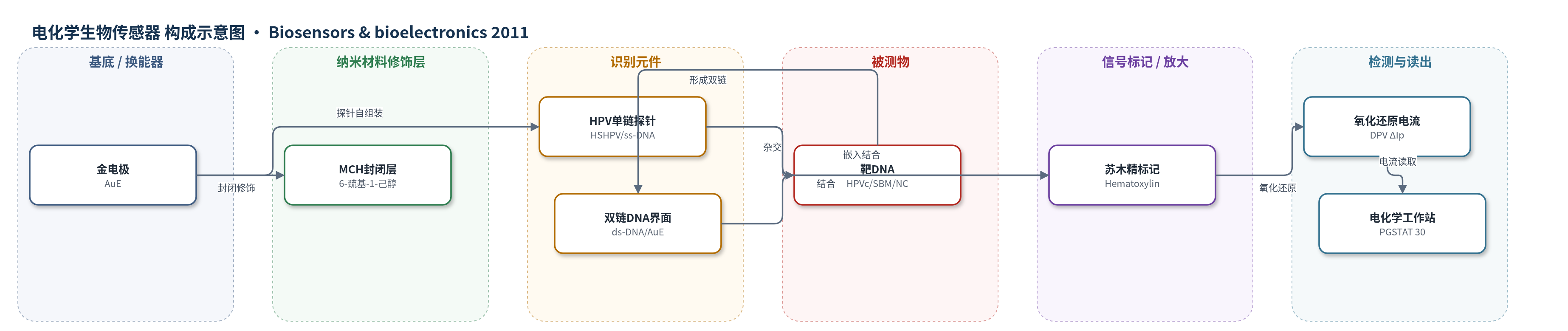
点击图片查看大图 · 依据论文自动绘制
传感器类型
电化学生物传感器
检测对象
人乳头瘤病毒(HPV)L1基因互补靶DNA(HPVc)、单碱基错配DNA(SBM)、非互补DNA(NC),样品基质为0.05 M磷酸盐缓冲液(PBS,pH 7.0,含0.3 M NaCl)杂交缓冲液
检测原理
该传感器利用苏木精对单链DNA(ss-DNA)和双链DNA(ds-DNA)亲和力的差异进行信号转导。硫醇化HPV探针自组装在金电极表面,与互补靶DNA杂交后形成更稳定的双链界面;苏木精可结合碱基并嵌入双链DNA,因此杂交后电极表面累积的苏木精量增加。在0.1 M PBS(pH 7.0)中,累积苏木精发生氧化还原反应,差分脉冲伏安法(DPV)峰电流随之增大。以双链与单链电极的电流差ΔIp=Ids-DNA−Iss-DNA作为分析信号,ΔIp随靶DNA浓度升高而增大,并在12.5–350.0 nM范围内线性。错配或非互补DNA不能形成完整双链,苏木精结合较弱,信号明显降低,从而实现序列特异性和单碱基错配鉴别。
检测灵敏度
LOD: 3.8 nM;线性范围: 12.5 nM–350.0 nM;灵敏度斜率: -0.2277 nA nM^-1;R^2 = 0.9978
效应效果
该传感器可区分互补、错配和非互补DNA。2.0 μM互补靶DNA杂交后苏木精DPV电流最高,为151.8±3.3 nA;错配和非互补DNA信号显著降低,表明可鉴别单碱基错配。50.0 nM靶DNA的10次重复测量平均电流为74.0±3.1 nA,RSD为4.2%。与表1中基于亚甲基蓝、亮甲酚蓝、金(I)配合物等DNA传感器相比,本文线性动态范围较宽,LOD 3.8 nM处于同类方法可接受水平,作者认为其在线性范围方面优于部分已报道传感器。未报告实际样品回收率、长期稳定性和抗基质干扰数据,应用价值在于HPV寡核苷酸序列特异性检测与错配鉴别。
传感器的构成
- 基底/换能器电极:金电极(AuE),作为工作电极提供电子转导
- 修饰/封闭层:6-巯基-1-己醇(MCH),自组装封闭非特异性位点并有序化探针
- 识别元件:硫醇化HPV单链DNA探针(HSHPV/ss-DNA),固定于金表面并识别靶DNA
- 杂交界面:双链DNA(ds-DNA/AuE),探针与靶DNA杂交形成,增强苏木精结合
- 信号标记物:苏木精(Hematoxylin),电活性DNA结合/嵌入指示剂,产生氧化还原电流
- 检测介质:0.1 M磷酸盐缓冲液(PBS,pH 7.0),支持苏木精氧化还原反应
中文摘要
本文报道了一种基于苏木精(hematoxylin)与人乳头瘤病毒(HPV)20-mer 脱氧寡核苷酸相互作用的新型电化学 DNA 生物传感器。研究以硫醇化 HPV 单链 DNA 探针自组装金电极(ss-DNA/AuE)及其杂交双链形式(ds-DNA/AuE)为基础,系统优化了探针在金电极表面的固定条件以及探针与靶 DNA 的杂交条件。在累积于修饰电极表面的苏木精具有电活性的电位范围内,采用循环伏安法(CV)和差分脉冲伏安法(DPV)监测杂交过程。由于互补、错配和非互补 DNA 杂交后苏木精伏安信号存在显著差异,该传感器能够识别并区分互补靶 DNA 与非互补及错配寡核苷酸。在最佳条件下,电化学信号与靶 DNA 浓度在 12.5 nM 至 350.0 nM 范围内呈线性关系,检出限为 3.8 nM。
英文摘要
For the detection of DNA hybridization, a new electrochemical biosensor was developed on the basis of the interaction of hematoxylin with 20-mer deoxyoligonucleotides (from human papilloma virus, HPV). The study was performed based on the interaction of hematoxylin with an alkanethiol DNA probe self-assembled gold electrode (ss-DNA/AuE) and its hybridization form (ds-DNA/AuE). The optimum conditions were found for the immobilization of HPV probe on the gold electrode (AuE) surface and its hybridization with the target DNA. Electrochemical detection of the self-assembled DNA and the hybridization process were performed by cyclic voltammetry (CV) and differential pulse voltammetry (DPV) over the potential range where the accumulated hematoxylin at the modified electrode was electroactive. Observing a remarkable difference between the voltammetric signals of the hematoxylin obtained from different hybridization samples (non-complementary, mismatch and complementary DNAs), we confirmed the potential of the developed biosensor in detecting and discriminating the target complementary DNA from non-complementary and mismatch oligonucleotides. Under optimum conditions, the electrochemical signal had a linear relationship with the concentration of the target DNA ranging from 12.5 nM to 350.0 nM, and the detection limit was 3.8 nM.