组成图示
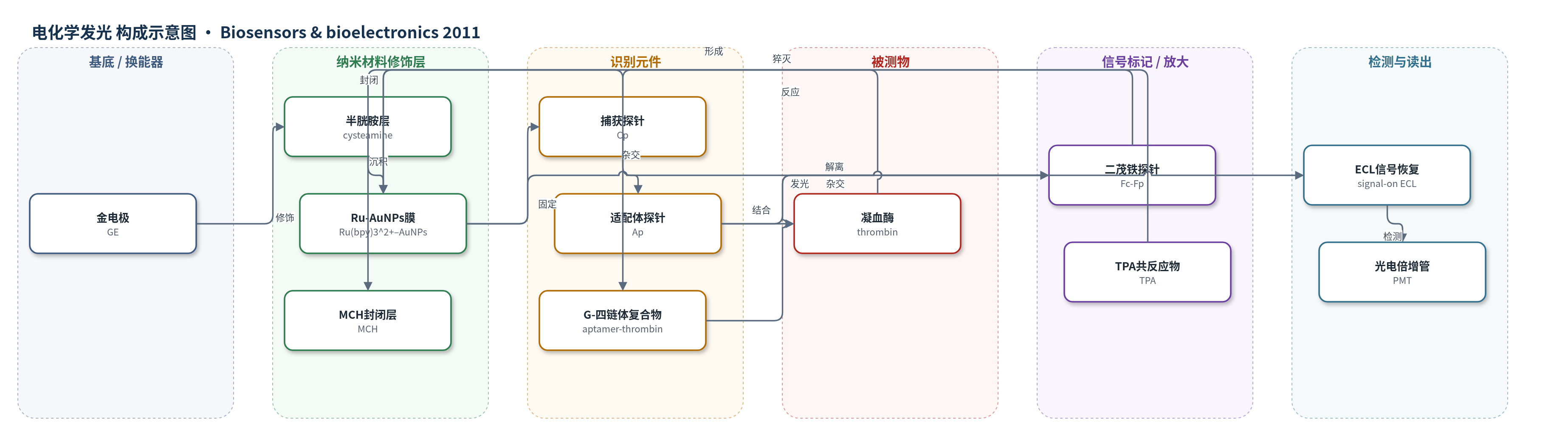
点击图片查看大图 · 依据论文自动绘制
传感器类型
电化学发光(ECL)生物传感器
检测对象
凝血酶(thrombin);样品基质:PBS/无菌水稀释的人凝血酶,文中未报告实际血清
检测原理
传感器以金电极为工作电极,表面依次构建半胱胺自组装层和Ru(bpy)3^2+–AuNPs固态ECL发光膜。巯基捕获探针Cp通过S–Au键固定于发光膜,再与含抗凝血酶适配体序列的Ap及二茂铁标记探针Fp杂交,形成三元Y型连接结构。此时Fp上的二茂铁(Fc)靠近Ru(bpy)3^2+–AuNPs,通过能量/电子转移猝灭Ru(bpy)3^2+的ECL,背景信号低。加入凝血酶后,Ap优先与凝血酶结合并形成G-四链体适配体–凝血酶复合物,Y型连接结构解体,Fp从电极表面解离并被洗脱,Ru(bpy)3^2+的ECL信号恢复。检测缓冲液中的TPA作为ECL共反应物,在循环伏安扫描下与Ru(bpy)3^2+反应产生光信号;凝血酶浓度越高,Fp解离越多,ECL增强越大,从而实现信号开启型定量检测。
检测灵敏度
LOD: 8.0 × 10⁻¹⁵ M;线性范围: 0.05 pM–100 pM(ECL强度与凝血酶浓度对数线性);斜率: 368.5 a.u./log(pM);R = 0.9965
效应效果
该传感器选择性良好:1 pM凝血酶产生明显ECL增强,而1000倍浓度(1 nM)的HSA、IgG和IgA仅引起可忽略变化。1 pM凝血酶检测RSD为5.24%(n=5)。传感器可再生,第二次测量ECL信号较第一次仅降低5.78%,稳定性良好。其检出限8.0×10⁻¹⁵ M低于文中比较的光学和电化学方法,并与采用复杂纳米材料放大技术的ECL适配体传感器相当。作者认为该传感器背景低、灵敏度高、选择性好、可重复使用,可作为传统凝血酶检测替代,并有望用于临床超痕量凝血酶监测和生物芯片。
传感器的构成
- 基底/换能器电极:金电极(GE,2 mm金盘)作为工作电极,提供ECL换能界面
- 半胱胺自组装层:半胱胺(cysteamine, SH–(CH2)2–NH2)修饰GE,形成自组装单分子层并辅助后续功能化
- ECL发光基底:Ru(bpy)3^2+–AuNPs复合物(三(2,2'-联吡啶)钌(II)–金纳米颗粒,AuNPs约16 nm)沉积于GE,提供固态ECL发光中心
- 捕获探针层:巯基末端捕获探针(Cp)通过S–Au键固定于Ru(bpy)3^2+–AuNPs/GE,用于捕获Ap和Fp形成Y型连接
- MCH封闭层:MCH(6-巯基-1-己醇/2-巯基乙醇)用于封闭非特异位点、优化探针取向并减少非特异吸附
- 识别元件:适配体探针(Ap,含15碱基抗凝血酶DNA适配体序列)与Cp杂交,并在凝血酶存在时形成G-四链体适配体–凝血酶复合物
- 信号标记/猝灭探针:二茂铁标记探针(Fp,ferrocene-labeled probe)与Ap杂交后靠近Ru(bpy)3^2+–AuNPs猝灭ECL,凝血酶结合后解离使信号恢复
- ECL共反应物:三正丙胺(TPA, tri-n-propylamine)在检测缓冲液中作为电子供体/共反应物,与Ru(bpy)3^2+反应产生ECL
中文摘要
本文报道了一种基于连接探针(junction-probe)策略的信号开启型电化学发光(ECL)适配体生物传感器,用于超痕量凝血酶检测。传感器由ECL发光基底和ECL强度开关组成:金电极(GE)表面修饰Ru(bpy)3^2+–AuNPs复合物作为发光基底;强度开关包含巯基捕获探针(Cp)、含15碱基抗凝血酶DNA适配体序列的适配体探针(Ap)和二茂铁标记探针(Fp)。无凝血酶时,Cp、Ap和Fp杂交形成三元Y型连接结构,Fp上的二茂铁靠近Ru(bpy)3^2+–AuNPs并猝灭ECL;存在凝血酶时,Ap优先与凝血酶形成G-四链体复合物,Y型结构解体,Fp解离,ECL信号恢复。该可重复使用平台实现了简便、快速、选择性良好的凝血酶检测,检出限为8.0×10⁻¹⁵ M,为临床超痕量凝血酶监测提供了重要进展。
英文摘要
A novel signal-on junction-probe electrogenerated chemiluminescence (ECL) aptamer biosensor has been developed for the detection of ultratrace thrombin based on a structure-switching ECL-quenching mechanism. The ECL aptamer biosensor comprises two main parts: an ECL substrate and an ECL intensity switch. The ECL substrate was made by modifying the complex of Au nanoparticle and ruthenium (II) tris-bipyridine (Ru(bpy)(3)(2+)-AuNPs) on the surface of gold electrode (GE), and the ECL intensity switch contains three probes designed according to the "junction-probe" strategy. The first probe is capture probe (Cp) which was functionalized with a thiol group at one end and covalently attached to Ru(bpy)(3)(2+)-AuNPs modified GE through S-Au bonding. The second probe is aptamer probe (Ap), which containing 15-base anti-thrombin DNA aptamer. The third one is ferrocene-labeled probe (Fp), which was functionalized with ferrocene tag at one end. We demonstrated that, in the absence of thrombin, Cp, Ap and Fp will hybridize to form a ternary "Y" junction structure and resulted in a quenching of ECL of Ru(bpy)(3)(2+). Whereas, in the presence of thrombin, the Ap prefers to form the G-quadruplex aptamer-thrombin complex and lead to an obvious recovery of ECL of Ru(bpy)(3)(2+), which provided a sensing platform for the detection of thrombin. Using this reusable sensing platform, a simple, rapid and selective signal-on ECL aptamer biosensor for the detection of thrombin with a detection limit of 8.0×10(-15) M has been developed. The success in the present biosensor served as a significant step towards the development of monitoring ultratrace thrombin in clinical detection.