组成图示
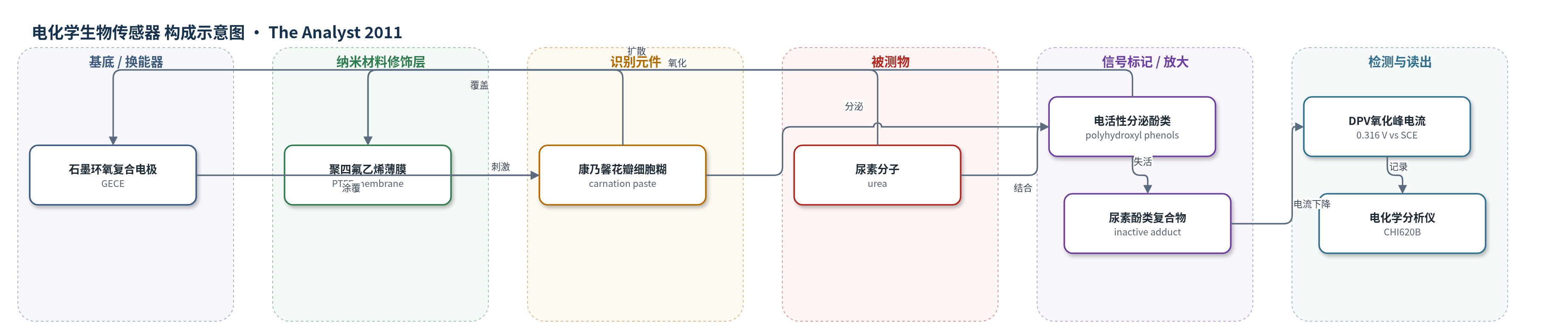
点击图片查看大图 · 依据论文自动绘制
传感器类型
电化学生物传感器
检测对象
尿素(urea);样品基质:水溶液、河流废水
检测原理
该传感器以康乃馨花瓣完整细胞为生物识别单元。研磨使花瓣细胞剥离并在石墨-环氧复合电极表面自组织,聚四氟乙烯薄膜覆盖后允许尿素扩散进入细胞糊。尿素作为刺激物与细胞接触,诱导细胞分泌电活性多羟基酚类(如儿茶酚)。这些酚类在电极表面发生准可逆氧化,在0.316 V(vs. SCE)处产生差分脉冲伏安氧化峰。尿素与酚类反应生成电活性降低的加合物,使可氧化物种减少,氧化峰电流随尿素浓度增加而下降。电流下降与尿素浓度对数呈线性,类似一级反应响应;细胞群自组织与群体感应可传递并放大生物信号,从而提高灵敏度。
检测灵敏度
LOD: 7.5 × 10^-16 M;线性范围: 1.3 × 10^-16–4.57 × 10^-8 M 和 3.4 × 10^-7–1.3 × 10^-1 M;斜率: -2.850(低浓度段)、-1.259(高浓度段);R = 0.9927(低浓度段)、R = 0.992(高浓度段)
效应效果
在1.0×10^-15 M尿素下,同一传感器或同一朵花新制传感器的重复测量平均峰电流为53.273 mA(原文单位),相对偏差为4.99%,结论中报告RSD为5.00%。实际样品为沈阳师范大学校园附近河流废水,测得尿素0.175 mM,加标0.909 mM后测得1.125 mM,加标回收率104.5%。选择性方面,硝酸根和铵离子摩尔比达10^4时不干扰尿素检测,作者称对尿素选择性超过10^4。最佳条件为pH 7.5、接触时间150 s、静置时间2 s。论文未与ELISA、HPLC或qPCR等现有方法直接对比,但主张该传感器具有宽线性范围、高灵敏度和高选择性,可用于环境废水中尿素检测。
传感器的构成
- 基底/换能器电极:石墨-环氧复合电极(GECE),由石墨粉、环氧树脂和聚酰胺树脂制成,含铜导线引线,提供导电基底与电化学换能
- 生物识别层:新鲜康乃馨花瓣研磨糊(carnation petal paste),含完整花瓣细胞,作为生物识别单元,受尿素刺激后分泌电活性物质
- 覆盖固定层:聚四氟乙烯薄膜(PTFE membrane),紧密覆盖花瓣糊,防止细胞糊泄漏并保持电极接触,允许尿素扩散
- 信号响应物:花瓣细胞分泌的多羟基酚类(polyhydroxyl phenols,如儿茶酚 catechols),在0.316 V处发生氧化,与尿素反应后电活性降低
- 电解液介质:0.1 M KCl与pH 7.5磷酸盐缓冲液(Na2HPO4–KH2PO4),提供离子导电环境
- 参比/对电极:饱和甘汞电极(SCE)与铂丝对电极,用于三电极差分脉冲伏安法测量
中文摘要
本文报道了一种基于康乃馨花瓣细胞分泌物的高选择性、高灵敏度、宽检测范围尿素生物传感器。将新鲜康乃馨花瓣研磨成糊状,紧密涂覆在石墨-环氧复合电极表面,并用聚四氟乙烯薄膜覆盖固定,使花瓣细胞与电极保持接触。水溶液中的尿素通过差分脉冲伏安法检测:研磨过程中花瓣细胞分泌的电活性物质在0.316 V(vs. SCE)处产生氧化峰,该物质与尿素分子相互作用后氧化峰电流下降。氧化峰电流与尿素浓度对数在1.3×10^-16–4.57×10^-8 M和3.4×10^-7–1.3×10^-1 M范围内呈线性关系,检出限为7.5×10^-16 M。该传感器经电化学和荧光光谱表征,并用于沈阳师范大学校园附近河流废水中尿素的测定,加标回收率为104.5%,相对标准偏差为5.00%。铵离子和硝酸根离子摩尔比达10^4时不干扰检测。
英文摘要
A new kind of biosensor for the detection of urea with a high selectivity, sensitivity and wide detection range was designed based on the secretion of carnation petals cells paste covered over a graphite-epoxy composite basic electrode surface. The carnation petal paste from mashed fresh carnation petals was tightly fixed on the basic electrode surface with Teflon thin film to keep it in contact with the electrode surface. Urea in aqueous solution was detected by differential pulse voltammetry based on the oxidation peak current at 0.316 V (vs. SCE) of the secreted species of carnation petal cells during the mashing process, which interacts with urea molecules and results in the decrease of the oxidation peak current. The oxidation peak current decreases linearly with the logarithm of urea concentration in the range of 1.3 × 10(-16)-4.57 × 10(-8) M and 3.4 × 10(-7)-1.3 × 10(-1) M with a detection limit of 7.5 × 10(-16) M. The biosensor was characterized by electrochemistry and fluorescent spectrometry, and applied to the determination of urea in waste water from a river around Shenyang Normal University campus with a recovery of 104.5% (RSD is 5.00%). The presence of larger amounts of ammonium ion and nitrate ion up to the molar ratio of 10(4) do not interfere with the urea detection.