组成图示
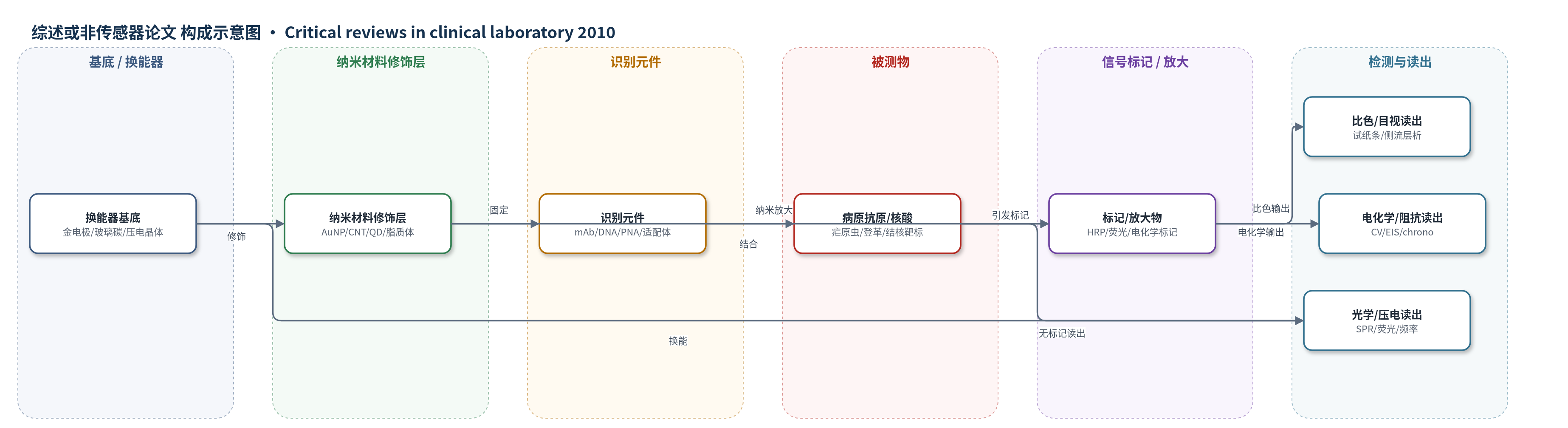
点击图片查看大图 · 依据论文自动绘制
传感器类型
综述或非传感器论文
检测对象
疟原虫(Plasmodium spp.)抗原(HRP-2、pLDH、醛缩酶)、登革病毒(Dengue virus)抗原/抗体(NS1、E蛋白、IgM/IgG)、结核分枝杆菌(Mycobacterium tuberculosis) DNA/抗原、利什曼原虫(Leishmania)抗原/核酸;样品基质:全血/血浆/血清、痰或肺组织匀浆、脾液/骨髓/淋巴结穿刺液。
检测原理
综述中的传感检测通常以抗体、DNA/PNA探针或适配体作为识别元件,固定在电极、压电晶体、光纤或SPR金膜表面。当血液、血清或组织匀浆中的病原抗原、抗体或核酸与识别元件结合后,若使用HRP、荧光标记物、二茂铁或Co(phenanthroline)3^3+等标记物,则通过酶催化底物显色/发光、电子转移或能量转移产生信号;若采用脂质体、纳米颗粒或NASBA/PCR扩增,则引入信号放大。无标记体系中,结合引起界面质量、电荷或折射率变化,经压电频率、电化学阻抗或SPR角度读出。信号强度随靶标浓度增加而增强。
检测灵敏度
—
效应效果
综述指出,疟疾侧流RDT约15 min出结果,WHO评估显示部分商品化试纸对低密度疟原虫检测良好、假阳性少,高温高湿下稳定,但批间差异明显;BinaxNOW总体灵敏度约82%,类风湿因子可致假阳性,HRP-2缺失可致假阴性。登革免疫芯片较EIA灵敏100倍,响应30–60 min;化学发光光纤传感器比MAC-EIA检出限更低、比比色法灵敏10–100倍,但重现性较差。结核电化学传感器可检测ng/mL DNA,压电免疫传感器检测范围10^5–10^8 cells/mL,RAPTOR 3 h出结果。总体主张满足ASSURED现场POCT需求。
传感器的构成
- 基底/换能器:金电极、玻璃碳电极、压电晶体、光纤、SPR金膜,作为信号转换基底
- 纳米材料修饰层:金纳米颗粒(AuNP)、碳纳米管(CNT)、量子点(QD)、脂质体(liposome)、壳聚糖(chitosan),用于固定识别元件或放大信号
- 识别元件:单克隆抗体(mAb)、DNA/PNA探针、适配体(aptamer)、刀豆蛋白A(concanavalin-A),用于特异性结合病原抗原或核酸
- 信号标记物:辣根过氧化物酶(HRP)、荧光染料(fluorophore/dye)、二茂铁(ferrocene)、Co(phenanthroline)3^3+、量子点(QD),用于产生电化学、光学或发光信号
- 封闭剂:牛血清白蛋白(BSA),用于封闭非特异性结合位点
- 微流控/试纸条载体:硝酸纤维素膜(nitrocellulose membrane)、PDMS微流控芯片、碳条电极,用于样品输送与反应
- 读出模块:目视比色、电化学伏安/阻抗、SPR角度、压电频率、荧光/化学发光/CCD成像,用于信号输出
中文摘要
有效诊断感染性病原体是疾病识别、合理治疗、防止耐药及实施公共卫生防控的前提。在热带地区,医疗诊断常面临资源有限、设备不足和现场检测需求,因此基于生物传感方法的简易、低成本、即时检测工具成为替代传统大型实验室仪器的有前景选择。然而,在许多发展中国家,商业诊断试剂的可及性和可负担性不足仍是疾病负担高的重要原因。本文系统综述了热带地区常规感染性疾病诊断面临的问题,并介绍用于现场和去中心化诊断当前主要热带感染病的新方法与分析工具。综述不仅涵盖已获监管机构批准并商业化的生物传感器快速诊断试剂,也包括处于早期研究阶段的新型传感检测方案。
英文摘要
Effective diagnosis of infectious pathogens is essential for disease identification and subsequent adequate treatment, to prevent drug resistance and to adopt suitable public health interventions for the prevention and control of epidemic outbreaks. Particular situations under which medical diagnostics operate in tropical environments make the use of new easy-to-use diagnostic tools the preferred (or even unique) option. These diagnostic tests and devices, usually based on biosensing methods, are being increasingly exploited as promising alternatives to classical, "heavy" lab instrumentation for clinical diagnosis, allowing simple, inexpensive and point-of-care testing. However, in many developing countries the lack of accessibility and affordability for many commercial diagnostic tests remains a major cause of high disease burden in such regions. We present a comprehensive overview about the problems of conventional medical diagnosis of infectious pathologies in tropical regions, while pointing out new methods and analytical tools for in-the-field and decentralized diagnosis of current major infectious tropical diseases. The review includes not only biosensor-based rapid diagnostic tests approved by regulatory entities and already commercialized, but also those at the early stages of research.