组成图示
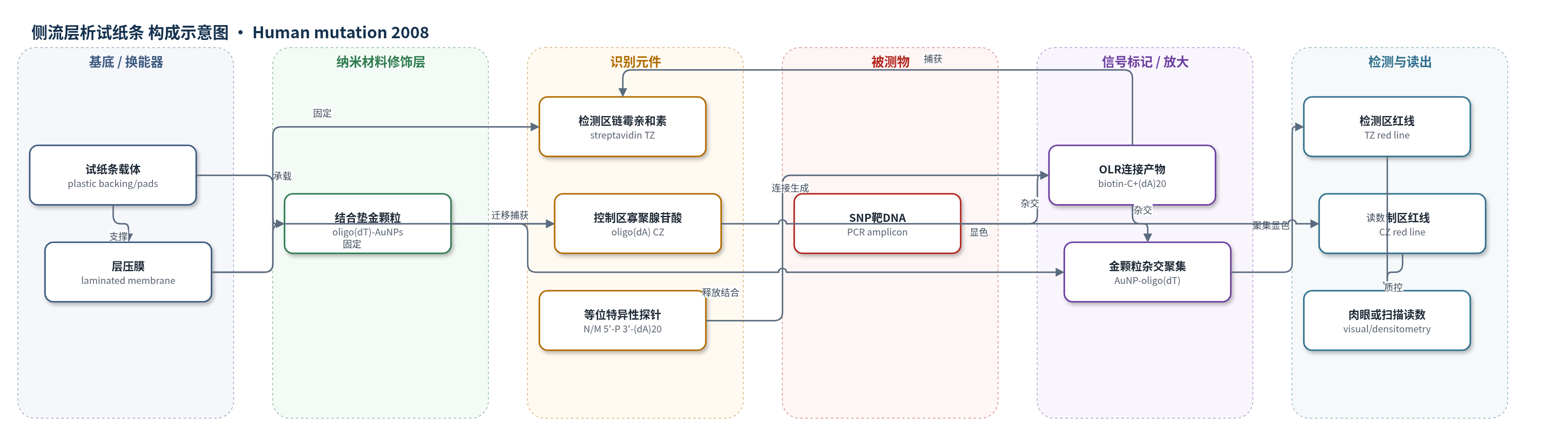
点击图片查看大图 · 依据论文自动绘制
传感器类型
侧流层析试纸条
检测对象
CYP2D6 *3(rs4986774,g.4168del4A)、CYP2D6 *4(g.3465G>A)、CYP2C19 *2(rs4244285,c.681G>A)、CYP2C19 *3(rs4986893,c.636G>A)单核苷酸多态性/基因型;样品基质:全血提取基因组 DNA 的 PCR 扩增产物。
检测原理
首先 PCR 扩增含 SNP 的基因组片段。OLR 中,生物素化通用探针 C 与等位基因特异性探针 N 或 M 在靶 DNA 相邻位点杂交;Taq DNA ligase 仅在连接处完全互补时催化形成磷酸二酯键,从而区分单碱基差异,生成同时携带生物素和 3'-(dA)20 的连接产物。反应后经 NaOH 变性,使未连接探针与靶 DNA 分离,避免假阳性。将变性产物滴于结合垫,浸入含甘油和 SDS 的 PBS 展开液,毛细作用驱动迁移。连接产物被检测区固定链霉亲和素捕获,其 (dA)20 与结合垫释放的 oligo(dT)-AuNPs 杂交,金颗粒聚集形成红色条带;多余金颗粒被控制区固定 oligo(dA) 捕获形成质控红线。N 和 M 两条试纸分别判断等位基因,条带有无及扫描密度可计算等位分数。
检测灵敏度
—
效应效果
该方法无需仪器即可肉眼判读,30 min 内完成可视检测。选择性来自 OLR 双重识别与变性步骤:未连接探针虽可被链霉亲和素捕获或结合金颗粒,但不能同时满足两个条件,因此不产生信号。临床全血基因组 DNA 样本中,CYP2D6*4 检测 20 例、CYP2D6*3 13 例、CYP2C19*3 15 例、CYP2C19*2 15 例,基因型结果与直接测序完全一致。重现性方面,一个月内重复 OLR 与试纸条检测,CYP2D6*4 正常型 N 反应 CV 为 5.5%、M 反应 12.2%;突变型 N 反应 11.4%、M 反应 5.3%。作者认为其成本低、操作简便,适合药物基因组学及即时检测。
传感器的构成
- 基底/载体:塑料背衬(plastic adhesive backing)及浸入垫、结合垫、层压膜、吸收垫,支撑试纸条并引导毛细流动。
- 结合垫:偶联寡聚胸苷酸的金纳米颗粒(oligo(dT)-conjugated AuNPs,40 nm),作为可移动信号标记,被释放后与 OLR 产物杂交。
- 检测区:固定链霉亲和素(immobilized streptavidin,TZ),捕获生物素标记的 OLR 连接产物。
- 控制区:固定寡聚腺苷酸(immobilized oligo(dA),CZ),捕获多余金纳米颗粒形成质控红线。
- 识别元件:生物素化通用探针(biotinylated common probe,C)与等位基因特异性探针(allele-specific probes N/M,5'-磷酸,3'-(dA)20),与靶 DNA 杂交并参与连接。
- 连接酶:Taq DNA ligase,仅在探针与靶 DNA 完全互补时催化形成磷酸二酯键,实现单碱基判别。
- 展开液/变性剂:PBS 含 40 mL/L 甘油和 10 g/L SDS 的展开液驱动毛细迁移;NaOH(0.75–1.5 M)变性分离未连接探针。
中文摘要
已知单核苷酸多态性(SNP)基因分型多基于等位基因特异性探针杂交、寡核苷酸连接反应(OLR)、引物延伸或侵入性切割。OLR 因涉及两个识别事件而具有更高特异性:等位基因特异性探针与通用探针在靶 DNA 相邻位点杂交,连接酶仅在完全互补时连接。连接产物可用比色、时间分辨荧光、化学发光、电泳、微阵列、微球或均相荧光/比色法检测。本文开发了一种简单、稳健、低成本的干试剂一次性生物传感器,无需仪器即可进行可视基因分型。OLR 体系含生物素化通用探针和 3' 端带 (dA)20 的等位基因特异性探针。连接产物经变性后与偶联寡聚胸苷酸的金纳米颗粒一起加到试纸条上,浸入展开液后各组分毛细迁移。OLR 产物被检测区固定链霉亲和素捕获,并与金纳米颗粒上的寡聚胸苷酸杂交,形成特征红色条带;多余金纳米颗粒被控制区固定寡聚腺苷酸捕获形成第二条红线。该方法成功用于 CYP2D6(*3 和 *4)及 CYP2C19(*2 和 *3)四个 SNP 的药物代谢基因分型,结果与直接测序一致。
英文摘要
Most genotyping methods for known single-nucleotide polymorphisms (SNPs) are based on hybridization with allele-specific probes, oligonucleotide ligation reaction (OLR), primer extension or invasive cleavage. OLR offers superior specificity because it involves two recognition events; namely, the hybridization of an allele-specific probe and a common probe to adjacent positions on target DNA. OLR products can be detected by microtiter well-based colorimetric, time-resolved fluorimetric or chemiluminometric assays, electrophoresis, microarrays, microspheres, and homogeneous fluorimetric or colorimetric assays. We have developed a simple, robust, and low-cost disposable biosensor in dry-reagent format, which allows visual genotyping with no need for instrumentation. The OLR mixture contains a biotinylated common probe and an allele-specific probe with a (dA)(20) segment at the 3'-end. OLR products are denatured and applied to the biosensor next to gold nanoparticles that are decorated with oligo(dT) strands. The sensor is immersed in the appropriate buffer and all components migrate by capillary action. The OLR product is captured by immobilized streptavidin at the test zone (TZ) of the sensor and hybridizes with the oligo(dT) strands of the nanoparticles. A characteristic red line is generated due to the accumulation of nanoparticles. The excess nanoparticles are captured by immobilized oligo(dA) at the control zone of the strip, giving a second red line. We have applied successfully the proposed OLR-dipstick assay to the genotyping of four SNPs in the drug-metabolizing enzyme genes CYP2D6 ((*)3 and (*)4) and CYP2C19 ((*)2 and (*)3). The results were in agreement with direct sequencing.