组成图示
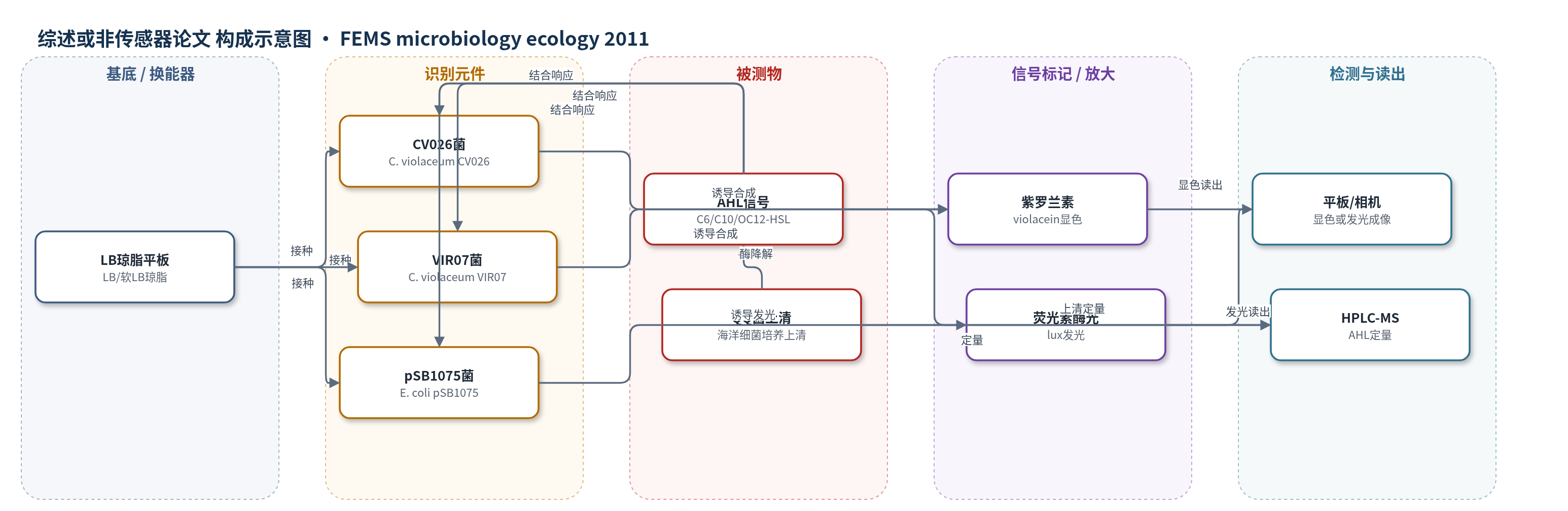
点击图片查看大图 · 依据论文自动绘制
传感器类型
综述或非传感器论文
检测对象
N-酰基高丝氨酸内酯(AHLs,包括 C6-HSL、C10-HSL、OC12-HSL、C4-HSL、C12-HSL);样品基质为海洋细菌培养上清及含 AHL 的 LB/MB 培养基。
检测原理
该检测基于 AHL 生物传感器菌株的报告基因响应。外源 AHL(如 C6-HSL、C10-HSL、OC12-HSL)扩散进入 LB 琼脂平板,与 C. violaceum CV026/VIR07 或 E. coli JM109 pSB1075 中的 AHL 感应系统结合,激活紫罗兰素合成或 lux 荧光素酶表达,分别产生紫色显色或生物发光。若待测海洋细菌上清含有群体感应干扰酶(如内酯酶、酰基酶或氧化酶),则会在共孵育过程中水解或氧化 AHL,使剩余 AHL 浓度下降,生物传感器信号随之减弱。平板显色/发光用于半定量判断 QQ 活性,HPLC-MS 则直接定量 C4-HSL 和 C12-HSL 的剩余量,并通过酸化恢复内酯环以区分内酯酶活性。
检测灵敏度
原文未报告 LOD、线性范围、灵敏度斜率或相关系数。
效应效果
166株海洋分离株中,24株(14.4%)降低 C6-HSL 活性;15株完全消除 C10-HSL 活性,10株抑制 OC12-HSL 活性。HPLC-MS 证实15株均显著降低 C4-HSL 和 C12-HSL,表明为酶促降解。来源差异显著:Fucus vesiculosus 阳性率约39.4%,鱼池沉积物约9.4%,水罐生物膜约6.3%。活性株涵盖9个海洋相关属,包括 Stappia、Oceanobacillus、Halomonas、Rhodococcus、Bacillus、Tenacibaculum,并发现一株与 Phaeobacter 相关新种。作者认为近岸海洋群落 QQ 细菌频率和多样性高于土壤报道,提示 QS/QQ 在海洋微生物互作和水产病害防控中具生态与应用价值。
传感器的构成
- 基底/换能器:LB 琼脂平板或软 LB 琼脂平板,承载生物传感器菌株并允许 AHL 扩散。
- 识别元件:Chromobacterium violaceum CV026 的 AHL 感应系统,响应 C4–C8 链 AHL 并诱导紫罗兰素。
- 识别元件:Chromobacterium violaceum VIR07 的 AHL 感应系统,用于检测 C10-HSL 活性。
- 识别元件:E. coli JM109 pSB1075 的 lux 报告系统,用于检测 OC12-HSL 活性。
- 信号标记物:紫罗兰素(violacein)显色或 lux 荧光素酶发光。
- 样品/被测物:C6-HSL、C10-HSL、OC12-HSL、C4-HSL、C12-HSL 及海洋细菌培养上清。
- 读出方式:平板显色观察、发光相机成像和 HPLC-MS 定量剩余 AHL。
中文摘要
N-酰基高丝氨酸内酯(AHL)介导的群体感应(QS)在海洋环境和海洋致病菌中似乎很常见,但关于海洋中能够干扰 QS 的细菌(即群体感应干扰,QQ)流行率的数据仍缺乏。本研究从不同海洋高密度微生物群落中分离的166株细菌中筛选其干扰 AHL 活性的能力。以生物传感器菌株 Chromobacterium violaceum CV026 检测,24株(14.4%)能够消除或显著降低 N-己酰基-L-高丝氨酸内酯(C6-HSL)活性,这一比例明显高于土壤分离株的报道,支持 QS 和 QQ 在海洋环境中的生态作用。其中15株还能抑制 N-癸酰基-L-高丝氨酸内酯(C10-HSL)活性,并经 HPLC-MS 确认它们通过酶促方式灭活 AHL 信号。活性分离株属于9个主要或专性海洋来源的属,包括 α-和 γ-变形菌(8株)、放线菌(2株)、厚壁菌(4株)和拟杆菌(1株)。近岸海洋分离株中 QQ 活性可培养细菌的高频率和多样性是否反映开阔海洋细菌群落中的普遍存在,仍需进一步研究,以理解 AHL 介导 QS 和 QQ 在海洋环境中的生态重要性。
英文摘要
Acylhomoserine lactone (AHLs)-mediated quorum-sensing (QS) processes seem to be common in the marine environment and among marine pathogenic bacteria, but no data are available on the prevalence of bacteria capable of interfering with QS in the sea, a process that has been generally termed 'quorum quenching' (QQ). One hundred and sixty-six strains isolated from different marine dense microbial communities were screened for their ability to interfere with AHL activity. Twenty-four strains (14.4%) were able to eliminate or significantly reduce N-hexanoyl-l-homoserine lactone activity as detected by the biosensor strain Chromobacterium violaceum CV026, a much higher percentage than that reported for soil isolates, which reinforces the ecological role of QS and QQ in the marine environment. Among these, 15 strains were also able to inhibit N-decanoyl-l-homoserine lactone activity and all of them were confirmed to enzymatically inactivate the AHL signals by HPLC-MS. Active isolates belonged to nine different genera of prevalently or exclusively marine origin, including members of the Alpha- and Gammaproteobacteria (8), Actinobacteria (2), Firmicutes (4) and Bacteroidetes (1). Whether the high frequency and diversity of cultivable bacteria with QQ activity found in near-shore marine isolates reflects their prevalence among pelagic marine bacterial communities deserves further investigation in order to understand the ecological importance of AHL-mediated QS and QQ processes in the marine environment.