组成图示
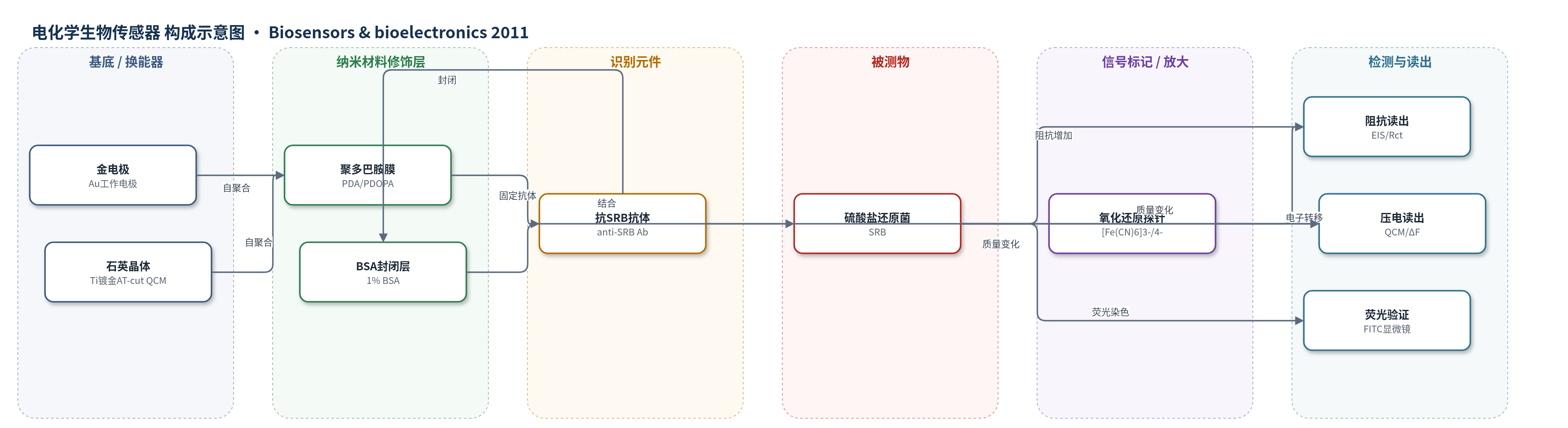
点击图片查看大图 · 依据论文自动绘制
传感器类型
电化学生物传感器
检测对象
硫酸盐还原菌(sulfate-reducing bacteria, SRB);样品基质:细菌培养液/生理盐水稀释菌悬液(实验接种样品)
检测原理
多巴胺在pH 8.5–9.0条件下自聚合,在金电极或石英晶体表面形成聚多巴胺(PDA)膜。PDA中的邻二酚基团与抗SRB抗体(Ab)的氨基发生席夫碱/强相互作用,使抗体直接、高密度固定;BSA封闭非特异位点。SRB与Ab特异性结合后,在电极界面形成阻碍层,降低[Fe(CN)6]3−/4−氧化还原探针的电子转移速率,使电荷转移电阻Rct增大;Rct随SRB浓度对数线性增加。QCM则通过Sauerbrey方程监测各步质量变化。该体系为无标记检测,未使用酶或核酸放大,主要依靠PDA高密度抗体固定和阻抗界面变化提高响应。
检测灵敏度
LOD: 50 CFU mL−1;线性范围: 1.8 × 10^2–1.8 × 10^6 CFU mL−1;灵敏度斜率: 54.6;相关系数: 0.984
效应效果
传感器对SRB选择性良好:约2×10^8 CFU/mL时,大肠杆菌ΔRct<45±11 kΩ,SRB为330±54 kΩ。EIS重复3次,以标准差表示重现性;1.8×10^8 CFU/mL时Rct增加1068%。线性范围覆盖五个数量级,LOD 50 CFU/mL,与无标记病原菌免疫传感器相当。QCM显示抗体固定量3.53×10^-6 nmol/mm^2,SRB结合频移128 Hz,但因菌体非刚性仅定性。FITC荧光在10^2 CFU/mL可见菌体。作者认为方法简便温和,可用于临床、水环境和食品安全监测,但特异性仍需提高。
传感器的构成
- 基底/换能器电极:金电极(Au)或Ti镀金AT切石英晶体(QCM),作为EIS工作电极或压电换能器
- 修饰层:自聚合聚多巴胺膜(polydopamine, PDA/PDOPA),生物启发涂层,用于固定和交联抗体
- 识别元件:抗SRB抗体(anti-SRB antibody, Ab),特异性识别硫酸盐还原菌
- 封闭层:1%牛血清白蛋白(BSA),封闭非特异性结合位点
- 氧化还原探针:铁氰化钾/铁氰化钾(K3Fe(CN)6/K4Fe(CN)6, [Fe(CN)6]3−/4−),用于EIS电子转移阻抗检测
中文摘要
本文报道了一种基于自聚合聚多巴胺(polydopamine, PDA)膜的无标记阻抗免疫传感器,用于敏感、选择性地检测硫酸盐还原菌(sulfate-reducing bacteria, SRB)。多巴胺在碱性条件下自聚合,在金电极表面形成生物启发多功能涂层;PDA膜既作为抗体固定化平台,又作为抗SRB抗体的交联剂,使抗体以高密度负载于电极表面,从而获得较高响应信号。传感器构建过程及抗体锚定量通过石英晶体微天平(QCM)监测,SRB检测则通过电化学阻抗谱(EIS)完成。对SRB/抗SRB抗体/PDA/金电极的Nyquist阻抗图进行建模后,以电子转移电阻(Rct)表征免疫复合物结合。Rct与细菌浓度在1.8×10^2至1.8×10^6 CFU/mL范围内相关,检测限为50 CFU/mL。该工作展示了一种用于开发敏感无标记阻抗和压电免疫传感器的新固定化平台,可应用于临床诊断和水环境污染监测;方法操作简便、条件温和,适用于多种材料。
英文摘要
A sensitive and selective immunosensor for the nonlabeled detection of sulfate-reducing bacteria (SRB) is constructed using a self-polymerised polydopamine film as the immobilisation platform. Self-polymerisation of dopamine is used as a powerful approach for applying multifunctional coatings onto the surface of a gold electrode. The polydopamine film is used not only as the immobilisation platform, but also as a cross-linker reagent for the immobilisation of the anti-SRB antibody. The polydopamine film is loaded with a high density of anti-SRB antibodies linked to the substrate to obtain high response signals. The formation and fabrication of the biosensor and the quantification of antibody anchoring are monitored, and SRB detection is performed by either quartz crystal microbalance (QCM) or electrochemical impedance spectroscopy (EIS). After modeling the impedance Nyquist plots of the SRB/anti-SRB/polydopamine/gold electrode for increasing concentrations of SRB, the electron transfer resistance (R(ct)) is used as a measure of immunocomplex binding. The R(ct) is correlated with the concentration of bacterial cells in the range of 1.8×10(2) to 1.8×10(6) CFU mL(-1); the detection limit is 50 CFU mL(-1). This work demonstrates a new immobilisation platform for the development of a sensitive and label-less impedimetric and piezoelectric immunosensor. This immunosensor may be broadly applied in clinical diagnoses and the monitoring of water environmental pollution. The method proposed is distinct in its ease of application, use of a simple protocol, and mild reaction conditions. These allow it to be applied to a wide variety of materials.