组成图示
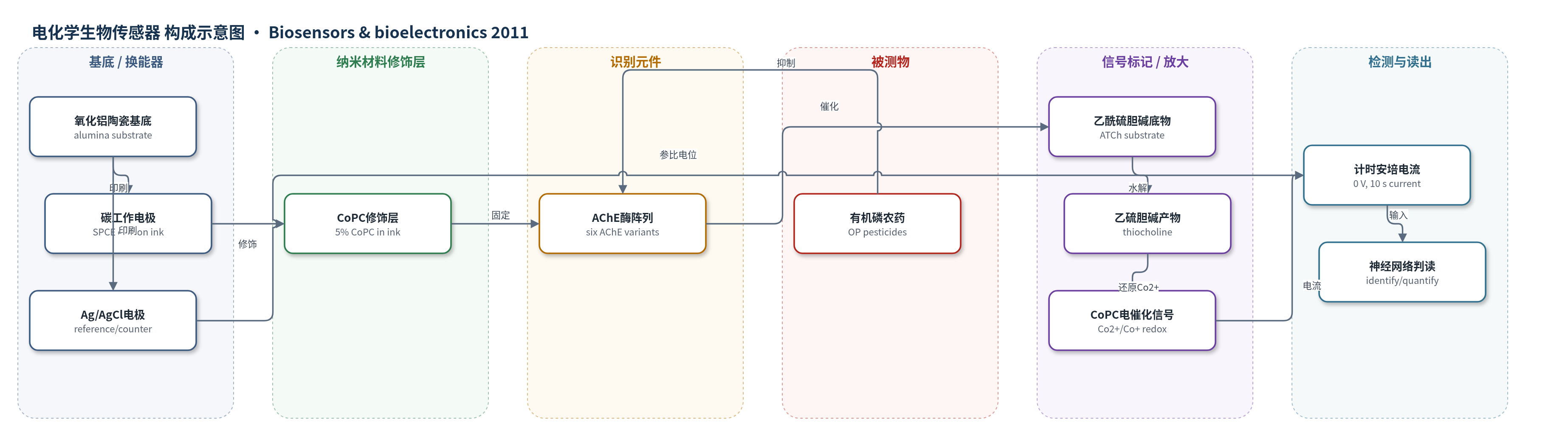
点击图片查看大图 · 依据论文自动绘制
传感器类型
电化学生物传感器
检测对象
有机磷农药(organophosphate pesticides, OPs;dichlorvos、malaoxon、chlorpyrifos-oxon、chlorpyrifos-methyl-oxon、chlorfenvinphos、pirimiphos-methyl-oxon);样品基质:水样(去离子水、水库/河水、湖水、雨水、水处理各阶段水样)、食品/蔬菜提取物(小麦、卷心菜、苹果、橙、樱桃)、磷酸盐缓冲液
检测原理
固定于CoPC-SPCE表面的AChE变体催化过量乙酰硫胆碱(ATCh)水解,生成电活性乙硫胆碱(thiocholine)。乙硫胆碱的硫醇基将CoPC中的Co2+还原为Co+,随后在0 V(vs. Ag/AgCl)下被再氧化,产生与乙硫胆碱浓度成正比的阳极电流。有机磷农药(OPs)抑制AChE活性,使乙硫胆碱生成减少,电流下降;不同AChE变体对同一OPs的抑制程度不同,形成特征响应模式。系统以计时安培法在10 s读取电流,并将六种酶阵列的响应输入神经网络,实现OPs的识别与定量。
检测灵敏度
校准浓度范围: 10^-5 M-10^-9 M;加标水样范围: 10^-5 M-10^-7 M
效应效果
系统对水、磷酸盐缓冲液、食品/蔬菜提取物及水处理各阶段水样均无有害基质效应;实验室水样与空白比较t检验P=0.90,现场样品P=0.67。108个CoPC-SPCE电流重现性CV=4.8%,水样酶响应CV=8.6%,现场样品CV=7.5%,食品提取物CV=6.7%。加标食品提取物中所有OPs均被识别,无假阳性/假阴性;chlorfenvinphos 10^-5 M和10^-7 M回收率分别为78%和93%。单次分析约300 s,酶阵列室温保存至少48 d,可车载电池现场运行,作者认为可用于水和食品污染快速早期预警。
传感器的构成
- 基底/换能器电极:氧化铝陶瓷基底(alumina substrate)上丝网印刷碳工作电极(SPCE)与Ag/AgCl参比/对电极,承载电极并传导电流
- 工作电极修饰层:碳墨(C2030408P3)含5% (m/m)钴酞菁(CoPC),电催化氧化/还原乙硫胆碱硫醇位点
- 识别元件:六种乙酰胆碱酯酶变体(AChE:WT/B131、B02、B04、B65、B394、B421)经戊二醛固定于工作电极表面,催化底物并受OPs抑制
- 底物/信号前体:乙酰硫胆碱氯化物(ATCh)过量加入,被AChE水解生成电活性乙硫胆碱(thiocholine)
- 参比/对电极:Ag/AgCl电极,提供稳定电位并构成电流回路
- 绝缘定义层:印刷介电层(dielectric layer)限定电极面积并隔离电极
- 自动读出系统:12通道Uniscan PG580RM恒电位仪与96孔板自动进样,37°C下计时安培读取电流
中文摘要
有机磷农药对人类健康和环境构成严重风险,亟需快速、可靠、经济且便携的检测系统。本文报道了一种基于六种乙酰胆碱酯酶(AChE)变体的丝网印刷安培生物传感器阵列,并将其集成到新型自动化仪器中,用于同时识别和定量有机磷农药(OPs)。检测采用计时安培法,在施加0 V(vs. Ag/AgCl)电位后10 s读取电流,完整分析时间少于6 min。利用六种OPs在10^-5 M至10^-9 M浓度范围内产生的校准数据训练神经网络,以解析不同酶对OPs的差异化抑制模式。评估表明,水、磷酸盐缓冲液、食品或蔬菜提取物均未产生有害基质效应;水处理各阶段水样也不影响传感器响应。该系统成功识别并定量了水、食品和蔬菜提取物中存在的不同OPs,未出现假阳性或假阴性。现场实验证明仪器可便携用于环境样品分析,有望用于水和食品污染的早期预警。
英文摘要
Organophosphate pesticides present serious risks to human and environmental health. A rapid reliable, economical and portable analytical system will be of great benefit in the detection and prevention of contamination. A biosensor array based on six acetylcholinesterase enzymes for use in a novel automated instrument incorporating a neural network program is described. Electrochemical analysis was carried out using chronoamperometry and the measurement was taken 10s after applying a potential of 0 V vs. Ag/AgCl. The total analysis time for the complete assay was less than 6 min. The array was used to produce calibration data with six organophosphate pesticides (OPs) in the concentration range of 10(-5) M to 10(-9) M to train a neural network. The output of the neural network was subsequently evaluated using different sample matrices. There were no detrimental matrix effects observed from water, phosphate buffer, food or vegetable extracts. Furthermore, the sensor system was not detrimentally affected by the contents of water samples taken from each stage of the water treatment process. The biosensor system successfully identified and quantified all samples where an OP was present in water, food and vegetable extracts containing different OPs. There were no false positives or false negatives observed during the evaluation of the analytical system. The biosensor arrays and automated instrument were evaluated in situ in field experiments where the instrument was successfully applied to the analysis of a range of environmental samples. It is envisaged that the analytical system could provide a rapid detection system for the early warning of contamination in water and food.