组成图示
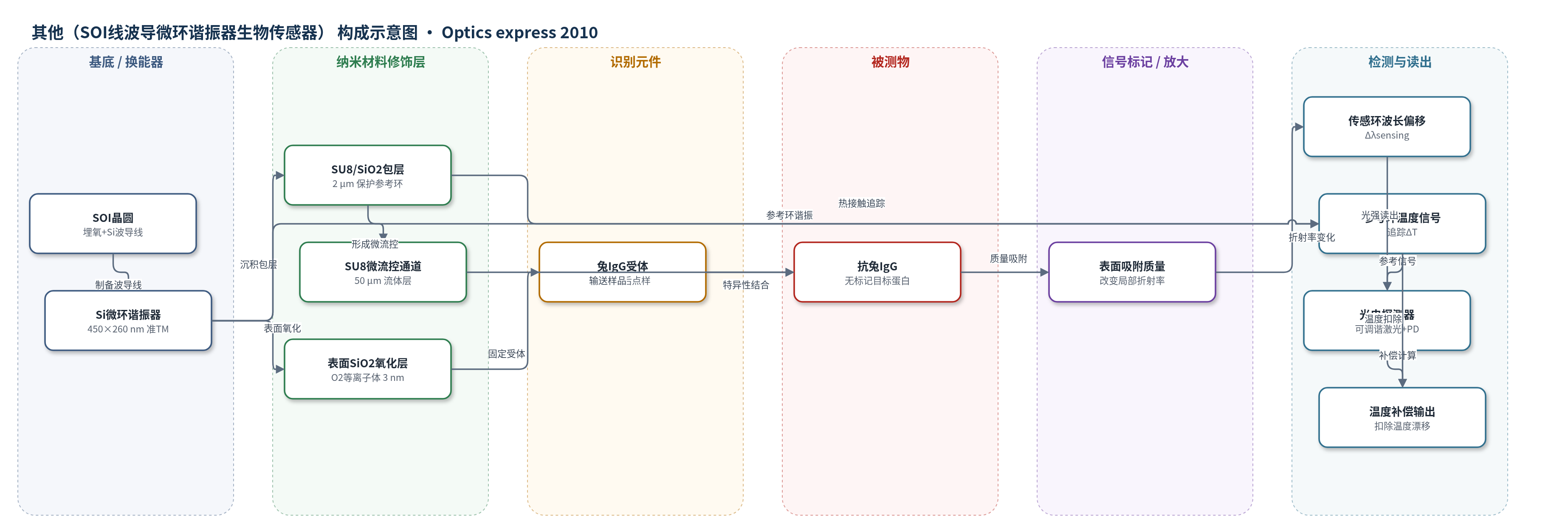
点击图片查看大图 · 依据论文自动绘制
传感器类型
其他(SOI线波导微环谐振器生物传感器)
检测对象
抗兔免疫球蛋白G(anti-rabbit IgG),样品基质为 PBS 缓冲液/去离子水;另用蔗糖水溶液作折射率校准
检测原理
该传感器为无标记集成光学微环谐振器。SOI 线波导中的光以准 TM 模式在微环中多次循环,倏逝场延伸至表面附近。当 anti-rabbit IgG 与表面固定的兔 IgG 结合后,吸附分子质量改变波导上方局部有效折射率,使传感环谐振波长发生偏移;浓度越高,吸附质量越大,波长偏移越大。温度变化会同时改变硅的热光系数和包层/流体折射率,造成额外谐振漂移。参考环被 2 μm SU8 或 SiO2 包层光学隔离,不响应流体折射率变化,但处于同一微流控通道中,其谐振偏移主要反映温度变化(SU8 还需扣除水渗透慢漂移)。通过稳态校准 ∂λ/∂T,并用参考环信号实时扣除传感环温度项,即可得到仅由表面结合引起的净信号。
检测灵敏度
检测下限: 20 pM(anti-rabbit IgG);等效表面质量 LOD: 0.3 pg/mm²;可分辨结合质量: 40 attograms;动态范围: 0.02–200 nM(4 orders of magnitude);折射率灵敏度: 135 nm/RIU;校正基线标准差: 0.1 pm/min(对应流体折射率波动 7×10^-7);可分辨波长偏移: <0.3 pm/min;SiO2 参考环波动: ≤±0.5 pm(对应体折射率 ±4×10^-6)
效应效果
SU8 阵列 4 个传感环对 0.5% 蔗糖响应(ΔλR≈95 pm)波动 ±1 pm,校正基线 <±2 pm,标准差 0.1 pm/min,对应流体折射率波动 7×10^-7,可分辨偏移 <0.3 pm/min。SiO2 参考环 2 小时波长散度 ≤±0.5 pm,对应体折射率 ±4×10^-6;故意温度波动下 30 min 校正后最大偏差 <3 pm。IgG 结合覆盖 0.02–200 nM 四个数量级,20 pM 对应 40 attograms(约 160 个 IgG 分子),反应可稳定测量 3 小时。SU8 易制备但有水渗透慢漂移(初始约 0.9 pm/min,2 h 后约 0.13 pm/min),适合中等速率信号;SiO2 稳定性更好,适合低浓度慢结合。作者认为无需严格温控,有利于发展紧凑低成本谐振器生物传感器。
传感器的构成
- 基底/换能器:SOI 晶圆(buried oxide + Si 波导线,450 nm×260 nm,准 TM 模式)构成微环谐振器,光场倏逝场感知表面吸附。
- 保护包层:2 μm SU8 或 SiO2 覆盖全芯片并开窗暴露传感环,参考环被包层光学隔离以追踪温度。
- 微流控层:50 μm SU8 微流控通道,将 PBS/去离子水/蔗糖溶液同时输送至参考环与传感环。
- 表面氧化层:O2 等离子体处理形成约 3 nm SiO2,辅助后续硅烷化与受体固定。
- 识别元件:硅烷化后非接触点样沉积兔 IgG(rabbit IgG)受体,特异性捕获 anti-rabbit IgG。
- 读出系统:可调谐激光器、偏振保持透镜光纤、20×显微物镜和光电探测器,通过 WDM 读取各环谐振波长。
中文摘要
本文首次系统研究了基于硅线波导环形谐振器的无标记生物传感器阵列中温度诱导谐振偏移的实时抵消方法。作者采用一个由 SU8 或 SiO2 包层保护的参考谐振器来追踪温度变化,该参考环与传感环位于同一微流控通道中,但被较厚包层光学隔离,使其对流体折射率变化不敏感而保持良好热接触。在稳态条件下测量了水溶液中谐振器的温度依赖关系,并讨论了波导尺寸、工作波长和包层热光系数对 ∂λ/∂T 的影响。实时测量表明,参考环谐振能够无明显时延地跟随温度变化,从而有效扣除传感环中的温度漂移。利用互补 IgG 蛋白对结合实验,传感器实现四个数量级动态范围,最低可检测至 20 pM,可分辨结合质量约 40 attograms。反应可稳定监测长达 3 小时,基线波动对应流体折射率变化约 ±4×10^-6。SU8 包层阵列制备简单,但存在水渗透引起的慢漂移;SiO2 包层在长时间、低浓度测量中稳定性更优。
英文摘要
A comprehensive investigation of real-time temperature-induced resonance shift cancellation for silicon wire based biosensor arrays is reported for the first time. A reference resonator, protected by either a SU8 or SiO(2) cladding layer, is used to track temperature changes. The temperature dependence of resonators in aqueous solutions, pertinent to biosensing applications, is measured under steady-state conditions and the operating parameters influencing these properties are discussed. Real-time measurements show that the reference resonator resonances reflect the temperature changes without noticeable time delay, enabling effective cancellation of temperature-induced shifts. Binding between complementary IgG protein pairs is monitored over 4 orders of magnitude dynamic range down to a concentration of 20 pM, demonstrating a resolvable mass of 40 attograms. Reactions are measured over time periods as long as 3 hours with high stability, showing a scatter corresponding to a fluid refractive index fluctuation of ± 4 × 10(-6) in the baseline data. Sensor arrays with a SU8 protective cladding are easy to fabricate, while oxide cladding is found to provide superior stability for measurements involving long time scales.