组成图示
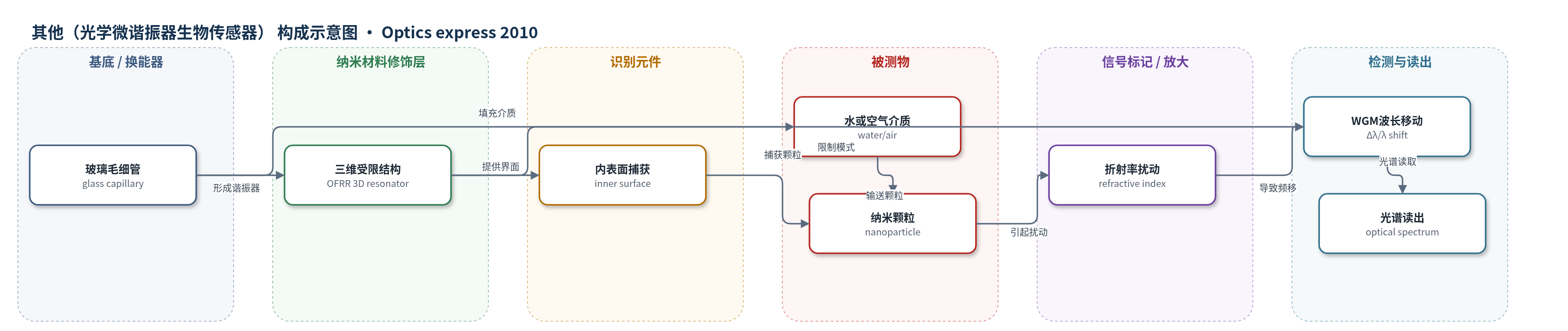
点击图片查看大图 · 依据论文自动绘制
传感器类型
其他(光学微谐振器生物传感器)
检测对象
纳米颗粒(nanoparticle,模型为聚苯乙烯微球 polystyrene beads);样品基质:水(water)、空气(air)
检测原理
光在玻璃毛细管形成的环形谐振器内传播并建立回音壁模式(WGM)。WGM电场在径向和轴向受到三维限制,其谐振波长对界面附近折射率变化敏感。当纳米颗粒附着于OFRR内表面时,颗粒折射率与周围水或空气不同,在局部扰动电磁场,使WGM谐振波长发生移动Δλ/λ。该移动量与颗粒体积、折射率差以及颗粒所在位置的局部电场强度重叠积分成正比,因此随颗粒半径近似按立方增大。通过优化毛细管壁厚,可使电场峰值靠近水-玻璃界面;通过瓶形或气泡形曲率,可进一步压缩轴向模式体积并提高界面场强,从而增强单颗粒信号。最终通过光谱仪读取谐振峰位移实现检测。
检测灵敏度
最小可检测半径: less than 20 nm in radius for a Δλ/λ resolution of 10^-8;Δk=0.2: approximately 17 nm;空气微气泡: about 20 nm;灵敏度增强: about 10 times(vs solid microsphere)
效应效果
本文为理论分析,未报告实验选择性、抗干扰、稳定性、重现性或实际样品回收率。理论预测显示,与实心微球生物传感器相比,三维受限OFRR的单纳米颗粒检测灵敏度约提高10倍。在水环境中,Δλ/λ分辨率为10^-8时,最小可检测半径小于20 nm;Δk=0.2瓶形结构约17 nm。在空气环境中,壁厚约1 μm的微气泡结构Q值仍约10^10,频移比微球大10倍以上,最小可检测半径约20 nm。若采用PPLN倍频技术将分辨率提高到10^-9,OFRR有望检测约7 nm半径颗粒,甚至可能实现约5 nm蛋白质单分子检测。作者认为其天然集成毛细管微流控可快速输送样品,适用于液体和空气中病毒等纳米生物/化学物种检测。
传感器的构成
- 基底/换能器:玻璃毛细管(glass capillary),形成环形谐振器并支持回音壁模式(WGM)
- 谐振结构:瓶形/气泡形光流体环形谐振器(microbottle/microbubble OFRR),三维限制WGM并减小模式体积
- 传感界面:OFRR内表面(inner surface),纳米颗粒附着位置,引起局部折射率变化
- 样品介质:水(water, n=1.33)或空气(air, n=1),填充毛细管核心,提供检测环境
- 被测物:纳米颗粒(nanoparticle),模型为聚苯乙烯微球(polystyrene beads, np=1.59)
- 信号读出:WGM谐振波长移动(Δλ/λ),由光谱读取
中文摘要
本文理论分析三维受限光流体环形谐振器(OFRR)在水和空气中检测单个纳米颗粒的能力。OFRR基于玻璃毛细管,可形成瓶形和气泡形环形谐振器。当纳米颗粒附着于OFRR内表面时,回音壁模式(WGM)的谐振波长发生移动。对于两种结构,可通过选择合适壁厚优化内表面电场;同时,不同曲率可实现沿毛细管轴向不同的电场限制,从而显著增强单纳米颗粒检测灵敏度。结果表明,与最近报道的实心微球生物传感器相比,灵敏度约提高10倍;在Δλ/λ分辨率为10^-8时,最小可检测纳米颗粒半径估计小于20 nm。高灵敏度与天然集成的毛细管微流控使OFRR成为检测液体和空气中多种纳米生物/化学物种的有前景传感平台。
英文摘要
We theoretically analyze the ability of 3-dimensionally confined optofluidic ring resonators (OFRRs) for detection of a single nanoparticle in water and in air. The OFRR is based on a glass capillary, on which bottle-shaped and bubble-shaped ring resonators can form. The spectral position of the whispering gallery mode in the OFRR shifts when a nanoparticle is attached to the OFRR inner surface. For both ring resonator structures, the electric field at the inner surface can be optimized by choosing the right wall thickness. Meanwhile, different electric field confinement along the capillary longitudinal axis can be achieved with different curvatures. Both effects significantly increase the sensitivity of the ring resonator for single nanoparticle detection. It is found that the sensitivity is enhanced about 10 times, as compared to that of a solid microsphere biosensor recently reported, and that the smallest detectable nanoparticle is estimated to be less than 20 nm in radius for a Δλ/λ resolution of 10(-8). The high sensitivity and the naturally integrated capillary based microfluidics make the OFRR a very promising sensing platform for detection of various nano-sized bio/chemical species in liquid as well as in air.