组成图示
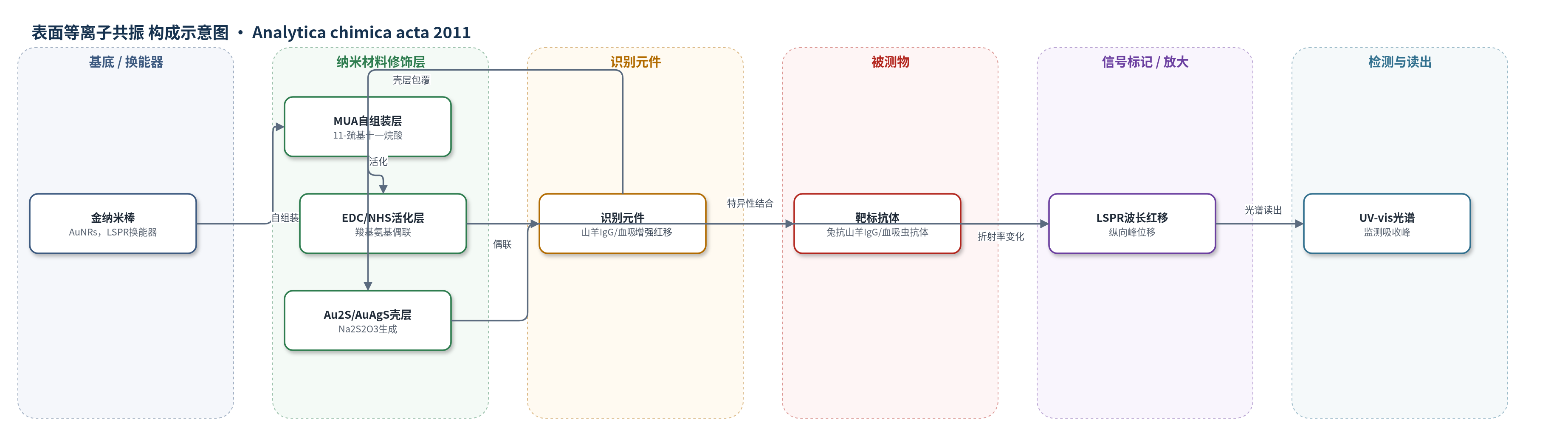
点击图片查看大图 · 依据论文自动绘制
传感器类型
表面等离子共振(SPR)生物传感器
检测对象
日本血吸虫感染血清中的特异性抗体(anti-schistosomiasis japonica antibodies);样品基质:人血清(human serum)
检测原理
金纳米棒具有横向和纵向局域表面等离子共振吸收,其中纵向峰对纳米棒周围介电环境或折射率变化高度敏感。首先用MUA在金纳米棒表面形成自组装单分子层,经EDC/NHS活化后与山羊IgG或日本血吸虫抗原的氨基共价偶联。随后加入Na2S2O3,与金纳米棒反应生成Au2S/AuAgS硫化物壳层,并轻微腐蚀金核,使长径比增大;壳层的高折射率和金核形貌变化共同导致纵向等离子体共振波长(LPW)显著红移,并放大波长响应。当感染人血清中的特异性抗体与固定抗原结合时,纳米棒界面局部折射率升高,引起LPW进一步红移;抗体浓度越高,红移幅度越大。最后用UV-vis光谱监测吸收峰位移,实现定量或半定量检测。
检测灵敏度
最低可检测稀释度: 1:50,000(体积比,血清/缓冲液);1:10,000 时 LPW 红移: 12 ± 1 nm (n=3);兔抗山羊IgG识别红移: 裸AuNRs 12 nm,Au2S/AuAgS壳层 28 nm 和 40 nm;RSD: 3.3–5.4% (n=3)
效应效果
该传感器对感染人血清具有良好选择性,正常血清无显著LPW变化;10份健康样本中6份出现轻微响应(<2 nm,平均0.8 nm),4份无红移(0 nm)。感染血清稀释1:10,000时产生12±1 nm红移,1:50,000仍可检测;裸金纳米棒在1:5000无显著变化,1:3600才出现8 nm红移。三次平行测定RSD为3.3–5.4%。与间接血凝试验(IHA)相比,该方法更简便、灵敏度更高,适用于日本血吸虫早期或轻感染筛查,并可扩展至其他免疫或特异识别体系。
传感器的构成
- 换能器/纳米基底:金纳米棒(AuNRs),提供横向与纵向局域表面等离子共振吸收,纵向峰对周围折射率变化敏感
- 自组装单分子层:11-巯基十一烷酸(MUA),通过Au-S键修饰金纳米棒,提供羧基用于生物分子偶联
- 交联活化层:EDC/NHS,活化MUA羧基,与识别元件氨基形成酰胺键
- 识别元件:山羊IgG(goat IgG)或日本血吸虫抗原(antigen of schistosomiasis japonica,重组rSjGST-32),固定于纳米棒表面以捕获兔抗山羊IgG或感染血清中的特异性抗体
- 核壳修饰/信号放大层:硫代硫酸钠(Na2S2O3)反应生成Au2S/AuAgS硫化物壳层,包裹识别元件,提高局部折射率并改变金核长径比,使纵向LSPR峰红移
- 稳定/分散介质:十六烷基三甲基溴化铵(CTAB)溶液,维持金纳米棒分散并辅助表面功能化
- 信号读出:紫外-可见分光光度计(UV-vis spectrophotometer),监测纵向等离子体共振波长(LPW)红移
中文摘要
本文报道了一种通过调控核壳金纳米棒的局域表面等离子共振(LSPR)性质来提高灵敏度的生物传感器。该策略在识别试剂(山羊IgG或日本血吸虫抗原)固定到金纳米棒表面后,利用硫代硫酸钠在金纳米棒表面生成硫化物壳层,形成核壳结构。所固定的生物分子保持生物活性,且壳层的形成可显著增强传感器的灵敏度。附着生物分子后的金纳米棒等离子体性质可被调节,其纵向等离子体共振波长可红移数百纳米至可见或近红外区,这对生物传感应用具有重要意义。与原始金纳米棒传感器相比,该方法产生更大的LSPR吸收红移,从而显著提高日本血吸虫检测灵敏度。感染日本血吸虫的人血清稀释至1:50,000(体积比,血清/缓冲液)即可被检测。该技术具有增强灵敏度,并可基于免疫识别或其他特异性反应扩展到其他传感应用。
英文摘要
An enhanced sensitive biosensor has been developed to detect biological targets by tailoring the localized surface plasmon resonance property of core-shell gold nanorods. In this new concept, a shell layer is produced on gold nanorods by generating a layer of chalcogenide on the gold nanorod surface after attachment of the recognition reagent, namely, goat IgG and antigen of schistosomiasis japonica. The bioactivity of these attached biomolecules is retained and the sensitivity of this biosensor is thus enhanced significantly. The plasmonic properties of the gold nanorods attached with the biomolecules can be adjusted and the plasmon resonance wavelength can be red-shifted up to several hundred nanometers in the visible or near infrared (NIR) region, which is extremely important to biosensing applications. This leads to a lager red-shift in the localized surface plasmon resonance absorption compared to the original gold nanorod-based sensor and hence offers greatly enhanced sensitivity in the detection of schistosomiasis japonica. The human serum infected with schistosomiasis japonica diluted to 1:50,000 (volume ratio, serum/buffer solution) can be detected readily. The technique offers enhanced sensitivity and can be easily extended to other sensing applications based on not only immuno-recognition but also other types of specific reactions.