组成图示
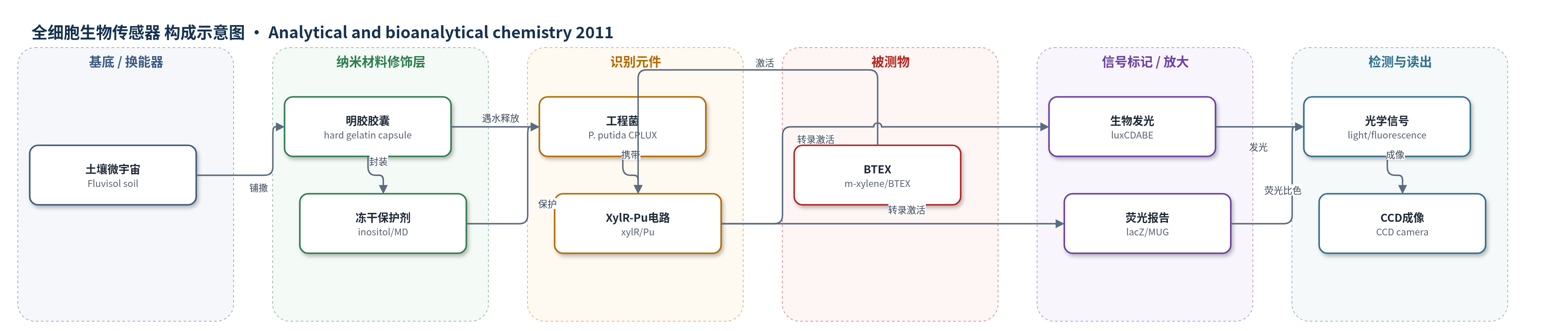
点击图片查看大图 · 依据论文自动绘制
传感器类型
全细胞生物传感器
检测对象
苯(benzene)、甲苯(toluene)、乙苯(ethylbenzene)、二甲苯(xylenes,尤其间二甲苯 m-xylene);样品基质:土壤/土壤微宇宙(soil microcosm)
检测原理
该传感器基于全细胞基因调控换能。BTEX 组分(如间二甲苯)扩散进入 Pseudomonas putida 细胞后,作为效应物激活 TOL 通路转录调控因子 XylR。XylR 结合并激活 Pu 启动子,驱动下游报告基因表达。在部署菌株 CPLUX 中,Pu 驱动 luxCDABE 生物发光基因簇,细胞内合成发光酶并产生可见光;在测试菌株 MAD1/MAD2 中,Pu 驱动 lacZ,产生 β-半乳糖苷酶,可被 MUG 荧光底物或 X-gal 比色底物检测。信号强度取决于 BTEX 的生物可利用浓度、XylR 激活程度、报告基因转录水平以及细胞存活与增殖状态。冻干保护剂和明胶胶囊不直接参与识别,而是维持细胞活力并实现原位释放,从而把基因转录放大和酶催化底物转化转化为可远程读取的光学信号。
检测灵敏度
—
效应效果
系统对 m-xylene 呈特异性响应:无芳香化合物对照无发光、荧光或 X-gal 蓝色。冻干保存中,15% 麦芽糊精与 5% 肌醇组合 30 天后保持 >2% 活力,材料约 10^9 菌/g,高于 0.1% 最低要求;LB 中麦芽糊精使 CFU 提高 4 倍。玉米芯在 65.4% 水饱和下 30 天维持较高活力,干燥至 7% 一天后 <10%,0.47% 后 <1%。明胶胶囊 7 天溶解释放,4 天可见生长,7 天完全定殖,保存 1 个月仍响应。土壤微宇宙中 MUG 荧光和 lux 发光仅见于 m-xylene 样品;LB 预培养信号早但衰减早,最小培养基预培养信号晚但持续至 82 h。作者认为可用于大范围土壤 BTEX 原位检测。
传感器的构成
- 识别元件:Pseudomonas putida KT2440 工程菌(P. putida CPLUX/MAD1/MAD2),携带 TOL 通路转录调控因子 XylR 及其启动子 Pu,识别 BTEX
- 信号报告元件:luxCDABE 生物发光报告子或 lacZ β-半乳糖苷酶报告子,受 Pu 激活后产生光、荧光或比色信号
- 冻干保护层:肌醇(inositol, Ino)与麦芽糊精(maltodextrins, MD),提高冻干存活率并改善材料一致性
- 吸附载体层:玉米芯粉(corncob powder),吸附细菌并维持半干状态下的活力
- 递送封装层:水溶性硬明胶胶囊(hard gelatin capsules,14.5% w/w 水、85.5% w/w 明胶),干燥时坚硬、遇水溶解释放细菌
- 样品基质:土壤微宇宙(soil microcosm,Fluvisol 型土壤,可含 agar),提供原位检测环境
- 读出试剂/设备:MUG(4-methylumbelliferyl-β-D-galactopyranoside)或 X-gal 底物,以及 CCD 相机/光子计数成像系统(Versadoc Imaging System Model 4000)
中文摘要
许多细菌已被工程化以在培养中响应特定分析物产生光学输出,但将其用于土壤中不同化学物种的大范围原位监测仍受限于缺乏可行的铺撒方案。本文报告并验证了一套用于长期保存遗传设计为检测苯、甲苯、乙苯和二甲苯(BTEX)的 Pseudomonas putida 细胞,并将其配方、铺撒和激活到目标地点与时间的综合系统。作者测试了多种冻干保护剂,发现肌醇与麦芽糊精组合最有利于冻干 BTEX 传感菌的保存;将 P. putida 细胞吸附到玉米芯粉上则赋予材料在常温下的持久活力。经保存的细菌生物量具有适合制成水溶性但干燥坚硬明胶胶囊的物理和机械性能,并具有较长货架期。将胶囊铺撒到土壤微宇宙后,用水或高湿度使其液化,释放的微生物形成斑点,在暴露于植入 P. putida 染色体中的传感电路效应物时发出强发光信号。作者认为,这些方法可促进大范围生物检测策略,用于揭示有毒或危险化学品的空间位置。
英文摘要
While many types of bacteria have been engineered to produce an optical output in response to given analytes in a culture, their use for extensive, in situ monitoring of distinct chemical species in soil is hampered by a dearth of practicable spreading schemes. In this work, we report and validate a comprehensive system for the long-term preservation of Pseudomonas putida cells genetically designed for biosensing benzene, toluene, ethylbenzene, and xylenes (BTEX) in soil, along with a procedure to formulate, spread, and vigorously activate such bacteria at the desired site and occasion. To this end, various known lyoprotectants were tested for promoting the long-term maintenance of biosensor cells with quite variable outcomes. While a formulation of inositol and maltodextrines was optimal for preservation of freeze-dried BTEX-sensing bacteria, adsorption of P. putida cells to corncob powder (an abundant residue of the corn industry) endowed the resulting material with a lasting viability at ambient conditions. In any case, the thereby preserved bacterial biomass acquired physical and mechanical properties adequate for formulating the biosensor agent in water-soluble but otherwise hard dry gelatine capsules with a long shelf life. When such capsules were spread in a soil microcosm and subsequently liquefied with water or high humidity, the released microorganisms formed spots that gave an intense luminiscent signal upon exposure to effectors of the sensor circuit implanted in the chromosome of the P. putida strain. We argue that the procedures described here can facilitate implementation of wide-area biological detection strategies for revealing the location of toxic or perilous chemicals.