组成图示
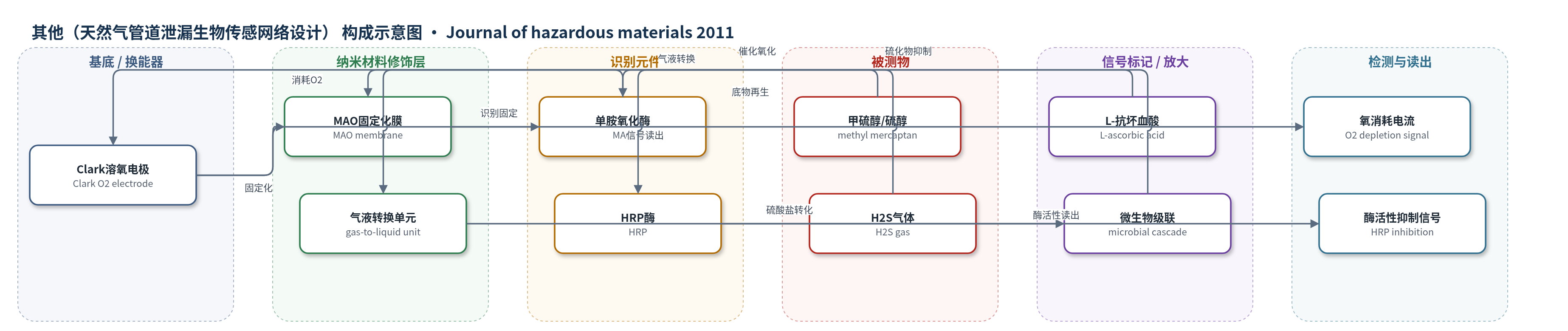
点击图片查看大图 · 依据论文自动绘制
传感器类型
其他(天然气管道泄漏生物传感网络设计)
检测对象
甲烷(methane, CH4)、硫醇(mercaptans)、硫化氢(hydrogen sulfide, H2S);样品基质:天然气管道泄漏气体/环境空气
检测原理
系统采用多分析物协同检测。甲烷由声光(PA)传感器检测:气体吸收调制光后产生压力波,麦克风将其转换为电信号,CH4浓度越高,光吸收越强,声压/电信号越大。硫醇由 biosniffer 检测:MAO 固定化膜催化甲硫醇等硫醇氧化并消耗溶解氧,Clark 型溶氧电极将氧浓度下降转换为电化学信号;L-抗坏血酸作为还原剂与单加氧酶耦合,实现底物再生并增强响应。H2S 先经气液转换器转为水相硫酸盐,再由微生物级联转化为硫化物/亚硫酸盐,进入 HRP 抑制型硫化物生物传感器;硫化物抑制 HRP 酶活性,酶活性变化被读出,抑制程度随 H2S 浓度增加而增大。
检测灵敏度
LOD: 0.2 ppm(甲硫醇 biosniffer);校准范围: 0.01–10 ppm(甲硫醇);LOD: 0.2 ppb(甲烷 PA 传感器);LOD: 0.05 μmol/L;检测范围: 0.1–38.5 μmol/L(HRP 硫化物生物传感器,水相)
效应效果
作者用模糊多准则分析(FMCA/PROMETHEE)筛选检测方案。甲烷首选声光(PA)传感器,检测限 0.2 ppb、响应 100 s,对次优 PLS 的敏感性分析显示稳健;硫醇选择已现场测试的 biosniffer,甲硫醇校准范围 0.01–10 ppm、检测限 0.2 ppm、响应 60 s;H2S 方案采用气液转换、微生物级联与 HRP 抑制型硫化物生物传感器组成,预计响应约 110 s,具抗干扰潜力但完整装置未测试。12.5 km 管道仿真中,22 传感器方案检测概率高于 0.7,单点泄漏平均检测时间约 380 s,双点同时泄漏约 280 s;9 传感器方案仅适合确认。作者认为该协同生物传感网络可低成本、可靠地实现长期管道泄漏监测。
传感器的构成
- H2S预处理层:气液转换器(gas-to-liquid converter),将气态硫化氢(H2S)转化为水相硫酸盐(SO4^2-)
- H2S微生物级联层:微生物转化单元(microbial cascade unit),将硫酸盐转化为硫化物/亚硫酸盐并送入酶传感器
- H2S识别层:辣根过氧化物酶(HRP)抑制型硫化物生物传感器,以 layer-by-layer 技术构建,检测硫化物对酶活性的抑制
- 硫醇识别层:单胺氧化酶(MAO)固定化膜,催化甲硫醇(methyl mercaptan)等硫醇氧化
- 硫醇换能层:Clark 型溶解氧电极(Clark-type dissolved oxygen electrode),检测氧消耗引起的电化学信号变化
- 硫醇电子供体:L-抗坏血酸(L-ascorbic acid),作为还原剂与单加氧酶耦合实现底物再生/信号放大
中文摘要
天然气管道(NG)监测对经济安全运行、防止损失和环境保护至关重要,及时可靠的泄漏检测是管道完整性管理的关键。由于现有检测技术和需覆盖监测范围的限制,新型检测系统研究仍很活跃。生物传感器在环境市场中被视为利基技术,只要经过合理设计、开发、布置、联网和维护,就能以较低成本提供所需检测能力。本文提出一种稳健的生物传感器与传统检测系统协同/互补方案,用于天然气管道泄漏监测;该网络经现场验证并优化,以在所需粒度水平提供可靠信息。所提方案基于知识方法,并采用模糊多准则分析(FMCA)选择最适合目标分析物和运行微环境的最佳生物传感器设计。该方法在希腊管道网络的泄漏监测设计中加以说明,涉及甲烷、硫醇和硫化氢检测。
英文摘要
Monitoring of natural gas (NG) pipelines is an important task for economical/safety operation, loss prevention and environmental protection. Timely and reliable leak detection of gas pipeline, therefore, plays a key role in the overall integrity management for the pipeline system. Owing to the various limitations of the currently available techniques and the surveillance area that needs to be covered, the research on new detector systems is still thriving. Biosensors are worldwide considered as a niche technology in the environmental market, since they afford the desired detector capabilities at low cost, provided they have been properly designed/developed and rationally placed/networked/maintained by the aid of operational research techniques. This paper addresses NG leakage surveillance through a robust cooperative/synergistic scheme between biosensors and conventional detector systems; the network is validated in situ and optimized in order to provide reliable information at the required granularity level. The proposed scheme is substantiated through a knowledge based approach and relies on Fuzzy Multicriteria Analysis (FMCA), for selecting the best biosensor design that suits both, the target analyte and the operational micro-environment. This approach is illustrated in the design of leak surveying over a pipeline network in Greece.