组成图示
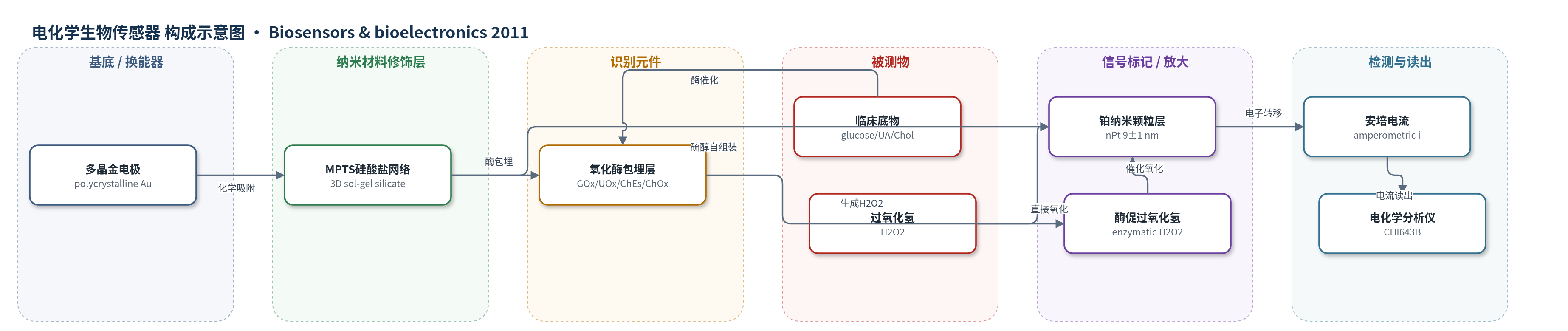
点击图片查看大图 · 依据论文自动绘制
传感器类型
电化学生物传感器
检测对象
过氧化氢(H2O2,雨水)、尿酸(uric acid, UA,血清)、胆固醇(cholesterol,血清)、葡萄糖(glucose,血清)
检测原理
氧化酶(GOx、UOx、ChEs/ChOx)包埋于 MPTS 溶胶-凝胶硅酸盐三维网络中,底物在氧存在下被酶催化氧化,生成与底物浓度成正比的 H2O2;H2O2 扩散至自组装在硫醇基团上的 Pt 纳米颗粒(nPt)表面,在 +0.45 V 附近发生电催化氧化,电子经金电极传递形成安培电流。nPt 的高催化活性降低 H2O2 氧化过电位,三维网络提供高比表面积和快速传质,使电流随 H2O2 或底物浓度增加而增加;低浓度呈线性,高浓度因酶动力学而饱和。直接 H2O2 传感无需酶和氧化还原介质。
检测灵敏度
H2O2: LOD: 0.1 nM (S/N = 9);灵敏度: 1.82 ± 0.01 nA/nM;线性范围: 0.1 nM–1.4 mM(CV 校准);葡萄糖: LOD: 10 nM (S/N = 6);灵敏度: 0.85 ± 0.01 μA/mM;尿酸: LOD: 100 nM (S/N = 5);灵敏度: 9.43 ± 0.01 nA/μM;胆固醇: LOD: 0.5 μM (S/N = 7);灵敏度: 0.0123 ± 0.003 μA/mM。
效应效果
该平台对 H2O2 的抗干扰性好,在 30 μM H2O2 存在下加入 0.1 mM 抗坏血酸、尿酸和对乙酰氨基酚,稳态电流无明显变化。稳定性高:5 μM H2O2 连续 20 次及 24 h 后再 20 次测量,峰电流变异系数 0.12%;PBS 中储存 15 d,11 d 内无变化,15 d 后电流仅降 9%;4 个电极结果一致。雨水 H2O2 为 150–170 nM,加标回收率 92–94%。生物传感器响应时间 2 s,血清中尿酸、葡萄糖、胆固醇加标回收率 94–99%,与临床比色法结果接近,作者认为可用于临床样品快速检测。
传感器的构成
- 基底/换能器电极:多晶金电极(polycrystalline Au),作为导电基底和安培换能器
- 溶胶-凝胶硅酸盐网络:由 3-巯基丙基三甲氧基硅烷(MPTS)水解缩合形成的三维硅酸盐网络,化学吸附于金表面并提供硫醇基团
- 识别元件:葡萄糖氧化酶(GOx)、尿酸酶(UOx)、胆固醇酯酶(ChEs)和胆固醇氧化酶(ChOx)包埋于 MPTS 网络中,催化底物氧化生成 H2O2
- 纳米催化层:铂纳米颗粒(nPt,平均 9±1 nm,7–10 nm)自组装于硫醇基团上,催化 H2O2 氧化
- 信号转导:nPt 直接电催化 H2O2 氧化,无需外加氧化还原介质,酶促 H2O2 作为信号中间体
- 支持电解质:磷酸盐缓冲液(PBS,pH 7.2 或尿酸体系 pH 8.5),提供离子导电环境
- 检测读出:三电极电化学池与 CHI643B 电化学分析仪,恒电位安培法读取电流
中文摘要
本文报道了一种基于铂纳米颗粒(nPt)的新型三维纳米架构电化学传感平台。nPt 通过硫醇基团自组装固定于由 3-巯基丙基三甲氧基硅烷(MPTS)溶胶-凝胶形成的三维硅酸盐网络中,粒径为 7–10 nm。该平台无需酶和氧化还原介质,即可在 +0.45 V 下高效催化过氧化氢(H2O2)氧化,在中性溶液中检出限达 0.1 nM,且不受常见易氧化干扰物影响,具有良好的重现性、长期储存和操作稳定性。作者将该平台用于雨水 H2O2 测定,并通过将葡萄糖氧化酶、尿酸酶、胆固醇酯酶/胆固醇氧化酶与 nPt 共同整合到硅酸盐网络中,构建了尿酸、胆固醇和葡萄糖的安培生物传感器。包埋酶保持活性,可无干扰地检测酶促生成的 H2O2,传感器响应快、稳定性好,并在血清样品中实现测定,结果与临床实验室方法一致。
英文摘要
A novel 3-D nanoarchitectured platform based on Pt nanoparticles (nPts) is developed for the sensing of sub-nanomolar levels of hydrogen peroxide and for the fabrication of amperometric biosensor for uric acid, cholesterol and glucose. The nPts have been immobilized on the thiol functional group containing sol-gel silicate 3-D network derived from 3-mercaptopropyltrimethoxysilane (MPTS). The nanoparticles on the 3-D architecture have size distribution between 7 and 10nm. The nPts on the platform efficiently catalyze the oxidation of H(2)O(2) at the potential of +0.45 V in the absence of enzymes and redox mediators. This nanoarchitectured platform is highly sensitive and can detect H(2)O(2) at sub-nanomolar levels (0.1 nM) in neutral solution. The nanoarchitectured platform does not suffer from interference due to other common easily oxidizable interfering agents. Excellent reproducibility, long-term storage and operational stability are observed. This platform is used to determine H(2)O(2) concentration in rainwater and for the fabrication of biosensors. Amperometric oxidase-based biosensing platforms are developed by integrating the enzymes and nPts with the silicate network for the sensing of uric acid cholesterol and glucose. The enzyme encapsulated 3-D architecture retains the enzymatic activity and efficiently detects enzymatically generated H(2)O(2) without any interference. These biosensors are stable and show excellent sensitivity and fast response time. A linear response was obtained for a wide concentration range of all analytes. The practical utilization of the biosensor for the measurement of uric acid, cholesterol and glucose in serum sample is demonstrated. The biological sample analysis was validated with clinical laboratory measurements.