组成图示
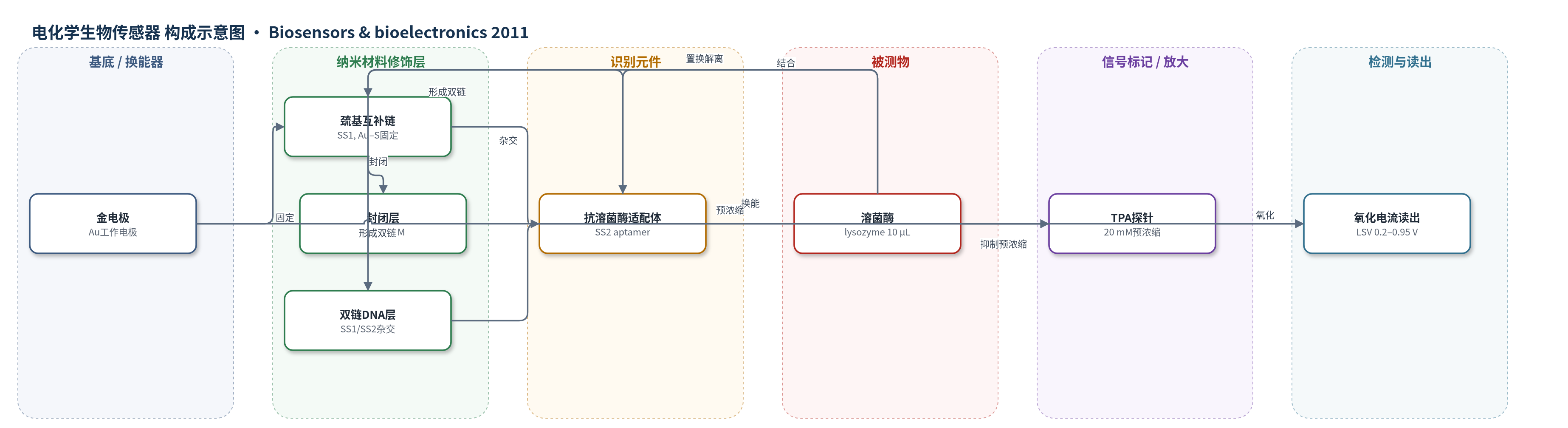
点击图片查看大图 · 依据论文自动绘制
传感器类型
电化学生物传感器
检测对象
溶菌酶(lysozyme, LYS);样品基质:Tris–HCl缓冲液、稀释蛋清(diluted egg white)
检测原理
传感器以金电极为基底,巯基互补链SS1经Au–S键固定,MCE封闭后,抗溶菌酶适配体SS2杂交形成ds-DNA。ds-DNA磷酸骨架带负电,可静电吸附质子化TPAH+,并在DNA微环境中促进TPA去质子化,使TPA氧化电流显著增强。加入溶菌酶后,溶菌酶与适配体高亲和结合,置换互补链SS1,ds-DNA解离为ss-DNA,电极表面TPA预浓缩减少,氧化电流下降且峰位正移。以TPA氧化电流变化定量溶菌酶。信号来自表面预浓缩TPA,相对单点标记具有信号放大;扫描电位0.2–0.95 V低于DNA碱基氧化电位,避免生物分子损伤。
检测灵敏度
线性范围: 1.0 pM–1.1 nM;可检测量: 10 amol 或 6.0×10^6 分子
效应效果
选择性良好:BHB、BSA、OB、arg和his在50 nM水平无显著响应,信号低于1.0 pM溶菌酶的1/5,选择性至少50,000倍。电极可再生,5天内重复测定1.0 pM溶菌酶日间RSD为7.1%(n=5);实际样品RSD为1.4%–4.2%。直接分析10 μL稀释蛋清,测得溶菌酶2.62×10^-4 M或3.77 mg/mL,处于文献正常范围;加标回收率93%–100%(摘要93.3%–100%)。作者认为其检出限低于多数已有适配体方法,无需DNA标记和复杂前处理,简单、稳定、特异、省时,可拓展至其他蛋白检测。
传感器的构成
- 基底/换能器电极:金电极(Au),经抛光和电化学清洗,作为工作电极承载DNA自组装层
- 捕获/互补链层:巯基修饰单链DNA(SS1,5′-(SH)-(CH2)6-GCA CTC TTT AGC CCT GAT GAA TTC GTA GAT-3′),通过Au–S键固定,作为抗溶菌酶适配体的互补链
- 封闭层:2-巯基乙醇(MCE,0.1 M),封闭金表面非特异位点,降低背景
- 识别/杂交层:抗溶菌酶适配体单链DNA(SS2,anti-lysozyme aptamer),与SS1杂交形成ds-DNA并识别溶菌酶
- 被测物:溶菌酶(lysozyme),与适配体高亲和结合并置换互补链,使ds-DNA解离
- 信号探针/电子供体:三丙胺(TPA,20 mM),在ds-DNA磷酸骨架静电预浓缩并被氧化,电流随ds-DNA解离下降
- 读出系统:三电极电化学分析仪(LK98BII),Ag/AgCl参比电极、Pt对电极,LSV 0.2–0.95 V记录TPA氧化电流
中文摘要
三丙胺(TPA)在双链DNA(ds-DNA)和单链DNA(ss-DNA)修饰电极上的氧化效率不同。作者利用这一性质,首次构建了一种以TPA氧化探测分子内置换的简单而灵敏的电化学生物传感器,并以溶菌酶为模型蛋白。抗溶菌酶适配体的互补单链DNA通过金–硫键固定于金电极表面,随后与适配体杂交形成ds-DNA。当10 μL样品中的溶菌酶与适配体结合时,由于二者亲和力高,互补链被置换,ds-DNA发生解离。在含20 mM TPA的溶液中,以0.2–0.95 V进行线性扫描,利用氧化电流变化定量溶菌酶,线性范围为1.0 pM–1.1 nM,相当于可检测10 amol或6.0×10^6个溶菌酶分子。由于信号来自电极表面预浓缩的TPA,该方法比单点标记策略更灵敏,且避免了复杂样品前处理和DNA标记。传感器直接分析稀释蛋清样品,回收率为93.3%–100%,重现性为1.4%–4.2%。
英文摘要
Tripropylamine (TPA) has different oxidation efficiency at double stranded (ds)-and single stranded (ss)-DNA-modified electrodes. Using this property, a simple but sensitive biosensor using TPA oxidation to probe the intramolecular displacement was constructed with the analysis of lysozyme as model for the first time. After the complementary ss-DNA strand of anti-lysozyme aptamer was immobilized onto gold electrode via gold-thiol bond, the incubation with the aptamer resulted in the formation of ds-DNA. Lysozyme (in 10 μL sample) binding with aptamer displaced the complementary strand because of the high affinity of lysozyme and its aptamer, corresponding to the dissociation of the ds-DNA. The modified electrode was swept in 20mM TPA solution from 0.2 to 0.95 V. The difference in oxidation current was used to quantify the content of lysozyme with a linear range from 1.0 pM to 1.1 nM. That means 10 amol or 6.0 × 10(6) lysozyme molecules can be detected. Because the signal is produced from the preconcentrated TPA at the electrode surface, the high sensitivity is achieved over the single site labelling strategy. The proposed method is simple, stable, specific, and time-saving while the complicated sample pre-treatment and the labelling to the DNA strand are avoided. The biosensor was validated by the analysis of the diluted egg white sample directly. The recovery and reproducibility were 93.3-100% and 1.4-4.2%, respectively.