组成图示
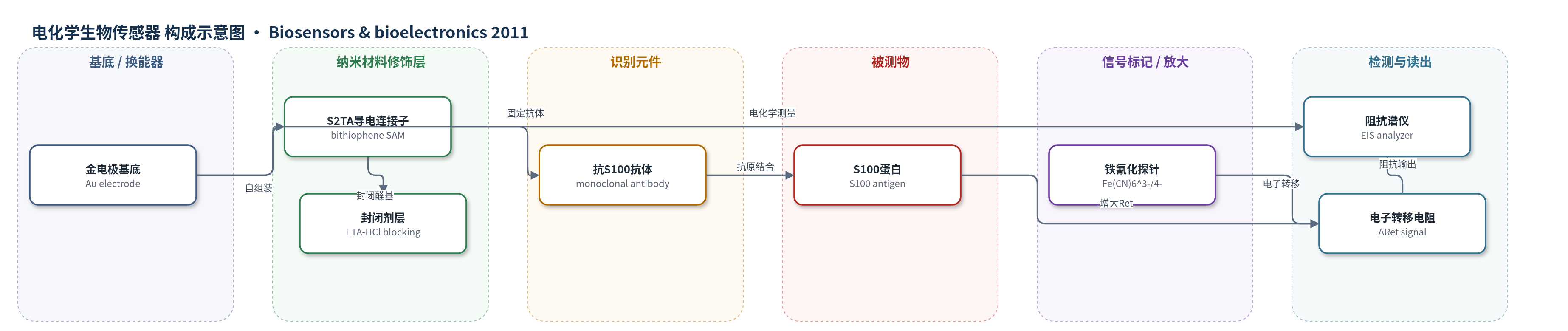
点击图片查看大图 · 依据论文自动绘制
传感器类型
电化学生物传感器
检测对象
S100蛋白(S100 protein),样品基质为1× PBS缓冲液(pH 7.2)稀释的蛋白溶液。
检测原理
该传感器采用无标记法拉第阻抗机制。S2TA导电连接子在金电极表面形成自组装单层,其噻吩共轭π轨道提供低电子转移电阻通道,并通过醛基固定antiS100抗体。当S100蛋白与抗体结合后,界面生物分子层增厚,空间位阻和静电排斥增强,阻碍Fe(CN)6^3−/4−氧化还原探针向金电极的电子转移,使电子转移电阻Ret增大。电化学阻抗谱在开路电位、5 mV交流幅值、1 Hz–100 kHz下测量,并用Randles等效电路拟合Ret。以ΔRet=Ret(S100)−Ret(ETA)作为响应,随S100浓度升高线性增加。S2TA将阻抗基线降至kΩ级,提高法拉第电流和信噪比,从而降低检测限。
检测灵敏度
LOD: 10 ng/ml (0.5 nM);线性范围: 10 ng/ml–10 µg/ml
效应效果
该传感器表现出良好的选择性与重现性。ELISA验证antiS100仅与S100反应,对CRP和HSA无显著响应,S100组OD比对照高约12–72倍。EIS重复三次,RSD在10 ng/ml–2 µg/ml约为5%,在5–10 µg/ml约为10%。与长链硫醇12-MCA相比,S2TA修饰电极的Ret为5.78 kΩ,而12-MCA为1.07 MΩ;5 mV下电流分别为870 nA和4.67 nA,信噪比提高约1000倍。作者指出该设计将检测限从82 nM改善至0.5 nM,适合低成本、小型化的即时检测应用。
传感器的构成
- 工作电极基底:2 mm 直径金电极(Au electrode),提供阻抗换能界面。
- 导电连接子层:5′-(mercaptomethyl)-2,2′-bithiophene-5-carbaldehyde(S2TA)自组装单层(SAM),增强电子转移并固定抗体。
- 识别元件:小鼠单克隆抗S100抗体(monoclonal antiS100),特异性结合S100抗原。
- 封闭剂:乙醇胺盐酸盐(ETA-HCl,1 M,pH 8.2),封闭未反应醛基。
- 氧化还原探针:铁氰化钾/四氰化铁(K3Fe(CN)6/K4Fe(CN)6,1 mM,Fe(CN)6^3−/4−),提供法拉第电流信号。
- 支持电解质:磷酸盐缓冲液(1× PBS,pH 7.2),维持检测环境。
- 辅助电极:Ag/AgCl 参比电极与 Pt 对电极,构成三电极阻抗测量体系。
中文摘要
本文开发了一种基于新型导电连接子的无标记阻抗生物传感器,用于检测抗体–抗原相互作用。传统长链硫醇导电性差,不适用于法拉第型生物传感器。本研究采用噻吩基导电生物连接子(S2TA)形成自组装单层并固定生物分子。循环伏安和阻抗谱验证其增强导电性:该导电连接子的电子转移电阻比传统长链硫醇连接子低约3个数量级。阻抗降低(法拉第电流增大)可提高信噪比,从而改善检测限。荧光显微镜验证其蛋白固定能力与传统长链硫醇相当。以S100蛋白为模型抗原,验证了系统蛋白相互作用检测能力,线性动态范围为10 ng/mL至10 µg/mL,检测限为10 ng/mL。结果表明,基于该导电连接子的电化学阻抗生物传感器在即时检测应用中具有很大潜力。
英文摘要
We developed a label-free impedance biosensor based on an innovative conductive linker for detecting antibody-antigen interactions. As the often used conventional long chain thiol is a poor conductor, it is not a suitable material for use in a faradaic biosensor. In this study, we adopted a thiophene-based conductive bio-linker to form a self-assembled monolayer and to immobilize the bio-molecules. We used cyclic voltammetry and impedance spectroscopy to verify the enhanced conductivity properties. Results showed that the electron transfer resistance of this new conductive linker was 3 orders of a magnitude lower than for a case using a conventional long chain thiol linker. With the decreased impedance (i.e. increased faradaic current), we can obtain a higher signal/noise ratio such that the detection limit is improved. Using fluorescence microscopy, we verified that our new conductive linker has a protein immobilization capability similar to a conventional long chain thiol linker. Also, using S100 proteins, we verified the protein interaction detection capability of our system. Our obtained results showed a linear dynamic range from 10 ng/ml to 10 μg/ml and a detection limit of 10 ng/ml. With our new conductive linker, an electrochemical impedance biosensor shows great potential to be used for point-of-care applications.