组成图示
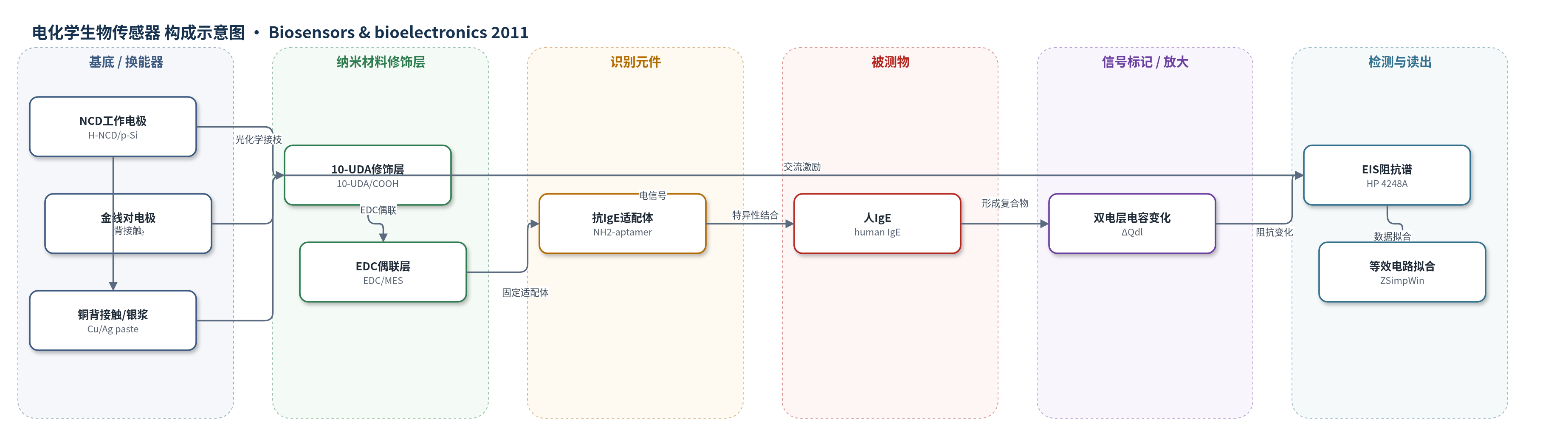
点击图片查看大图 · 依据论文自动绘制
传感器类型
电化学生物传感器
检测对象
人免疫球蛋白E(human IgE, IgE);样品基质:TGK buffer、加标人血清(human serum)
检测原理
传感器以H-terminated NCD薄膜为工作电极,10-UDA光化学接枝后提供COOH,再通过EDC/MES将NH2末端抗IgE适配体共价固定,形成稳定的生物界面。当样品中的IgE与表面适配体结合时,在适配体层上方形成适配体–IgE复合物层。由于IgE蛋白的引入增加了生物分子膜厚度并降低局部介电常数,NCD/溶液界面的双电层电容Qdl下降。EIS在20 Hz–100 kHz施加10 mV交流信号,低频区阻抗主要受分子层和双电层控制,因此IgE结合表现为低频阻抗模下降和Nyquist图第二半圆变化。通过等效电路拟合提取ΔQdl,ΔQdl与IgE浓度在0.03–42.8 μg/mL内线性相关,实现无标记定量。
检测灵敏度
LOD: 0.03 μg/mL;线性范围: 0.03 μg/mL–42.8 μg/mL;灵敏度: 0.42 nS sn mL/μg;R^2 = 0.994
效应效果
该传感器对IgE具有良好选择性:32.1 μg/mL IgG孵育后阻抗几乎回到基线,ΔQdl变化可忽略,表明BSA封闭有效降低非特异结合。可重复性方面,经0.05 M NaOH/1 M NaCl变性再生后,四个反应池六次循环在82 Hz阻抗的RSD分别为1.1%、1.3%、1%和0.8%。实际人血清加标检测中,IgE在0.05–5.8 μg/mL范围内线性,R^2=0.98,高于5.8 μg/mL后饱和;与ELISA结果相关系数0.99,斜率1.01,显示良好临床一致性。ELISA检出限为0.01 μg/mL,而本传感器线性范围约为ELISA的三倍。作者认为其可用于血清IgE直接无标记检测,但仍需降低测量变异并优化表面、样品前处理与微型化。
传感器的构成
- 基底/换能器:H-terminated NCD薄膜(2–4 μm,晶粒5–15 nm,p-Si衬底),作为工作电极和阻抗换能层
- 修饰层:10-undecenoic acid(10-UDA)光化学接枝于H-terminated NCD,提供COOH官能团
- 偶联层:EDC(1-ethyl-3-(3-dimethylaminopropyl)-carbodiimide)在MES缓冲液中介导酰胺键偶联
- 识别元件:NH2-terminated anti-IgE aptamer(500 pmol,5′氨基、20T延伸),特异性结合IgE
- 封闭层:1×PBS含6% BSA,4℃过夜封闭,降低非特异结合
- 电极/器件:Cu背接触、Ag浆、Au线对电极、Teflon盖与O-ring反应池,构成两电极阻抗测量池
- 信号标记物:无标记检测,无外加荧光/酶/纳米标记物
中文摘要
与抗体类似,适配体因高选择性、特异性和稳定性而适合作为蛋白生物标志物的生物识别分子。本文将适配体与半导体材料结合,报道了一种基于纳米晶金刚石(NCD)薄膜工作电极的阻抗式适配体生物传感器,用于人免疫球蛋白E(IgE)的直接无标记检测。氨基(NH2)末端抗IgE适配体通过碳二亚胺化学共价连接到羧基(COOH)修饰的NCD表面。采用电化学阻抗谱(EIS)监测适配体功能化金刚石表面接触IgE溶液后界面电学性质的变化。孵育过程中,适配体–IgE复合物的形成显著改变双电层电容,且变化与IgE浓度良好对应。IgE检测线性范围为0.03–42.8 μg/mL,检出限达生理相关浓度0.03 μg/mL。该NCD适配体传感器在大量IgG存在下仍具高选择性,并在六次再生循环中保持可重复信号。该阻抗式适配体传感器成功用于人血清样品检测,表明EIS可用于血液中IgE水平的直接无标记检测。
英文摘要
Like antibodies, aptamers are highly valuable as bioreceptor molecules for protein biomarkers because of their excellent selectivity, specificity and stability. The integration of aptamers with semiconducting materials offers great potential for the development of reliable aptasensors. In this paper we present an aptamer-based impedimetric biosensor using a nanocrystalline diamond (NCD) film as a working electrode for the direct and label-free detection of human immunoglobulin E (IgE). Amino (NH(2))-terminated IgE aptamers were covalently attached to carboxyl (COOH)-modified NCD surfaces using carbodiimide chemistry. Electrochemical impedance spectroscopy (EIS) was applied to measure the changes in interfacial electrical properties that arise when the aptamer-functionalized diamond surface was exposed to IgE solutions. During incubation, the formation of aptamer-IgE complexes caused a significant change in the capacitance of the double-layer, in good correspondence with the IgE concentration. The linear dynamic range of IgE detection was from 0.03 μg/mL to 42.8 μg/mL. The detection limit of the aptasensor reached physiologically relevant concentrations (0.03 μg/mL). The NCD-based aptasensor was demonstrated to be highly selective even in the presence of a large excess of IgG. In addition, the aptasensor provided reproducible signals during six regeneration cycles. The impedimetric aptasensor was successfully tested on human serum samples, which opens up the potential of using EIS for direct and label-free detection of IgE levels in blood serum.