组成图示
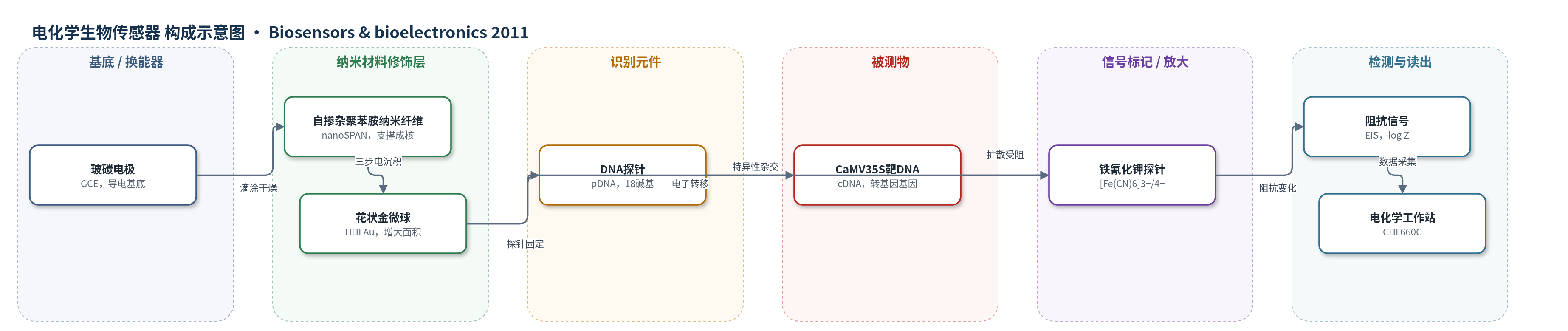
点击图片查看大图 · 依据论文自动绘制
传感器类型
电化学生物传感器
检测对象
花椰菜花叶病毒35S基因片段(CaMV35S gene fragment,转基因植物筛选靶DNA);样品基质:转基因植物DNA/寡核苷酸溶液(Tris–HCl/NaCl,2× SSC)
检测原理
DNA探针(pDNA)固定于HHFAu/nanoSPAN/GCE表面后,加入含CaMV35S靶序列的杂交液。靶DNA与探针互补杂交形成双链DNA(dsDNA),使电极表面负电荷密度增加并形成更厚的DNA层。该界面阻碍电活性探针[Fe(CN)6]3−/4−向电极表面扩散,导致电荷转移阻抗增大。HHFAu与nanoSPAN协同提供大电活性面积和快速电子转移通道,使阻抗变化更明显。以10^4 Hz处log Z差值Δlog Z为信号,Δlog Z随靶DNA浓度对数线性增加,从而实现无标记阻抗检测。
检测灵敏度
LOD: 1.9 × 10⁻¹⁴ M;线性范围: 1.0 × 10⁻¹³ M–1.0 × 10⁻⁶ M;灵敏度斜率: 0.0116(Δlog Z/log C);相关系数 r = 0.9985
效应效果
该传感器对完全互补靶DNA响应最强,双碱基错配DNA的阻抗低于互补序列,非互补DNA几乎不引起阻抗变化,显示良好选择性。作者报告其具有良好稳定性、高重现性和再生能力。与已有EIS金纳米复合DNA传感器相比,本工作线性范围更宽、检出限更低:Au-Bd2MPTS为1.0×10⁻⁸–1.0×10⁻⁵ M、LOD 5.0×10⁻⁹ M;Au/PDC/GCE为1.0×10−10–1.0×10−5 M、LOD 2.4×10⁻¹¹ M;Au/nanoPAN/GCE为1.0×10−12–1.0×10−6 M、LOD 3.1×10⁻¹³ M;本工作为1.0×10⁻¹³–1.0×10⁻⁶ M、LOD 1.9×10⁻¹⁴ M。作者认为该平台可用于转基因植物CaMV35S基因检测及其他生物/化学分子传感。
传感器的构成
- 基底/换能器电极:玻碳电极(GCE),经Al2O3抛光和超声清洗,提供导电基底与电子转移动力
- 导电聚合物修饰层:自掺杂聚苯胺纳米纤维(nanoSPAN)悬浮液滴涂干燥,提供中性pH电活性、亲水性和磺酸基/亚胺基成核位点
- 金属纳米结构层:花状金微球(HHFAu),由5.0 mM HAuCl4在0.25 M H2SO4中三步电沉积形成,增大电活性面积并促进电子转移
- 识别元件:DNA探针(pDNA,18碱基寡核苷酸),固定于HHFAu表面,用于CaMV35S靶序列特异性杂交
- 电活性信号探针:铁氰化钾/亚铁氰化钾([Fe(CN)6]3−/4−,20.0 mM),作为EIS氧化还原探针,其扩散受阻引起阻抗变化
- 检测介质:2× SSC(pH 7.0)杂交缓冲液和0.1 M KCl支持电解质,维持杂交离子强度并提供EIS测量环境
中文摘要
本文采用三步电沉积法,在自掺杂聚苯胺纳米纤维(nanoSPAN)修饰的玻碳电极(GCE)上制备形貌可控的花状金微球(HHFAu)。氯金酸(HAuCl4)浓度和沉积步骤对金微球形貌及电化学性能影响显著。在5.0 mM HAuCl4溶液中,经三步电沉积获得层次分明、均匀分散的HHFAu,其具有大比表面积、优异电子转移能力和良好生物相容性。DNA探针可有效固定于HHFAu表面,并以电化学阻抗谱(EIS)为检测方法构建高性能DNA生物传感器。该传感器成功检测了与转基因植物筛选相关的花椰菜花叶病毒35S基因(CaMV35S)片段,线性范围为1.0×10⁻¹³ M至1.0×10⁻⁶ M,检出限为1.9×10⁻¹⁴ M。该HHFAu/nanoSPAN阻抗传感平台有望用于其他生物分子和化学分子检测。
英文摘要
A three-step electrodeposition method has been successfully adopted to fabricate morphology-controlled novel Au microspheres on self-doped polyaniline nanofibers (nanoSPAN) modified glassy carbon electrode. The deposition conditions, such as HAuCl(4) concentration and deposition step, have significant influences on the morphologies and electrochemical properties of the resulted Au microspheres. Well hierarchical and homogeneously dispersed flower-like Au microspheres (HHFAu) were obtained under optimal conditions by the three-step electrodeposition strategy in 5.0mM HAuCl(4) solution. HHFAu possess large surface area, excellent electron transfer ability and good biocompatibility. The DNA probe could be effectively attached to HHFAu and thus a high-performance DNA biosensor was constructed by using electrochemical impedance spectroscopy as detection method. A gene fragment of the cauliflower mosaic virus 35S gene, which is related to one of the screening genes for the transgenically modified plants, has been satisfactorily detected. The linear range was from 1.0 × 10(-13)M to 1.0 × 10(-6)M and the detection limit was 1.9 × 10(-14)M. This HHFAu/nanoSPAN-based impedance biosensing platform holds great promise for the detection of other biological and chemical molecules.