组成图示
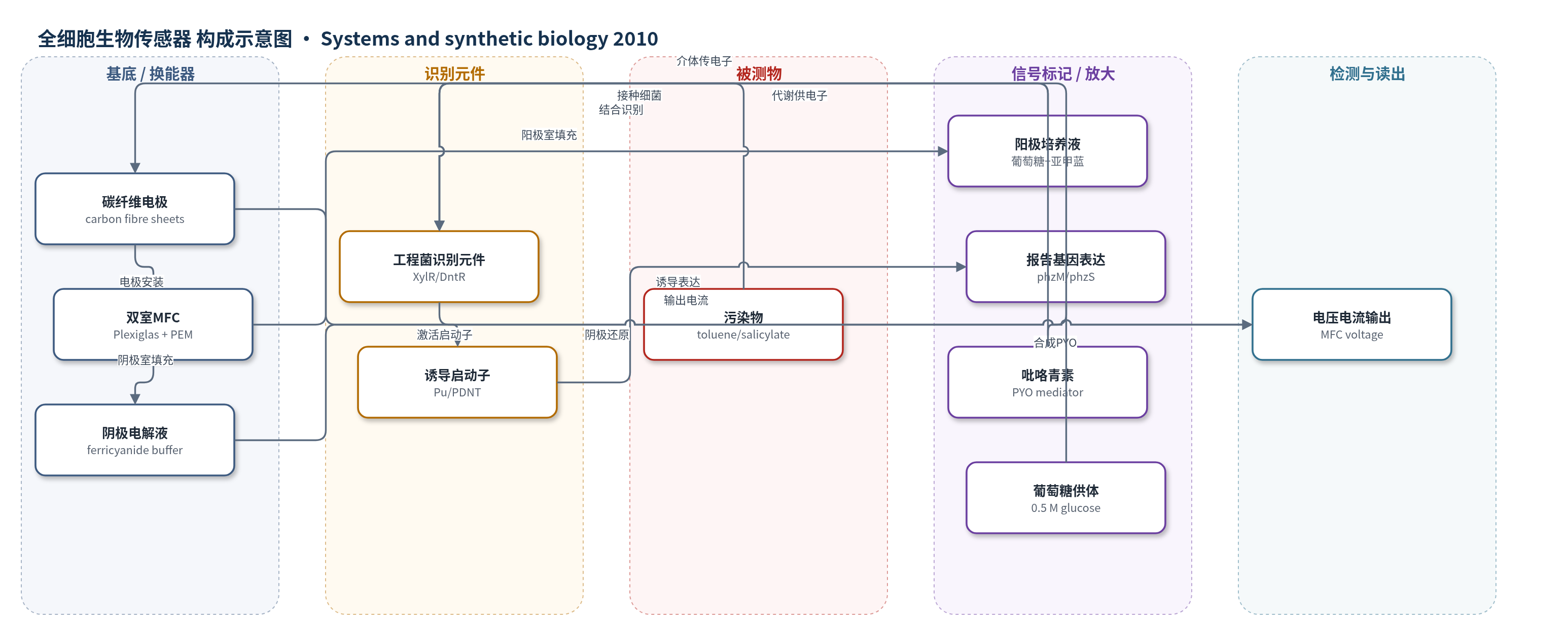
点击图片查看大图 · 依据论文自动绘制
传感器类型
全细胞生物传感器
检测对象
甲苯(toluene)、水杨酸(salicylate);样品基质为细菌培养液/环境污染物模拟液(extracellular medium)
检测原理
污染物(甲苯或水杨酸)进入工程菌后,与XylR或DntR转录激活因子结合,使其构象改变并激活Pu或PDNT启动子,诱导phzM和phzS表达。PhzM与PhzS将前体PCA转化为吡咯青素(PYO)。PYO具有可逆氧化还原性质,在MFC阳极室中作为电子介体,将细菌代谢产生的电子穿梭至碳纤维阳极;阴极铁氰化钾接受电子完成回路。污染物浓度升高时,PYO表达量增加,介体浓度和电子转移速率提高,MFC电压/电流随之增大。初步实验以亚甲蓝模拟PYO,加入后MFC可持续输出约500 mV,无介体时约150 mV。
检测灵敏度
未报告LOD、线性范围、灵敏度斜率或相关系数。
效应效果
XylR传感模块在Miller试验中对甲苯和二甲苯的LacZ活性最高,表明对BTEX有一定选择性;在荧光素酶试验中,250 μM甲苯可产生可观察的定性响应。DntR模块的LacZ活性与20–200 μM水杨酸浓度呈相关,说明可间接定量芳香污染物中间体。MFC预实验中,加入亚甲蓝模拟PYO后,E. coli TOP10阳极室在8 h内维持约500 mV,无电子介体时约150 mV。论文未报告RSD、回收率或与ELISA/HPLC/qPCR的定量对比。作者主张该自供电全细胞传感器成本低、可实时监测,并获iGEM 2007金奖及环境与传感类别一等奖。
传感器的构成
- 换能器电极:碳纤维片(carbon fibre sheets)作阳极/阴极,收集电子并输出电流。
- 双室反应器:透明塑料/聚甲基丙烯酸甲酯(Plexiglas)两室微生物燃料电池(MFC),阳极室与阴极室由聚合物质子交换膜(PEM)分隔。
- 阴极电解液:0.02 M 铁氰化钾(K3Fe(CN)6)磷酸盐缓冲液(pH 7),作为阴极电子受体。
- 阳极培养液:含葡萄糖(0.5 M)和亚甲蓝(methylene blue, MB)的细菌培养液,提供电子供体与PYO类似介体。
- 识别元件:工程菌内XylR或DntR转录激活蛋白,分别识别甲苯/BTEX或水杨酸/2,4-DNT。
- 调控启动子:Pu(XylR响应)或PDNT(DntR响应),污染物结合后诱导下游报告基因表达。
- 报告/信号元件:phzM与phzS编码PhzM、PhzS,将PCA转化为吡咯青素(PYO);phzABCDEFG在组成型启动子下产生PCA。
- 信号读出:MFC电压/电流输出(如500 mV),反映污染物诱导的PYO/介体电子转移。
中文摘要
本文报道格拉斯哥大学本科生在iGEM合成生物学竞赛中设计并构建一种名为ElectrEcoBlu的自供电电化学生物传感器。该装置将生物传感器与微生物燃料电池(MFC)耦合,把环境污染输入转换为易于测量的电信号。系统由模块化传感元件和通用报告元件组成:传感元件采用可替换的污染物响应转录激活因子,报告元件通过诱导表达吡咯青素(pyocyanin, PYO)合成基因,使PYO作为MFC的电子介体,在目标污染物存在时产生电流。文中以甲苯和水杨酸为检测对象,并采用定性、随机和连续计算建模框架指导设计与构建。作者认为该策略可推动新一代生物传感器发展,并为合成生物学中生化系统的工程化提供参考框架。
英文摘要
This paper records the efforts of a multi-disciplinary team of undergraduate students from Glasgow University to collectively design and carry out a 10 week project in Synthetic Biology as part of the international Genetic Engineered Machine competition (iGEM). The aim of the project was to design and build a self-powering electrochemical biosensor called 'ElectrEcoBlu'. The novelty of this engineered machine lies in coupling a biosensor with a microbial fuel cell to transduce a pollution input into an easily measurable electrical output signal. The device consists of two components; the sensor element which is modular, allowing for customisation to detect a range of input signals as required, and the universal reporter element which is responsible for generating an electrical signal as an output. The genetic components produce pyocyanin, a competitive electron mediator for microbial fuel cells, thus enabling the generation of an electrical current in the presence of target chemical pollutants. The pollutants tested in our implementation were toluene and salicylate. ElectrEcoBlu is expected to drive forward the development of a new generation of biosensors. Our approach exploited a range of state-of-the-art modelling techniques in a unified framework of qualitative, stochastic and continuous approaches to support the design and guide the construction of this novel biological machine. This work shows that integrating engineering techniques with scientific methodologies can provide new insights into genetic regulation and can be considered as a reference framework for the development of biochemical systems in synthetic biology.