组成图示
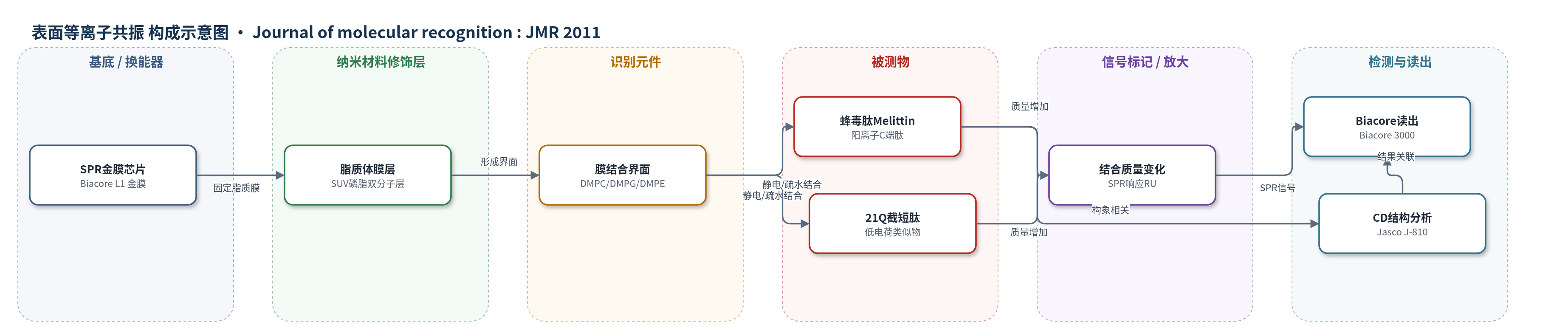
点击图片查看大图 · 依据论文自动绘制
传感器类型
表面等离子共振(SPR)生物传感器
检测对象
检测对象:melittin(蜂毒肽)、21Q(C端截短melittin类似物);样品基质:20 mM磷酸盐缓冲液(pH 7.4,可含150 mM NaCl)中的小单层脂质体/磷脂双分子层模型膜。
检测原理
SPR 芯片表面固定小单层脂质体磷脂双分子层,作为识别界面。将 melittin 或 21Q 注入流动池后,肽的 C 端阳离子残基先与膜表面发生静电吸引,随后疏水作用驱动肽插入或重排,使膜界面质量增加。结合质量改变局部折射率,引起表面等离子共振条件变化,Biacore 3000 以响应单位(RU)记录结合与解离曲线。melittin 因带正电尾,在低盐下出现快速初始结合和浓度阈值,高浓度响应更强;加入 150 mM NaCl 屏蔽静电后,结合随浓度更线性。21Q 缺少阳离子尾,初始静电结合减弱,结合更慢且对 DMPE/胆固醇膜选择性下降。未使用酶或核酸放大。
检测灵敏度
未报告 LOD、线性范围、灵敏度斜率、相关系数。
效应效果
选择性方面,melittin 在 DMPE 和 DMPE/DMPG 膜上响应高于 DMPC 膜,12 mM 时 DMPE 约 7000 RU、DMPE/DMPG 约 9000 RU;含 150 mM NaCl 时 10 mM melittin 在 DMPC、DMPC/DMPG、DMPE/DMPG 上分别约 6500、4000、3600 RU,说明 NaCl 屏蔽静电并改变选择性。21Q 在 DMPC 和 DMPC/DMPG 上 12 mM 时分别约 4800、3200 RU,而在 DMPC/DMPG/胆固醇、DMPE、DMPE/DMPG 上仅约 1000、800、800 RU,显示阳离子尾决定磷脂选择性。解离 600 s 后 melittin 约 50–70% 残留,21Q 大部分解离。CD 显示 melittin 在 DMPC/DMPG/胆固醇中 α 螺旋含量最高(51%),与较高结合相关。未报告 RSD、回收率或与 ELISA/HPLC/qPCR 对比。作者认为该结果有助于理解抗菌肽膜结合机制,并通过调节阳离子区优化膜选择性。
传感器的构成
- 基底/换能器:Biacore L1 传感器芯片(金膜 SPR 芯片),提供表面等离子共振换能表面。
- 清洗/预处理:20 mM CHAPS 清洗芯片,10 mM NaOH 处理脂质表面,去除多层结构并稳定基线。
- 识别/固定膜层:小单层脂质体(SUV,约 50 nm)磷脂双分子层,包括 DMPC、DMPC/DMPG、DMPC/DMPG/胆固醇、DMPE、DMPE/DMPG,作为膜识别界面。
- 分析物/识别对象:melittin 和 21Q 抗菌肽,通过 C 端阳离子残基与膜表面静电作用及疏水作用结合。
- 运行缓冲液:20 mM 磷酸盐缓冲液,pH 7.4,可含 150 mM NaCl,用于控制离子强度与静电屏蔽。
- 信号读出:Biacore 3000 SPR 系统,记录结合/解离传感器图(RU)。
- 辅助结构分析:Jasco J-810 圆二色仪,测定 melittin 在缓冲液和脂质体中的 α 螺旋含量。
中文摘要
本研究利用表面等离子共振(SPR)技术,考察蜂毒肽 melittin 及其 C 端截短类似物 21Q 与多种磷脂双分子层模型膜的结合行为。模型膜包括两性离子型二肉豆蔻酰磷脂酰胆碱(DMPC)和二肉豆蔻酰磷脂酰乙醇胺(DMPE),以及 DMPC/二肉豆蔻酰磷脂酰甘油(DMPG)、DMPC/DMPG/胆固醇和 DMPE/DMPG 混合物。结果显示,melittin 可快速结合所有膜混合物;而电荷降低的 21Q 在 DMPC 和 DMPC/DMPG 膜上结合明显变慢,说明初始静电相互作用的重要性。去除 C 端阳离子残基还显著降低 21Q 与 DMPC/DMPG/胆固醇、DMPE 和 DMPE/DMPG 膜的结合。缓冲液中 NaCl 的加入改变了 melittin 对不同膜的结合方式,使响应随浓度增加更均匀。SPR 结果与圆二色(CD)测定的肽构象相关联,较高 α 螺旋含量对应较高结合亲和力。结果表明,melittin C 端正电荷残基对膜结合至关重要,调节抗菌肽电荷可改变其对不同磷脂的选择性。
英文摘要
The binding of melittin and the C-terminally truncated analogue of melittin (21Q) to a range of phospholipid bilayers was studied using surface plasmon resonance (SPR). The phospholipid model membranes included zwitterionic dimyristylphosphatidylcholine (DMPC) and dimyristylphosphatidylethanolamine (DMPE), together with mixtures DMPC/dimyristylphosphatidylglycerol (DMPG), DMPC/DMPG/cholesterol and DMPE/DMPG. Melittin bound rapidly to all membrane mixtures, whereas 21Q, which has a reduced charge, bound much more slowly on the DMPC and DMPC/DMPG mixtures reflecting the role of the initial electrostatic interaction. The loss of the cationic residues also significantly decreased the binding of 21Q with DMPC/DMPG/Cholesterol, DMPE and DMPE/DMPG. The role of electrostatics was also highlighted with NaCl in the buffer, which affected the way melittin bound to the different membranes, causing a more uniform, concentration dependant increase in response. The biosensor results were correlated with the conformation of the peptides determined by circular dichroism analysis, which indicated that high α-helicity was associated with high binding affinity. Overall, the results demonstrate that the positively charged residues at the C-terminus of melittin play an essential role in membrane binding, that modulation of peptide charge influences selectivity of binding to different phospholipids and that manipulation of the cationic regions of antimicrobial peptides can be used to modulate membrane selectivity.