组成图示
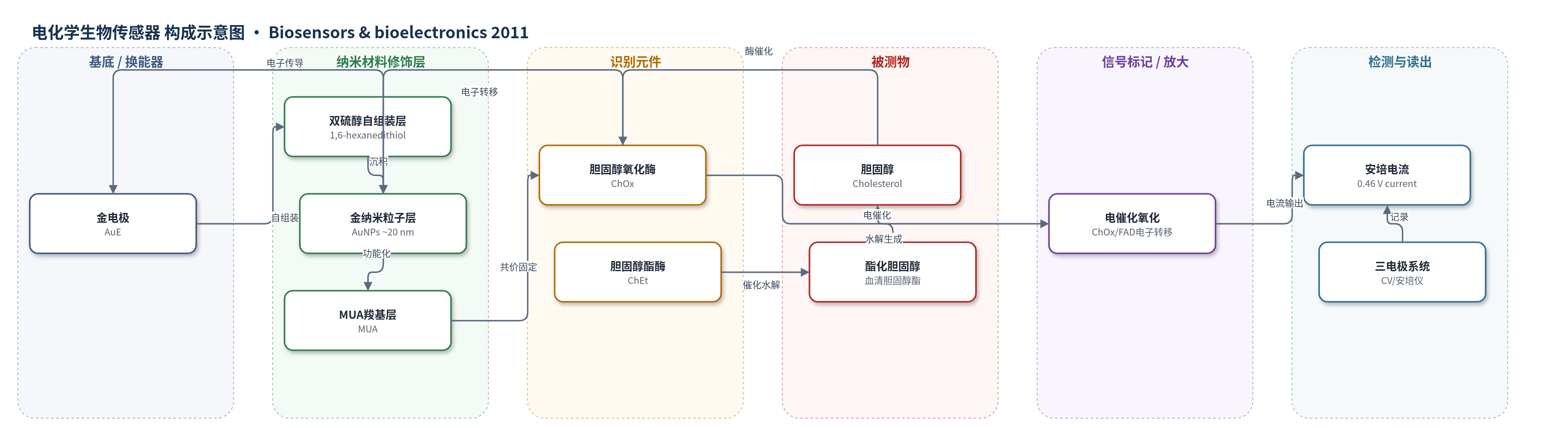
点击图片查看大图 · 依据论文自动绘制
传感器类型
电化学生物传感器
检测对象
胆固醇(cholesterol,总胆固醇);样品基质:人血清(human serum)、PBS缓冲液
检测原理
胆固醇进入生物电极后,被共价固定于金纳米粒子/羧基自组装层表面的胆固醇氧化酶(ChOx)识别并催化氧化。ChOx的FAD氧化还原中心与金纳米粒子及金电极之间发生直接电子转移,AuNPs作为电子导线并增大有效电极面积,提高酶负载和生物相容性,从而降低电子传递阻力。在0.46 V工作电位下,胆固醇催化氧化产生的电子转移使阳极电流随胆固醇浓度增加而线性增大。该体系未使用外源信号标记物,信号放大主要来自AuNPs的高比表面积、导电网络和对酶构象的保持;反应同时生成H2O2,但主要安培信号来自ChOx的电催化氧化。
检测灵敏度
LOD: 34.6 μM;线性范围: 0.04–0.22 mM;灵敏度斜率: 9.02 μA mM−1 (45.96 μA mM−1 cm−2);R^2 = 0.997
效应效果
该生物电极抗干扰性较好:0.2 mM胆固醇存在下,0.01 mM抗坏血酸、0.2 mM葡萄糖、0.01 mM尿酸、0.2 mM乳酸和0.2 mM尿素未显著影响响应;抗坏血酸和尿酸高于0.01 mM时电流增加,但样品稀释可消除干扰。0.2 mM胆固醇重复测定RSD为2.6%。连续30次测量后保持80%初始活性,4℃ PBS保存1个月后保留约95%响应。与商用CHOD-PAP试剂盒测定5份健康人血清比较,配对t检验P=0.920,无显著差异。AuNPs使酶负载由0.00098 U cm−2提高到0.0037 U cm−2,表观Km为0.062 mM,适合高灵敏稳定检测。
传感器的构成
- 基底电极:金电极(AuE,直径0.5 cm),作为工作电极和电子传导基底
- 双硫醇自组装层:1,6-己二硫醇(1,6-hexanedithiol)通过Au–S键修饰AuE,提供锚定位点并调控界面
- 金纳米粒子层:约20 nm柠檬酸稳定金纳米粒子(AuNPs)自组装沉积,增大有效表面积、提供生物相容微环境并作为电子导线
- 羧基功能化层:11-巯基十一烷酸(MUA)修饰AuNPs表面,引入羧基用于酶共价偶联
- 偶联活化层:EDC/NHS活化MUA羧基,形成活性酯以实现ChOx共价连接
- 识别元件:胆固醇氧化酶(ChOx,EC 1.1.3.6)共价固定于AuNPs/MUA表面,催化胆固醇氧化
中文摘要
本文提出一种金纳米粒子修饰胆固醇氧化酶生物电极的新制备方案,并研究其作为胆固醇生物传感器的应用潜力。制备过程包括:在1,6-己二硫醇修饰的金电极上沉积金纳米粒子,用11-巯基十一烷酸对金纳米粒子表面进行羧基功能化,再采用EDC/NHS偶联化学将胆固醇氧化酶共价固定于金纳米粒子膜表面。作者利用原子力显微镜、循环伏安法和电化学阻抗谱表征了生物电极的组装过程。金纳米粒子膜为酶提供了有利于电催化活性的界面环境,从而增强了分析响应。所得生物电极用于胆固醇的安培检测,在0.04–0.22 mM范围内呈线性响应,检出限为34.6 μM,表观米氏常数为0.062 mM,灵敏度为9.02 μA mM−1。该生物电极还可用于人血清样品中胆固醇的选择性测定。
英文摘要
A novel scheme for the fabrication of gold nanoparticle modified cholesterol oxidase based bioelectrode is presented and its application potential for cholesterol biosensor is investigated. The fabrication procedure is based on the deposition of gold nanoparticles on the 1,6-hexanedithiol modified gold electrode, functionalization of the surface of deposited gold nanoparticles with carboxyl groups using 11-mercaptoundecanoic acid and then covalent immobilization of cholesterol oxidase on the surface of gold nanoparticle film using the N-ethyl-N'-(3-dimethylaminopropyl carbodimide) and N-hydroxysuccinimide ligand chemistry. The assembly process of the bioelectrode is investigated using atomic force microscopy, cyclic voltammetry and electrochemical impedance spectroscopy. The gold nanoparticle film on the electrode surface provided an environment for the enhanced electrocatalytic activities and thus resulted in enhanced analytical response. The resulting bioelectrode is further applied to the amperometric detection of cholesterol and exhibited a linear response to cholesterol in the range of 0.04-0.22 mM with a detection limit of 34.6 μM, apparent Michaelis-Menten constant (K(m)(app)) of 0.062 mM and a high sensitivity of 9.02 μA mM(-1). The fabricated bioelectrode is successfully used for the selective determination of cholesterol in human serum samples.