组成图示
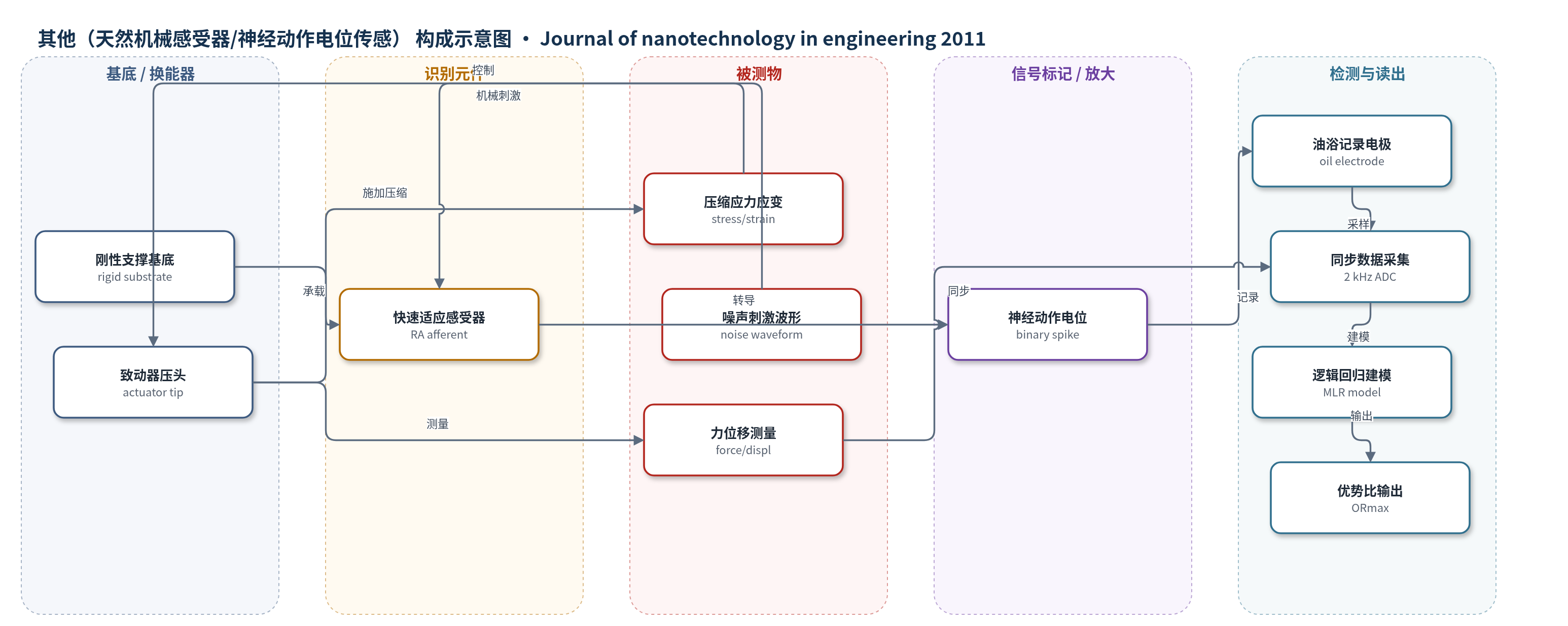
点击图片查看大图 · 依据论文自动绘制
传感器类型
其他(天然机械感受器/神经动作电位传感)
检测对象
压缩应力(compressive stress, σ)、压缩应变(compressive strain, ε)及其时间导数;样品基质为离体大鼠毛皮(rat hairy skin)/生理间质液
检测原理
致动器以伪随机或非重复噪声对离体大鼠毛皮施加动态压缩,形成应力、应变及其时间导数等机械输入。快速适应机械感受器作为识别与换能元件,其机械敏感通道和感受器囊将局部形变、应力及应力/应变速率转换为膜电位变化;当刺激超过阈值时产生二值动作电位。油浴电极记录动作电位,力/位移信号同步采集。随后将标准化后的应力、应变、导数及交互项作为协变量,以动作电位有无为二值输出,用最大似然估计拟合多变量逻辑回归,并计算优势比 OR。OR>1 表示该机械变量增加神经发放概率,ORmax 及其滞后时间反映受体对压缩刺激的选择性敏感。
检测灵敏度
原文未报告 LOD、线性范围、灵敏度斜率或相关系数。
效应效果
研究对 10 条大鼠毛皮快速适应传入神经、共 105 次试验进行压缩刺激,模型预测动作电位概率的最大误差为 8.6%。结果显示受体对压缩应力最敏感(平均最大 OR=26.10±87.81),其次为应力速率(15.03±44.74)、应变(12.01±31.46)和应变速率(7.29±18.23),最大 OR 通常出现在神经响应前约 7.3 ms;交互项 OR 接近 1 且不显著,说明主要敏感于应力/应变及其时间导数。方差分析显示刺激类型、控制方式、试验次数、供体大鼠和神经对最大 OR 有显著影响(p<0.05),刺激强度对最大 OR 不显著(p=0.0863)。作者认为该框架可表征生物纳米传感器并用于仿生触觉传感。
传感器的构成
- 基底/支撑层:刚性支撑基底(rigid support substrate)与塑料腔室,承载离体大鼠毛皮并维持生理环境
- 刺激/换能输入层:Aurora Scientific 300B 杠杆致动器(actuator)与圆形压头(4.2/16.6/34.2 mm^2),施加位移或力控制压缩刺激
- 识别/机械转导元件:大鼠毛皮快速适应机械感受器传入神经(RA afferents,Meissner/Pacinian 类),将压缩应力/应变转为动作电位
- 信号读出电极:油浴记录腔中的电极(oil-filled electrode),包裹微解剖神经纤维并记录动作电位
- 信号采集系统:2 kHz 采样、模数转换器(ADC)与自定义软件,同步采集力/位移与神经信号
- 统计建模层:多变量逻辑回归(MLR)模型,以应力、应变、时间导数及交互项预测二值神经响应并输出优势比(OR)
中文摘要
触觉是皮肤机械刺激产生的复杂感觉,其基本单元为皮肤机械感受器。本文旨在建立一种框架,将传入机械感受器在动态压缩载荷下的行为建模为纳米尺度生物传感器,并采用多变量回归技术进行表征。由于系统包含连续输入变量和对应神经动作电位的单一二值输出变量,作者选择多变量逻辑回归模型。该方法用于量化 10 条来自大鼠毛皮的快速适应传入神经对压缩应力、应变、各自时间导数及交互项的敏感性。体外实验中,使用伪随机和非重复噪声序列对离体传入神经施加压缩刺激,并通过多变量逻辑回归分析得到与机械转导相关的优势比(OR)。结果表明,皮肤机械感受器优先对应力(平均最大 OR 为 26.10)、应力速率(15.03)、应变(12.01)和应变速率(7.29)敏感,这些敏感事件通常发生在神经响应前约 7.3 ms 内。该分析框架作为受体表征的新方法,在多个输入、二值输出的神经系统中得到验证。
英文摘要
Tactile sensation is a complex manifestation of mechanical stimuli applied to the skin. At the most fundamental level of the somatosensory system is the cutaneous mechanoreceptor. The objective here was to establish a framework for modeling afferent mechanoreceptor behavior as a nanoscale biosensor under dynamic compressive loads using multivariate regression techniques. A multivariate logistical model was chosen because the system contains continuous input variables and a singular binary-output variable corresponding to the nerve action potential. Subsequently, this method was used to quantify the sensitivity of ten rapidly adapting afferents from rat hairy skin due to the stimulus metrics of compressive stress, strain, their respective time derivatives, and interactions. In vitro experiments involving compressive stimulation of isolated afferents using pseudorandom and nonrepeating noise sequences were completed. An analysis of the data was performed using multivariate logistical regression producing odds ratios (ORs) as a metric associated with mechanotransduction. It was determined that cutaneous mechanoreceptors are preferentially sensitive to stress (mean OR(max) = 26.10), stress rate (mean OR(max) = 15.03), strain (mean OR(max) = 12.01), and strain rate (mean OR(max) = 7.29) typically occurring within 7.3 ms of the nerve response. As a novel approach to receptor characterization, this analytical framework was validated for the multiple-input, binary-output neural system.