组成图示
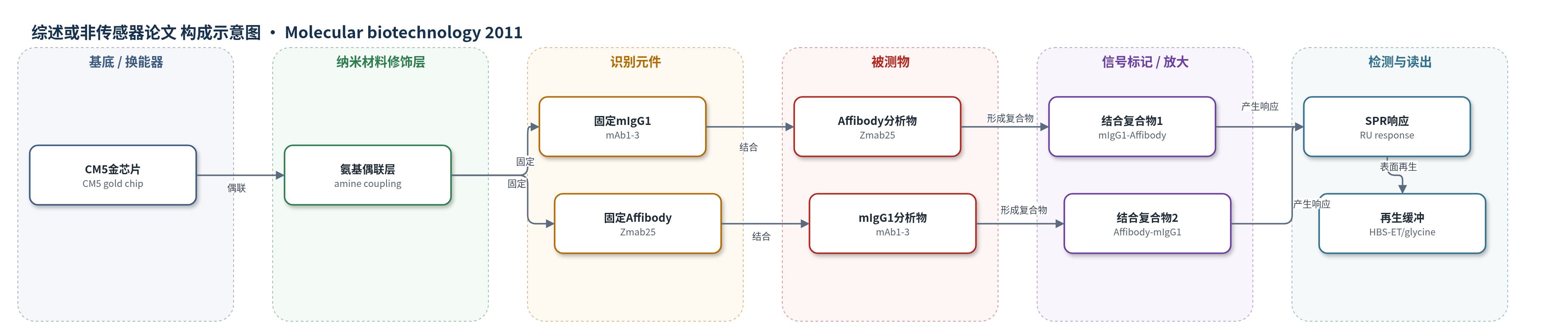
点击图片查看大图 · 依据论文自动绘制
传感器类型
综述或非传感器论文
检测对象
小鼠IgG1单克隆抗体(mouse IgG1 mAbs,mAb1/mAb2/mAb3/8F11/HDL110)、Affibody结合分子(Zmab22/Zmab25/Zmab22_25);样品基质:HBS-ET缓冲液、10% FBS模拟杂交瘤培养上清、亲和层析洗脱液。
检测原理
本文并非报道传感检测方法,但使用SPR生物传感器表征结合。CM5芯片经氨基偶联固定小鼠IgG1单抗或Affibody,注入分析物后,结合事件改变芯片表面质量与折射率,产生SPR响应(RU)。响应随分析物浓度增加而增大,按Langmuir 1:1模型拟合得到KD。Zmab25与小鼠IgG1 Fab CH1结合,且与SPG C2-C3竞争,提示表位功能重叠;对人IgG1、牛Ig及FBS无结合,因此可在含FBS样品中种属选择性捕获小鼠IgG1。无酶或信号放大,直接质量响应。
检测灵敏度
原文未报告LOD、线性范围、灵敏度斜率或相关系数。
效应效果
Zmab25对小鼠IgG1具有种属选择性:不结合人IgG1、牛Ig及10% FBS,仅在FBS中加入133 nM mAb3后出现SPR响应。SPG柱洗脱液同时含牛Ig和小鼠Ig,而Zmab25柱洗脱液仅与抗小鼠Ig表面结合,证明可从10% FBS中选择性回收mAb3和8F11。竞争实验显示100倍SPG C2-C3显著抑制、1000倍几乎完全阻断Zmab25结合。未报告RSD、稳定性或回收率百分比。作者认为其可替代蛋白G用于杂交瘤上清中小鼠IgG1纯化。
传感器的构成
- 非传感器说明:本文未报道传感器;SPR仅用于结合表征
- 基底/换能器:CM5金基SPR芯片,提供表面等离子共振检测界面
- 化学修饰层:氨基偶联化学(amine coupling),将mIgG1或Affibody固定于芯片表面
- 识别元件:小鼠IgG1单抗mAb1/mAb2/mAb3或Affibody Zmab25/Zmab22_25,用于结合分析物
- 信号标记物:无外源标记,结合质量直接产生SPR响应
- 缓冲/再生体系:HBS-ET缓冲液与0.1 M glycine-HCl再生液,维持结合与表面再生
中文摘要
识别抗体恒定区的亲和试剂在免疫技术中具有重要价值。本研究以小鼠IgG1(单克隆抗体的主要亚型)为目标,从10^11规模的组合核糖体展示Affibody文库中筛选新型结合分子。采用三种不同小鼠IgG1单克隆抗体作为交替靶标进行四轮筛选,获得具有广泛小鼠IgG1识别能力、解离常数处于低纳摩尔至低微摩尔范围的结合分子。其中Zmab25与链球菌蛋白G(SPG)片段在全长小鼠IgG1结合中发生竞争,并在木瓜蛋白酶切割后选择性捕获小鼠IgG1 Fab片段,提示其表位与SPG结合位点在CH1结构域功能重叠。基于生物传感器的结合实验显示,Zmab25不识别人IgG1或胎牛血清中的牛Ig。该选择性结合特性被用于从含FBS的复杂样品中种属特异性回收两种小鼠单克隆抗体,模拟杂交瘤培养上清。
英文摘要
Affinity reagents recognizing constant parts of antibody molecules are invaluable tools in immunotechnology applications, including purification, immobilization, and detection of immunoglobulins. In this article, murine IgG₁, the primary isotype of monoclonal antibodies (mAbs) was used as target for selection of novel binders from a combinatorial ribosome display (RD) library of 10¹¹ affibody molecules. Four rounds of selection using three different mouse IgG₁ mAbs as alternating targets resulted in the identification of binders with broad mIgG₁ recognition and dissociation constants (K(D)) in the low nanomolar to low micromolar range. For one of the binders, denoted Z(mab25), competition in binding to full length mIgG₁ by a streptococcal protein G (SPG) fragment and selective affinity capture of mouse IgG₁ Fab fragments after papain cleavage of a full mAb suggest that an epitope functionally overlapping with the SPG-binding site in the CH₁ domain of mouse IgG₁ had been addressed. Interestingly, biosensor-based binding experiments showed that neither human IgG₁ nor bovine Ig, the latter present in fetal bovine serum (FBS) was recognized by Z(mab25). This selective binding profile towards murine IgG₁ was successfully exploited in species selective recovery of two different mouse mAbs from complex samples containing FBS, resembling a hybridoma culture supernatant.