组成图示
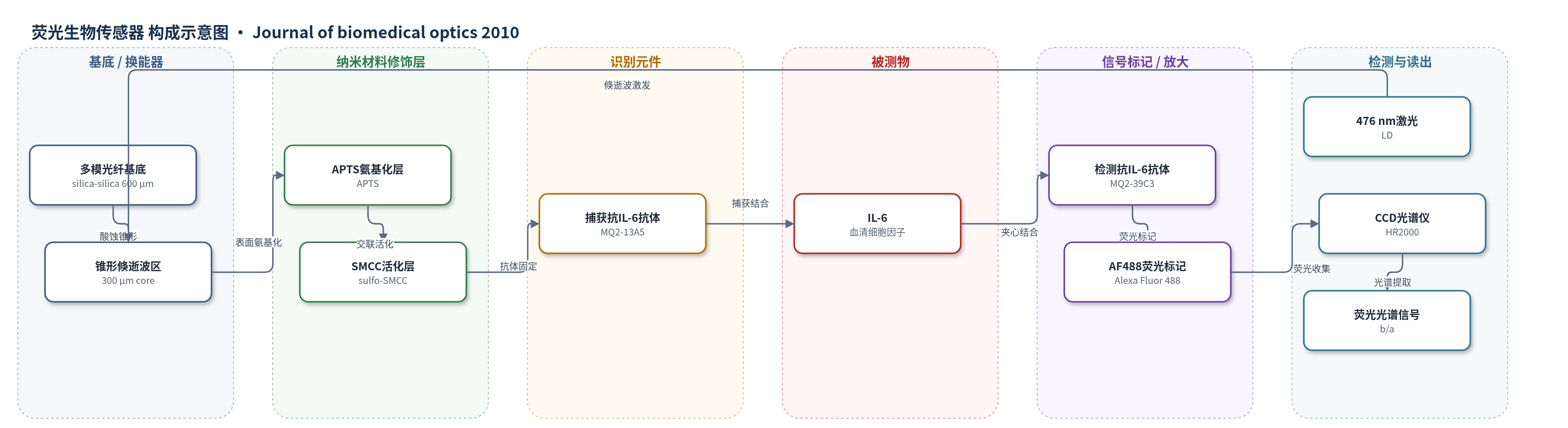
点击图片查看大图 · 依据论文自动绘制
传感器类型
荧光生物传感器
检测对象
白介素-6(interleukin-6, IL-6),样品基质:人血清(狼疮患者血清、淋巴瘤患者血清)
检测原理
探针表面先经APTS氨基化和sulfo-SMCC活化,再通过MEA还原的捕获抗IL-6抗体Fab端巯基定向固定。血清中的IL-6与捕获抗体结合后,加入AF488标记的检测抗IL-6抗体形成夹心复合物,使AF488靠近光纤表面。476 nm激光二极管激发光纤锥形区,倏逝波仅激发靠近表面的AF488,产生荧光并沿光纤传回CCD光谱仪。记录全谱后,用最小二乘拟合将总谱分解为背景自荧光fB(λ)和AF488特征荧光fFl(λ),以b/a作为归一化信号。IL-6浓度越高,结合的检测抗体越多,AF488特征荧光贡献越大,信号在5–150 pM内线性增加。
检测灵敏度
线性范围: 5–150 pM;R^2 = 0.9992;斜率: B = 0.00189 – 0.00003;可检测水平: 5 pM or higher with 100% specificity
效应效果
六根探针在100 pM IL-6下信号变异为12%(一个标准差)。标准曲线估算值与真实值接近,R^2=0.9992。1 nM IL-8、PBS及未固定捕获抗体的对照均无显著信号,选择性高。ROC分析31根探针,最大准确率97%、特异性83%;阈值0.01 a.u.时灵敏度100%,5 pM平均信号0.014±0.007 a.u.时特异性100%。狼疮血清测得5.9±0.6 pM(143±15 pg/ml),淋巴瘤低于检测限;xMAP为14.8±0.8 pM和0.50±0.07 pM,趋势一致但绝对值不同。作者认为可用于体液分析物快速、低成本检测。
传感器的构成
- 基底/换能器:600 μm silica-silica multimode fiber,经10% HF酸蚀形成300 μm锥形,产生倏逝波并传导荧光
- 表面氨基化层:APTS(3-aminopropyltriethoxysilane),在光纤表面引入伯胺
- 交联活化层:sulfo-SMCC,与胺反应形成马来酰亚胺基团,用于抗体定向偶联
- 识别元件:抗人IL-6捕获抗体(Clone MQ2-13A5),经MEA还原后通过Fab端巯基与马来酰亚胺结合,捕获IL-6
- 封闭/抗非特异吸附:EA(egg albumin),在PBS稀释缓冲液中抑制标记检测抗体非特异吸附
- 信号标记物:Alexa Fluor 488(AF488)标记抗人IL-6检测抗体(Clone MQ2-39C3),与捕获的IL-6结合产生荧光
- 光学读出组件:476 nm LD、滤光片与CCD光谱仪(HR2000),激发并记录AF488荧光
中文摘要
本文报道了一种用于血清样品中蛋白质快速、低成本定量的组合锥形光纤生物传感器(CTFOB)浸没探针。该器件采用二极管激光激发和电荷耦合器件(CCD)光谱仪,基于夹心免疫分析技术。作为原理验证,作者将其用于定量估算血清中的白介素-6(IL-6)。探针可在狼疮和淋巴瘤患者血清中检测皮摩尔水平的IL-6;狼疮样品中IL-6估算浓度为5.9±0.6 pM,淋巴瘤样品低于检测限。上述结果通过珠基xMAP技术验证,两种方法显示相似的浓度趋势。接收者操作特征(ROC)分析表明,该浸没探针能以100%特异性检测5 pM及以上浓度的IL-6。研究结果为进一步利用此类探针高特异、高灵敏地定量体液中其他分析物提供了依据。
英文摘要
A combination tapered fiber-optic biosensor (CTFOB) dip probe for rapid and cost-effective quantification of proteins in serum samples has been developed. This device relies on diode laser excitation and a charged-coupled device spectrometer and functions on a technique of sandwich immunoassay. As a proof of principle, this technique was applied in a quantitative estimation of interleukin IL-6. The probes detected IL-6 at picomolar levels in serum samples obtained from a patient with lupus, an autoimmune disease, and a patient with lymphoma. The estimated concentration of IL-6 in the lupus sample was 5.9 ± 0.6 pM, and in the lymphoma sample, it was below the detection limit. These concentrations were verified by a procedure involving bead-based xMAP technology. A similar trend in the concentrations was observed. The specificity of the CTFOB dip probes was assessed by analysis with receiver operating characteristics. This analysis suggests that the dip probes can detect 5-pM or higher concentration of IL-6 in these samples with specificities of 100%. The results provide information for guiding further studies in the utilization of these probes to quantify other analytes in body fluids with high specificity and sensitivity.