组成图示
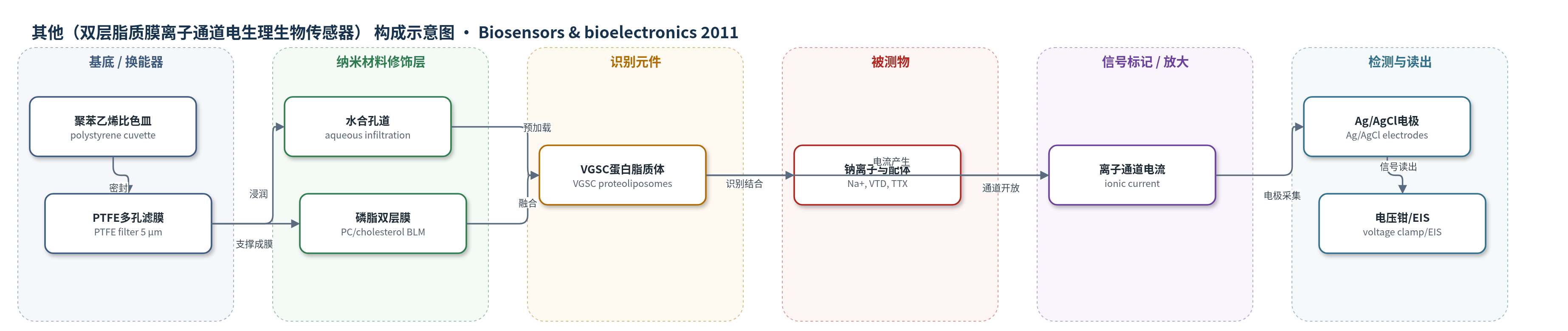
点击图片查看大图 · 依据论文自动绘制
传感器类型
其他(双层脂质膜离子通道电生理生物传感器)
检测对象
电压门控钠通道(VGSC)活性、钠离子(Na+)跨膜电流;样品基质:人工缓冲液(300 mM NaCl、10 mM HEPES,pH 7.4)
检测原理
该传感器以多孔PTFE支撑的BLM为功能界面。重组VGSC蛋白脂质体通过预加载或加入后与BLM融合,使通道蛋白嵌入磷脂双层;毒豆碱(VTD)结合并激活VGSC,Na+在施加电压下跨膜流动,形成离子电流;河豚毒素(TTX)结合通道后阻断电流。Ag/AgCl电极与电压钳将离子电流转换为电信号,EIS同时监测膜电阻和电容以判断膜完整性。信号大小取决于通道开放概率、Na+浓度和VTD/TTX作用;多孔PTFE预加载可提高蛋白脂质体融合效率,使多个通道同时开放,将pA级单通道/少量通道电流放大为nA级宏观电流。
检测灵敏度
—
效应效果
EIS显示BLM电容1.8±0.2 nF、电阻25.9±4.1 GΩ(n=20)。短杆菌肽使+80 mV电流30 min增加30%、2 h增加68%(n=4,p<0.05)。未预加载VGSC时,VTD使电流平均升高8.1倍,TTX恢复至接近对照;无蛋白脂质体与BLM单独响应相近(53.38±7.80 pA vs 56.36±7.11 pA,+80 mV,n=6)。预加载后平均电流10 nA,TTX在+80 mV抑制53±16%(n=4,p<0.001),幅度比直接加入高约100倍。重复使用比色皿后BLM电阻1.4±0.3 GΩ、电容0.47±0.06 nF(n=14),64%维持30 min、21%维持3 h,VTD使电流升高7.0倍且均被TTX抑制。可用于药物筛选、毒素检测和气味传感。
传感器的构成
- 基底/液室:聚苯乙烯半微量比色皿(polystyrene semi-micro spectrophotometric cuvettes),打孔1 mm,提供液室与机械支撑
- 多孔支撑膜:聚四氟乙烯(PTFE,Teflon)滤膜(孔径5.0 μm、厚125 μm、孔隙率60%),经真空水合浸润,支撑BLM并形成多孔通道
- 脂质双层膜:磷脂酰胆碱(PC)5% w/w与胆固醇(cholesterol)2% w/w溶于正辛烷(n-octane),涂覆于PTFE表面形成BLM,作为离子通道功能环境
- 识别/功能元件:重组电压门控钠通道(VGSC,hSkM1)蛋白,整合于蛋白脂质体中;短杆菌肽D(gramicidin D)用于验证BLM
- 蛋白脂质体:磷脂酰乙醇胺(PE)50 mg、PC 10 mg与胆固醇10 mg与VGSC重组,用于通道蛋白递送与预加载
- 电极/换能器:Ag/AgCl工作/参考电极与Pt对电极(EIS),或Ag/AgCl电极连接HEKA/Axon电压钳放大器,记录阻抗与离子电流
- 溶液/信号介质:300 mM NaCl、10 mM HEPES(pH 7.4)缓冲液提供Na+库;毒豆碱(VTD,100 μM)激活、河豚毒素(TTX,100 nM)抑制通道
中文摘要
许多离子通道蛋白具有毒素和药物结合位点,可作为高通量技术与生物传感器中的传感元件。测量离子通道电导变化需要稳健且寿命足够的生物膜。传统平面双层脂质膜(BLM)直径100–300 μm,通常只含少于十几个通道,而细胞药物筛选需记录多个离子通道电流。本文提出一种简单方法,利用水合聚四氟乙烯(PTFE,特氟龙)滤膜(孔径5 μm,滤膜直径1 mm)制备可抛弃多孔支撑BLM离子通道生物传感器。通过电化学阻抗谱监测脂质层厚度与机械稳定性,测得膜电容1.8±0.2 nF、膜电阻25.9±4.1 GΩ,表明形成脂质双层。加入短杆菌肽后电流升高;加入含电压门控钠通道的蛋白脂质体后可记录1–80 pA宏观钠电流。若在BLM形成前将钠通道蛋白脂质体预加载到多孔PTFE中,在毒豆碱存在下可记录1–10 nA电流,随时间增加并被河豚毒素抑制。缺乏整流提示通道以两种取向整合。该工作证明PTFE滤膜可支撑BLM,为离子通道保持功能活性提供环境,可用于药物发现、毒素检测和气味传感。
英文摘要
Many ion channel proteins have binding sites for toxins and pharmaceutical drugs and therefore have much promise as the sensing entity in high throughput technologies and biosensor devices. Measurement of ionic conductance changes through ion channels requires a robust biological membrane with sufficient longevity for practical applications. The conventional planar BLM is 100-300 μm in diameter and typically contains fewer than a dozen channels whereas pharmaceutical screening methods in cells use current recordings for many ion channels. We present a new, simple method for the fabrication of a disposable porous-supported bilayer lipid membrane (BLM) ion channel biosensor using hydrated Teflon (polytetrafluoroethylene, PTFE) filter material (pore size 5 μm, filter diameter=1 mm). The lipid layer was monitored for its thickness and mechanical stability by electrical impedance spectroscopy. The results showed membrane capacitances of 1.8±0.2 nF and membrane resistances of 25.9±4.1 GΩ, indicating the formation of lipid bilayers. The current level increased upon addition of the pore-forming peptide gramicidin. Following addition of liposomes containing voltage-gated sodium channels, small macroscopic sodium currents (1-80 pA) could be recorded. By preloading the porous Teflon with sodium channel proteoliposomes, prior to BLM formation, currents of 1-10 nA could be recorded in the presence of the activator veratridine that increased with time, and were inhibited by tetrodotoxin. A lack of rectification suggests that the channels incorporated in both orientations. This work demonstrates that PTFE filters can support BLMs that provide an environment in which ion channels can maintain their functional activity relevant for applications in drug discovery, toxin detection, and odour sensing.