组成图示
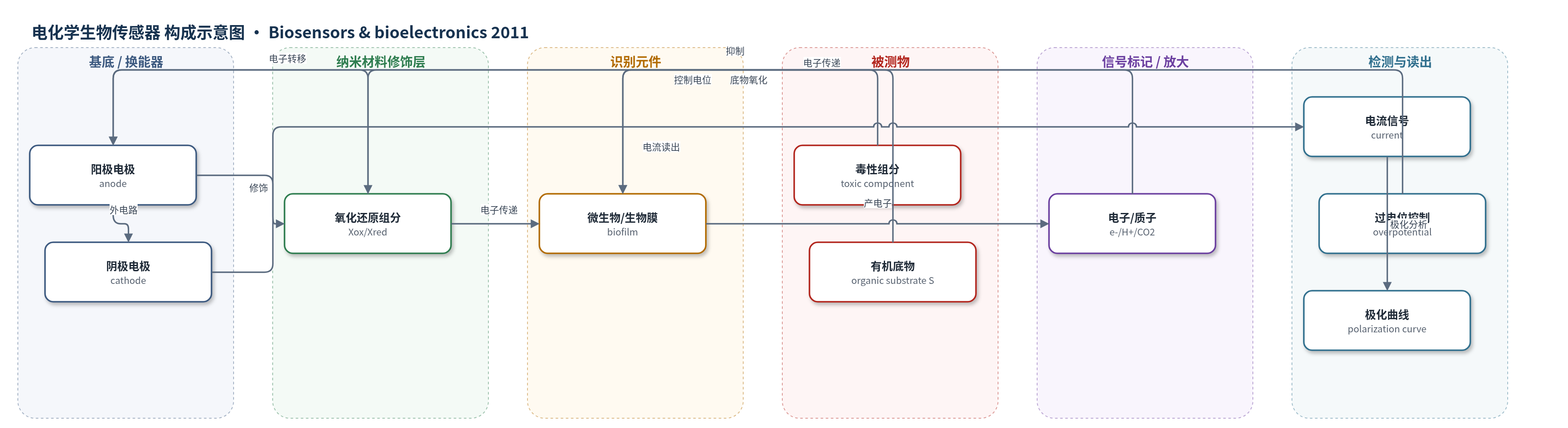
点击图片查看大图 · 依据论文自动绘制
传感器类型
电化学生物传感器
检测对象
毒性组分(toxic components,未指定具体化合物);样品基质:水样/水质(water)
检测原理
该传感器以微生物燃料电池为换能器:微生物/生物膜在阳极表面氧化有机底物,生成 CO2、质子和电子;电子经氧化还原组分(Xox/Xred)传递至阳极,再经外电路到达阴极,在阴极发生氧还原,形成可测电流。毒性组分进入后,通过非竞争/不可逆抑制、改变生化与电化学速率常数比 K1、改变正向/反向生化速率常数比 K2 或改变底物亲和常数 Km 等机制影响微生物代谢或电子传递,使电流下降。通过控制阳极过电位,使电流对毒性浓度的一阶导数 dI/dCi 最大,从而提高检测灵敏度;过电位同时影响基线稳定性和对参数漂移的稳健性。
检测灵敏度
灵敏度斜率: dI/dCi = 0.20 mA l/mmol(Itox, Ci=2 mM, 250 mV);dI/dCi = 1.60 mA l/mmol(Itox, Ci=0.1 mM, 250 mV);dI/dCi = 0.09 mA l/mmol(IK1, Ci=2 mM, 112 mV);dI/dCi = 0.13 mA l/mmol(IK1, Ci=0.1 mM, 105 mV);dI/dCi = 0.14 mA l/mmol(IK2, Ci=2 mM, 100 mV);dI/dCi = 0.33 mA l/mmol(IK2, Ci=0.1 mM, 76 mV);dI/dCi = 0.03 mA l/mmol(IKm, Ci=2 mM, 250 mV);dI/dCi = 0.04 mA l/mmol(IKm, Ci=0.1 mM, 250 mV)
效应效果
本文为模拟研究,未报告实际样品回收率、RSD 或方法对比。模拟显示不同毒性机制的最优过电位不同:Itox 与 IKm 在 250 mV 最敏感;IK1 在 112 mV(Ci=2 mM)或 105 mV(0.1 mM)最敏感;IK2 在 100 mV(2 mM)或 76 mV(0.1 mM)最敏感。IK1 对 K2 变化在 0 或 250 mV 最稳健,73 mV 最不稳健;对 S 变化在 120 mV 最不稳健,S=5 mM 时影响较小。若要求 dI/dCi≥0.1 mA/mmol/l 且 K2 影响≤0.002 mA/mmol/l,过电位宜控制在 118–140 mV。作者认为可用于水质毒性在线监测,但需结合极化曲线判断机制。
传感器的构成
- 换能器电极:阳极(anode)与阴极(cathode),阳极接收微生物电子,阴极发生氧还原并形成电流回路
- 生物识别层:微生物/生物膜(microorganism/biofilm),氧化有机底物并产生电子
- 电子传递介质:氧化还原组分(redox component, Xox/Xred),在微生物与阳极之间传递电子
- 反应底物:有机底物(organic substrate, S),被微生物氧化为 CO2、质子和电子
- 信号读出:电流/极化曲线(current/polarization curve),通过控制过电位读取毒性引起的电流变化
中文摘要
目前描述微生物燃料电池(MFC)极化曲线的模型未能表征毒性组分的影响。本文在生物电化学模型与酶抑制动力学结合的基础上,对用于毒性检测的 MFC 生物传感器极化曲线模型进行修正,以描述四种毒性作用类型。为获得稳定且高灵敏的传感器,需要控制阳极过电位。基于非毒性条件下的实验数据和参数值,对四个修正模型进行模拟,预测使传感器最敏感的过电位。结果表明,在给定参数下,将过电位控制在 250 mV 时,对影响整个细菌代谢或底物亲和常数 Km 的组分最敏感;控制在 105 mV 时,对影响生化与电化学速率常数比值 K1 的组分最敏感;控制在 76 mV 时,对影响正向与反向生化速率常数比值 K2 的组分最敏感。此外,还分析了传感器对毒性以外模型参数变化的稳健性,并以 IK1 模型为例给出灵敏度与稳健性的权衡。模拟条件下,将过电位控制在 118–140 mV 时,传感器对毒性组分敏感,同时对参数 K2 的变化具有稳健性。
英文摘要
Currently available models describing microbial fuel cell (MFC) polarization curves, do not describe the effect of the presence of toxic components. A bioelectrochemical model combined with enzyme inhibition kinetics, that describes the polarization curve of an MFC-based biosensor, was modified to describe four types of toxicity. To get a stable and sensitive sensor, the overpotential has to be controlled. Simulations with the four modified models were performed to predict the overpotential that gives the most sensitive sensor. These simulations were based on data and parameter values from experimental results under non-toxic conditions. Given the parameter values from experimental results, controlling the overpotential at 250 mV leads to a sensor that is most sensitive to components that influence the whole bacterial metabolism or that influence the substrate affinity constant (Km). Controlling the overpotential at 105 mV is the most sensitive setting for components influencing the ratio of biochemical over electrochemical reaction rate constants (K1), while an overpotential of 76 mV gives the most sensitive setting for components that influence the ratio of the forward over backward biochemical rate constants (K2). The sensitivity of the biosensor was also analyzed for robustness against changes in the model parameters other than toxicity. As an example, the tradeoff between sensitivity and robustness for the model describing changes on K1 (IK1) is presented. The biosensor is sensitive for toxic components and robust for changes in model parameter K2 when overpotential is controlled between 118 and 140 mV under the simulated conditions.