组成图示
点击图片查看大图 · 依据论文自动绘制
传感器类型
表面等离子共振(SPR)生物传感器
检测对象
合成RGDS(PO3H2)PA肽(P-RGD peptide)、o-磷酸-L-苏氨酸(P-Thr)、o-磷酸-L-丝氨酸(P-Ser);样品基质为H3PO4溶液(pH 1.8–3.0)及Milli-Q水。
检测原理
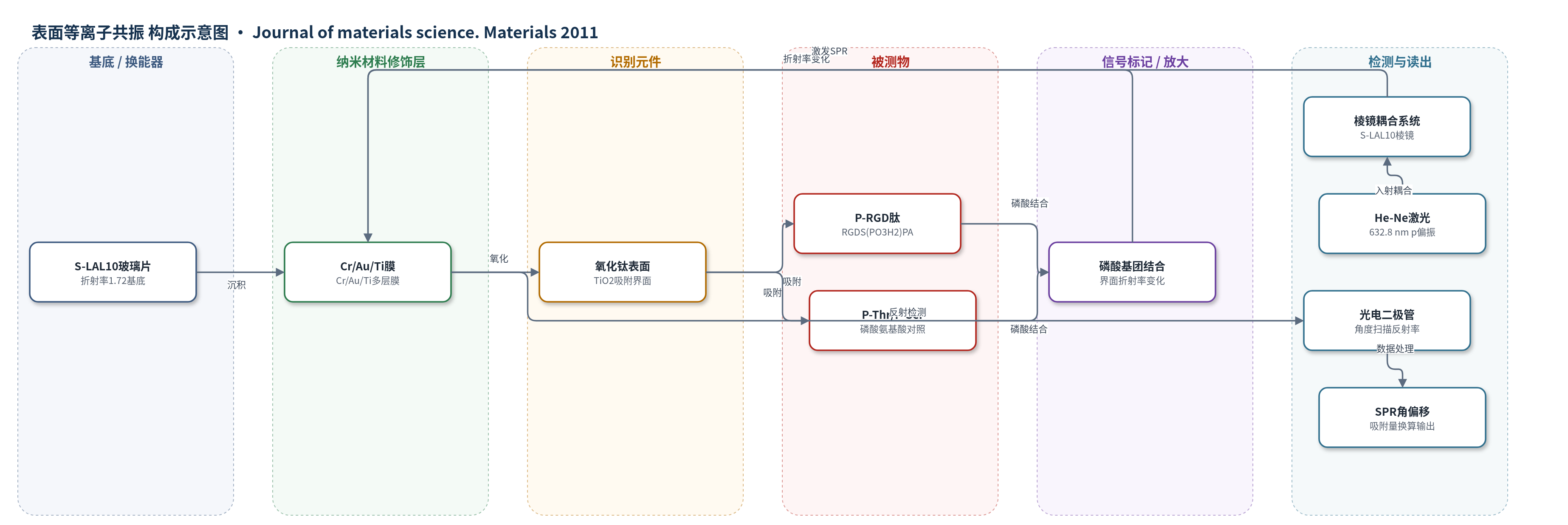
该传感器基于表面等离子共振(SPR)原理。He-Ne激光经棱镜耦合激发Au/Ti界面SPR,当P-RGD、P-Thr或P-Ser中的磷酸基团与氧化钛表面发生结合/解离时,传感层质量与折射率发生变化,导致SPR角偏移。由于TiO2零电荷点约5.6–5.8,低pH下表面带正电,磷酸基团带负电,二者通过静电与化学键合相互作用;pH越低,P-RGD吸附越强。以同pH H3PO4溶液为基线扣除蚀刻影响,用Fresnel多层模拟得到换算系数4.02 pg/mm2/mDa,将实际SPR角偏移转换为吸附量,从而实时反映被测物浓度与时间变化。
检测灵敏度
未报告LOD、线性范围、灵敏度斜率或相关系数;SPR角偏移换算系数: 4.02 (pg/mm2/mDa)
效应效果
该Ti-SPR传感器可实时监测磷酸化生物分子在氧化钛表面的吸附动力学,5次独立测量以均值±标准差表示。pH 2.0 P-Thr实际SPR角偏移32.7±12.8 mDa,吸附量131.5±62.9 pg/mm2;pH 1.9 P-Ser为36.6±9.8 mDa、146.9±48.3 pg/mm2,两者无显著差异。pH 3.0 P-RGD为35.7±22.3 mDa、143.3±109.9 pg/mm2;pH 1.9 P-RGD为128.6±40.1 mDa、517.1±197.4 pg/mm2,约为pH 3.0的3.6倍(P<0.05)。H3PO4在pH≤2.0时蚀刻氧化钛,pH 2.0、1.9、1.8厚度变化约20、50、120 pm。作者认为pH控制可促进含磷酸基团生物分子与钛表面稳定结合,适用于钛植入物表面修饰研究。
传感器的构成
- 基底:S-LAL10玻璃片(直径15.0 mm、厚1.0 mm、折射率1.72),作为SPR基底。
- 光学耦合层:S-LAL10等边三角棱镜(折射率1.72)与折射率匹配液(折射率1.72),用于耦合He-Ne激光并激发SPR。
- 粘附/导电层:1 nm Cr膜,电子束蒸发沉积于玻璃片表面,作为SPR金属层粘附/导电层。
- SPR金属层:49 nm Au传感层,沉积于Cr上,用于激发表面等离子共振。
- 传感界面层:5 nm Ti传感膜,沉积于Au上,形成氧化钛表面,作为肽吸附与蚀刻监测界面。
- 识别/吸附层:P-RGD肽(RGDS(PO3H2)PA,5 mM)或P-Thr/P-Ser磷酸氨基酸,通过磷酸基团与氧化钛表面结合/解离实现识别与固定。
- 信号读出:He-Ne激光(632.8 nm)、Gran-Thomson棱镜偏振、光电二极管角度扫描与计算机处理,输出SPR角偏移。
- 流路:SPR流池,Milli-Q水及H3PO4/P-Thr/P-Ser/P-RGD溶液以2.5 ml/min流动,实现吸附与清洗。
中文摘要
本研究旨在利用钛表面等离子共振(SPR)生物传感器测量合成RGDS(PO3H2)PA(P-RGD)肽与钛表面之间随时间变化的化学相互作用,并确定肽在表面的固定程度。采用基于Knoll方法的“单点”SPR仪器,以He-Ne激光实现生物分子吸附的纳米级检测。结果表明,氧化钛表面在接触pH≤2.0的H3PO4溶液时发生蚀刻;pH 1.9时P-RGD的吸附量约为pH 3.0时的3.6倍(P<0.05)。P-RGD通过磷酸功能基团的结合与解离机制自然吸附于氧化钛表面,且pH控制对P-RGD与表面相互作用具有重要作用。这些发现表明,pH控制可促进含磷酸功能基团的生物分子与钛表面的逐步结合。
英文摘要
The purpose of this study was to measure the time-dependent chemical interaction between synthetic RGDS(PO(3)H(2))PA (P-RGD) peptide and titanium surfaces using a titanium surface plasmon resonance (SPR) biosensor and to determine the degree of peptide immobilization on the surfaces. An SPR instrument for 'single-spot' analysis was used for nanometer-scale detection of biomolecular adsorption using a He-Ne laser light according to Knoll's method. The oxidized titanium surface was etched when exposed to H(3)PO(4) solutions with a pH of 2.0 or below. The amount of P-RGD adsorbed at pH 1.9 was approximately 3.6 times as much as that at pH 3.0 (P < 0.05). P-RGD naturally adsorbed on the oxidized titanium surface as a consequence of the bonding and dissociation mechanism of the phosphate functional group. Furthermore, the control of pH played a very important role in the interaction between P-RGD and the surface. These findings show that pH control may promote progressive binding of biomolecules with the phosphate functional group to the titanium surface.