组成图示
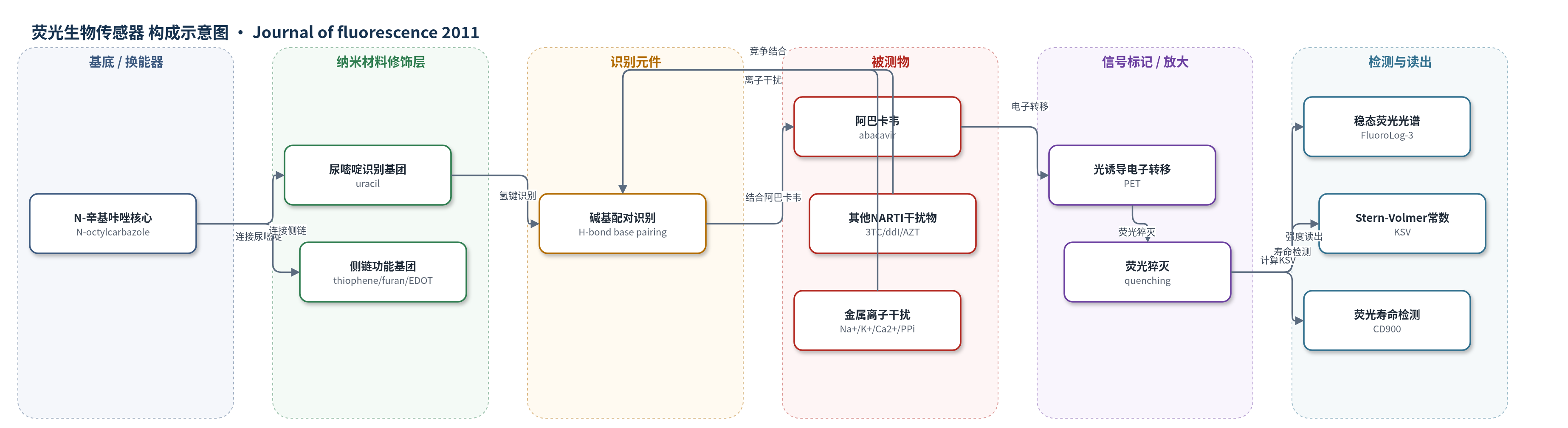
点击图片查看大图 · 依据论文自动绘制
传感器类型
荧光生物传感器
检测对象
阿巴卡韦(abacavir, ABC)、拉米夫定(lamivudine, 3TC)、双脱氧腺苷(didanosine, ddI)、齐多夫定(zidovudine, AZT);样品基质为 0.1 M HEPES 缓冲液(pH 7.4),文中关联人体体液/血浆药物浓度。
检测原理
N-辛基咔唑-尿嘧啶衍生物在 275 nm 或 350 nm 激发下产生荧光。尿嘧啶识别元件通过 Watson–Crick 或 Hoogsteen 氢键与阿巴卡韦中的鸟嘌呤碱基配对,形成 U1 的 1:1 或 U4 的 1:2 静态复合物。结合后发生光诱导电子转移(PET),阿巴卡韦作为电子供体/猝灭剂,咔唑作为电子受体,使荧光强度降低。猝灭效率用 Stern–Volmer 方程 I0/I=1+KSV[Q] 描述,KSV 随结合和电子转移效率增大。U4 双尿嘧啶对阿巴卡韦 KSV 最高(45.3×10^3 M^-1),猝灭强于单尿嘧啶衍生物 3–5 倍。荧光寿命基本不变,表明静态猝灭和基态复合物形成。信号随阿巴卡韦浓度增加而下降,可用于荧光检测。
检测灵敏度
LOD: 200 ng/ml (4.2 μM);表3 LOD [μg/ml]: 阿巴卡韦 U1 0.9、U2 2.1、U3 1.6、U4 0.2;拉米夫定 U1 2.7、U2 7.2、U3 4.5、U4 1.1;双脱氧腺苷 U1 3.5、U2 9.6、U3 5.5、U4 1.5;齐多夫定 U1 5.1、U2 12.3、U3 9.5、U4 1.9;Stern–Volmer 斜率(KSV)对阿巴卡韦:U1 18.3±0.3×10^3 M^-1、U2 9.5±0.1×10^3 M^-1、U3 13.2±0.2×10^3 M^-1、U4 45.3±0.7×10^3 M^-1。
效应效果
U4 对阿巴卡韦选择性最好,KSV 45.3±0.7×10^3 M^-1,较单尿嘧啶强 3–5 倍;对拉米夫定、双脱氧腺苷、齐多夫定 KSV 分别为 10.3±0.2、8.1±0.2、6.2±0.1×10^3 M^-1。150 mM Na+、K+、Ca2+、PPi 干扰仅引起约 10%、10%、18%、5% 的阿巴卡韦诱导猝灭,苯无影响。检测 0.1 mM 阿巴卡韦时,U4 可容忍拉米夫定 2.1±0.2 mM、双脱氧腺苷 3.2±0.5 mM、齐多夫定 5.5±1.1 mM。LOD 200 ng/mL 低于人体体液常见 500 ng/mL,作者认为可用于多分析物阵列和微流控平台。
传感器的构成
- 荧光传感分子核心:N-辛基咔唑(N-octylcarbazole)作为荧光发射单元,提供紫外吸收与可见荧光。
- 识别元件:尿嘧啶(uracil)基团通过 Watson–Crick/Hoogsteen 氢键识别阿巴卡韦中的鸟嘌呤。
- 侧链功能基团:噻吩(thiophene, U1)、呋喃(furan, U2)、亚乙基二氧噻吩(ethylenedioxythiophene, U3)或第二尿嘧啶(U4),调节溶解性、稳定性和猝灭效率。
- 溶液介质:0.1 M HEPES 缓冲液(pH 7.4),维持生理 pH 并作为荧光检测介质。
- 信号读出:稳态荧光光谱仪(FluoroLog-3)与单光子计数荧光寿命仪(CD900),读取荧光强度与寿命变化。
中文摘要
由于咔唑衍生物具有光学和电导特性,是生物传感器应用的有趣材料。本研究报道了新型咔唑荧光传感器的合成路线与荧光评估。通过尿嘧啶修饰,使传感器能够经 Watson–Crick 或 Hoogsteen 碱基配对对抗逆转录病毒药物产生特殊亲和力。在 N-辛基咔唑-尿嘧啶化合物上分别连接噻吩、呋喃、亚乙基二氧噻吩和另一个尿嘧啶,得到四种衍生物。文中描述了这些新衍生物的光物理性质,以及它们与逆转录酶抑制剂阿巴卡韦、齐多夫定、拉米夫定和双脱氧腺苷的相互作用。基于 Stern–Volmer 方程评估各分析物对生物传感器荧光的影响,并以 Stern–Volmer 常数表示。结果表明,含尿嘧啶的咔唑结构可成功并入其他咔唑衍生物,用于抗逆转录病毒药物的分子识别荧光传感。
英文摘要
Due to their optical and electro-conductive attributes, carbazole derivatives are interesting materials for a large range of biosensor applications. In this study, we present the synthesis routes and fluorescence evaluation of newly designed carbazole fluorosensors that, by modification with uracil, have a special affinity for antiretroviral drugs via either Watson-Crick or Hoogsteen base pairing. To an N-octylcarbazole-uracil compound, four different groups were attached, namely thiophene, furane, ethylenedioxythiophene, and another uracil; yielding four different derivatives. Photophysical properties of these newly obtained derivatives are described, as are their interactions with the reverse transcriptase inhibitors such as abacavir, zidovudine, lamivudine and didanosine. The influence of each analyte on biosensor fluorescence was assessed on the basis of the Stern-Volmer equation and represented by Stern-Volmer constants. Consequently we have demonstrated that these structures based on carbazole, with a uracil group, may be successfully incorporated into alternative carbazole derivatives to form biosensors for the molecular recognition of antiretroviral drugs.