组成图示
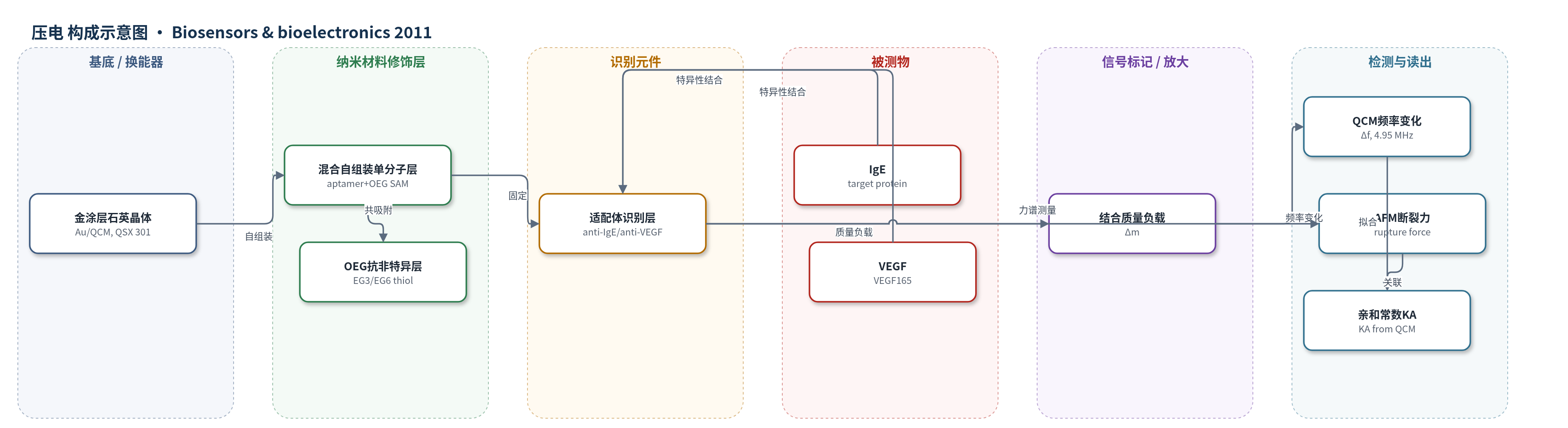
点击图片查看大图 · 依据论文自动绘制
传感器类型
压电(QCM)生物传感器
检测对象
免疫球蛋白E(IgE)、血管内皮生长因子(VEGF/VEGF165);样品基质为 PBS 缓冲液中的蛋白溶液
检测原理
传感器以金涂层石英晶体为基底,5′-硫醇化适配体通过 Au–S 键固定,并与 OEG 硫醇形成混合 SAM。目标蛋白 IgE 或 VEGF 与适配体结合后,界面质量增加,QCM 谐振频率下降;按 Sauerbrey 方程 Δf = −56.5×10⁻³ Δm/A,频率变化与结合质量成正比。平衡时 1/Δfe 与 1/C 线性相关,可拟合 KA,信号随浓度升高而增大。OEG 降低非特异吸附,短链 EG3 比长链 EG6 更利于适配体可及性;两步回填比一步共吸附覆盖更高。AFM 力谱测量单分子断裂力,验证不同固定策略下适配体生物物理性质基本一致。
检测灵敏度
LOD: <10 nM(IgE);灵敏度: 1 μg 质量负载约 72 Hz
效应效果
混合 SAM 降低非特异吸附,仅 OEG 对照频率变化远小于适配体传感器。IgE 体系中 A、B、C 的 KA 分别为 0.058±0.009、0.030±0.002、0.041±0.003 nM−1,均可检测 <10 nM。EG6 抗非特异较好但降低适配体可及性,EG3 更利于结合;两步回填覆盖更高,一步法 C 总结合量 80.9 ng,仅为 B 的 56%,结合事件比例 3.2%(B 27.5%、A 16.7%)。AFM 断裂力相近(64.1±0.9、64.0±2.9、61.7±0.7 pN),VEGF 体系 95.0±2.5 pN、KA 0.043 nM−1,接近 SPR 0.092 nM−1。作者认为可用于超灵敏传感与分子生物物理研究。
传感器的构成
- 基底/换能器:金涂层 AT 切石英晶体(Au-coated AT-cut quartz crystal, QSX 301),提供压电换能与 QCM 频率读出
- 修饰层:混合自组装单分子层(mixed SAM),由适配体硫醇与 OEG 硫醇组成,形成抗非特异蛋白吸附表面
- 识别元件:5′-硫醇化抗 IgE DNA 适配体(HS-C6-anti-IgE aptamer)或抗 VEGF DNA 适配体(HS-C6-anti-VEGF aptamer),通过 Au–S 键固定并识别目标蛋白
- 共吸附/封闭层:寡乙二醇硫醇 HS-C11-(EG)3OH(EG3)或 HS-C11-(EG)6OH(EG6),填充金表面空隙并抑制非特异蛋白吸附
- 信号标记物:无外源标记物,采用无标记 QCM 检测目标蛋白结合引起的质量变化
- 修饰策略:两步混合 SAM(先适配体自组装后 OEG 回填)或一步混合 SAM(适配体与 OEG 共吸附),控制适配体覆盖密度与可及性
中文摘要
为将适配体用作生物传感器和生物诊断中的分子识别元件,必须发展可靠的表面固定策略,使其保持生物物理特性与结合能力。本文报道了石英晶体微天平(QCM)测量和基于原子力显微镜(AFM)的力谱研究,用于评估采用不同修饰策略制备的适配体传感器。金表面用适配体硫醇与寡乙二醇(OEG)硫醇(HS-C11-(EG)nOH,n=3或6)形成混合自组装单分子层(SAM),以抑制非特异性蛋白吸附。亲和分析表明,短链 OEG 硫醇对适配体可及性的影响小于长链硫醇;在适配体固定后再用 OEG 回填,比一步共吸附形成混合 SAM 可获得更高表面覆盖。实验以免疫球蛋白 E(IgE)和血管内皮生长因子(VEGF)为目标蛋白。不同策略获得的结合力相近,说明传感器上适配体的生物物理性质与固定策略无关。结果表明,适配体与共同吸附剂构成的混合 SAM 是适配体传感器平台(包括超灵敏生物传感器设计)的通用策略。
英文摘要
To utilize aptamers as molecular recognition agents in biosensors and biodiagnostics, it is important to develop strategies for reliable immobilization of aptamers so that they retain their biophysical characteristics and binding abilities. Here we report on quartz crystal microbalance (QCM) measurements and atomic force microscope (AFM)-based force spectroscopy studies to evaluate aptasensors fabricated by different modification strategies. Gold surfaces were modified with mixed self assembled monolayers (SAMs) of aptamer and oligoethylene glycol (OEG) thiols (HS-C(11)-(EG)(n)OH, n=3 or 6) to impart resistance to nonspecific protein adsorption. By affinity analysis, we show that short OEG thiols have less impact on aptamer accessibility than longer chain thiols. Backfilling with OEG as a step subsequent to aptamer immobilization provides greater surface coverage than using aptamer and OEG thiol to form a mixed SAM in one-step. Immunoglobulin E and vascular endothelial growth factor (VEGF) were studied as target proteins in these experiments. Binding forces obtained by these strategies are similar, demonstrating that the biophysical properties of the aptamer on the sensors are independent from the immobilization strategy. The results present mixed SAMs with aptamers and co-adsorbents as a versatile strategy for aptamer sensor platforms including ultrasensitive biosensor design.