组成图示
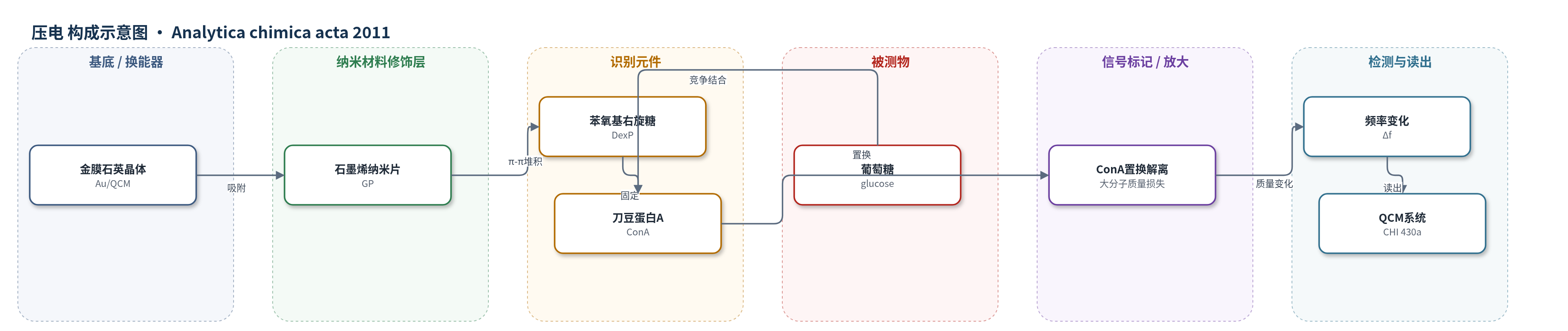
点击图片查看大图 · 依据论文自动绘制
传感器类型
压电(QCM)生物传感器
检测对象
葡萄糖(glucose, Glc);样品基质:蒸馏水、空白牛血清(生物流体/血清)
检测原理
该传感器采用葡萄糖/右旋糖置换模式。石墨烯纳米片(GP)修饰的金膜石英晶体表面先固定苯氧基衍生右旋糖(DexP),再结合刀豆蛋白 A(ConA)。检测时,溶液中的葡萄糖与表面 DexP 竞争结合 ConA 的糖结合位点;由于葡萄糖对 ConA 的亲和力高于右旋糖,葡萄糖将 ConA 从探针表面置换下来。ConA 分子量约 26.5 kDa,远大于葡萄糖(180.2 Da),因此少量葡萄糖即可引起较大表面质量损失。根据 Sauerbrey 方程,QCM 共振频率变化 Δf 与表面质量变化成正比,葡萄糖浓度越高,被置换的 ConA 越多,频率变化越大,从而在 0.01–7.5 mM 范围内实现线性响应。
检测灵敏度
LOD: 5.0 μM glucose (at 3σ);线性范围: 0.01–7.5 mM;灵敏度斜率: 31.19 Hz/mM;R^2 = 0.996
效应效果
该传感器表现出良好的重现性和选择性。对 0.05、0.1、1.0、3.0 和 6.0 mM 葡萄糖的重复测量 RSD 分别为 4.3%、3.9%、6.2%、4.8% 和 5.6%,均低于 6.2%。在抗干扰实验中,抗坏血酸(AA)、尿酸(UA)、牛血清白蛋白(BSA)和 4-乙酰氨基酚(AP)等干扰物未引起显著响应差异,RSD ≤9.0%。实际样品加标回收率方面,蒸馏水加标回收率为 92–115.3%,空白牛血清加标回收率为 113–160%。与文献中酶基和非酶基葡萄糖传感器相比,该传感器动态范围相对较窄,但检出限较低,且无需酶,可避免 pH 和温度对酶活性的影响,降低成本,适用于非常规生物流体中葡萄糖检测。
传感器的构成
- 基底/换能器电极:金膜石英晶体(Au/QCM),提供压电换能表面与导电基底
- 纳米材料修饰层:石墨烯纳米片(GP),吸附于金表面,提供高比表面积和 π–π 堆积固定位点
- 识别/固定层:苯氧基衍生右旋糖(DexP),通过 π–π 堆积组装于 GP 上,作为葡萄糖类似物并固定 ConA
- 识别元件:刀豆蛋白 A(ConA),通过右旋糖–ConA 相互作用固定于 DexP 上,作为糖结合识别蛋白
- 被测物:葡萄糖(glucose),与 DexP 竞争结合 ConA 并引起表面质量变化
- 信号读出:QCM 频率变化(Δf),由 CHI 430a 电化学石英晶体微天平系统检测
中文摘要
本文报道了一种基于葡萄糖/右旋糖置换模式的无酶石英晶体微天平(QCM)生物传感器,用于生物流体中葡萄糖的灵敏检测。该传感器以石墨烯包覆的 QCM 探针为传感平台,首先通过 π–π 堆积作用将苯氧基衍生右旋糖(DexP)组装到石墨烯表面,再利用右旋糖与刀豆蛋白 A(ConA)的特异性相互作用将 ConA 固定于 DexP 上。检测时,溶液中的葡萄糖与表面右旋糖竞争结合 ConA,并将 ConA 从探针表面置换下来,引起 QCM 共振频率变化。在优化条件下,频率变化与葡萄糖浓度呈线性关系,动态范围为 0.01–7.5 mM,检出限为 5.0 μM(3σ)。传感器的重现性和选择性相对标准偏差分别低于 6.2% 和 9.0%。在蒸馏水和空白牛血清加标样品中,检测结果与参考值具有良好相关性,表明该无酶 QCM 传感器可用于生物流体中葡萄糖检测。
英文摘要
A sensitive and facile quartz crystal microbalance (QCM) biosensor for glucose detection in biological fluids was developed by means of a displacement-type assay mode between glucose and its analogy dextran for concanavalin A (ConA) binding sites on a graphene-based sensing platform. To construct such a displacement-based sensor, phenoxy-derived dextran (DexP) molecules were initially assembled onto the surface of graphene-coated QCM probe via π-π stacking interaction, and ConA molecules were then immobilized on the dextran through the dextran-ConA interaction. Upon addition of glucose, the analyte competed with the dextran for the ConA, and displaced it from the QCM probe, leading to a change in the frequency. Under optimal conditions, the frequency change relative to the basic resonant frequency was proportional to glucose concentration, and exhibited a dynamic range from 0.01 to 7.5 mM with a low detection limit (LOD) of 5.0 μM glucose (at 3σ). The relative standard deviations (RSDs) were below 6.2% and 9.0% for the reproducibility and selectivity of the QCM glucose sensors, respectively. In addition, the assay system was evaluated with glucose spiking samples into the distilled water and blank cattle serum, receiving in excellent correlation with the referenced values.