组成图示
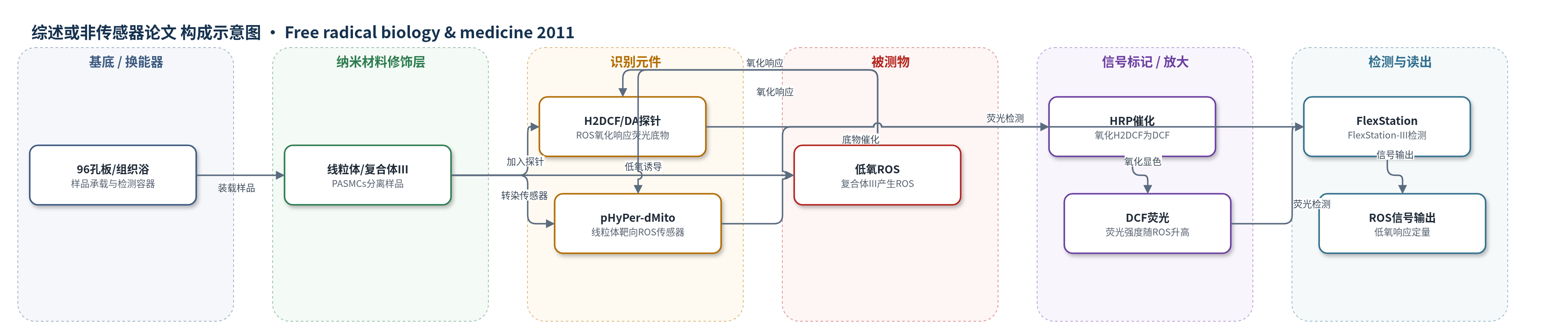
点击图片查看大图 · 依据论文自动绘制
传感器类型
综述或非传感器论文
检测对象
活性氧(ROS,reactive oxygen species);样品基质:肺动脉平滑肌细胞(PASMCs)、分离线粒体、分离复合体III、离体肺动脉
检测原理
低氧暴露使肺动脉平滑肌细胞线粒体复合体III活性增强,Rieske铁硫蛋白参与泛醌循环电子传递,泛半醌/泛醌中间体更易泄漏电子给氧,生成超氧等ROS。ROS作为被测物进入或作用于检测体系:H2DCF/DA被ROS氧化为H2DCF,HRP进一步催化其氧化为荧光DCF,荧光强度随ROS浓度升高;pHyPer-dMito靶向线粒体内膜,其荧光团被ROS氧化后双激发荧光比改变,从而反映线粒体ROS水平。该体系无电极换能,主要依靠荧光探针/基因编码传感器的氧化还原响应和HRP催化放大,由分光光度计/荧光检测器读出。
检测灵敏度
原文未报告 LOD、线性范围、灵敏度斜率或相关系数。
效应效果
原文未报告LOD、线性范围、RSD或回收率。选择性方面,pHyPer-dMito靶向线粒体内膜,外源H2O2可浓度依赖增强HyPer信号;siRNA沉默Rieske铁硫蛋白使其表达下降约90%,并完全阻断低氧诱导的复合体III、线粒体和细胞ROS增加,同时将低氧[Ca2+]i升高从671.0±35.5 nM降至173.3±9.7 nM,显著抑制离体肺动脉低氧血管收缩(HPV)。过表达Rieske铁硫蛋白则增强低氧ROS与复合体III活性。低氧不改变线粒体ATP产生和呼吸活性,提示ROS信号独立于耗氧/ATP下降。作者认为Rieske铁硫蛋白是低氧ROS产生的关键初级分子,为肺动脉高压机制提供新证据。
传感器的构成
- 样品基质层:分离的肺动脉平滑肌细胞(PASMCs)、线粒体或复合体III,作为低氧响应与ROS来源。
- 识别/响应元件:二氯二氢荧光素二乙酸酯(H2DCF/DA)或pHyPer-dMito基因编码ROS生物传感器,响应ROS/H2O2并产生荧光变化。
- 信号催化层:辣根过氧化物酶(HRP),在H2DCF/DA体系中催化H2DCF氧化为荧光DCF。
- 读出层:FlexStation-III分光光度计/荧光检测器,测量485/532 nm或420/500 nm激发下的荧光/吸光度变化。
中文摘要
本研究旨在确定:(1)低氧能否直接影响肺动脉平滑肌细胞(PASMCs)分离线粒体和线粒体复合体III的活性氧(ROS)产生;(2)复合体III中的Rieske铁硫蛋白是否介导低氧ROS产生并导致低氧肺血管收缩(HPV)。数据首次表明,以标准ROS指示剂二氯二氢荧光素二乙酸酯(H2DCF/DA)测定,低氧显著增强PASMCs分离线粒体的ROS产生。使用新开发特异性ROS生物传感器pHyPer的研究也发现,低氧增加分离PASMCs的线粒体ROS生成。在分离复合体III中也观察到低氧ROS产生。siRNA沉默Rieske铁硫蛋白可消除分离肺动脉平滑肌复合体III、线粒体和细胞中的低氧ROS形成,而过表达则产生相反效应。Rieske铁硫蛋白沉默抑制PASMCs低氧诱导的胞内钙升高和离体肺动脉低氧血管收缩。这些发现提供新证据,表明线粒体是PASMCs中低氧的直接靶点,其中复合体III的Rieske铁硫蛋白可能是介导低氧ROS生成、导致PASMCs胞内钙升高和HPV的关键初级分子。
英文摘要
This study was designed to determine whether: (1) hypoxia could directly affect ROS production in isolated mitochondria and mitochondrial complex III from pulmonary artery smooth muscle cells (PASMCs) and (2) Rieske iron-sulfur protein in complex III might mediate hypoxic ROS production, leading to hypoxic pulmonary vasoconstriction (HPV). Our data, for the first time, demonstrate that hypoxia significantly enhances ROS production, measured by the standard ROS indicator dichlorodihydrofluorescein/diacetate, in isolated mitochondria from PASMCs. Studies using the newly developed, specific ROS biosensor pHyPer have found that hypoxia increases mitochondrial ROS generation in isolated PASMCs as well. Hypoxic ROS production has also been observed in isolated complex III. Rieske iron-sulfur protein silencing using siRNA abolishes the hypoxic ROS formation in isolated PASM complex III, mitochondria, and cells, whereas Rieske iron-sulfur protein overexpression produces the opposite effect. Rieske iron-sulfur protein silencing inhibits the hypoxic increase in [Ca(2+)](i) in PASMCs and hypoxic vasoconstriction in isolated PAs. These findings together provide novel evidence that mitochondria are the direct hypoxic targets in PASMCs, in which Rieske iron-sulfur protein in complex III may serve as an essential, primary molecule that mediates the hypoxic ROS generation, leading to an increase in intracellular Ca(2+) in PASMCs and HPV.