组成图示
点击图片查看大图 · 依据论文自动绘制
传感器类型
化学发光生物传感器
检测对象
葡萄糖(glucose, Glc)、尿酸(uric acid, UA);样品基质:人工尿液(artificial urine),Tris-HCl 缓冲液(TBS)配制。
检测原理
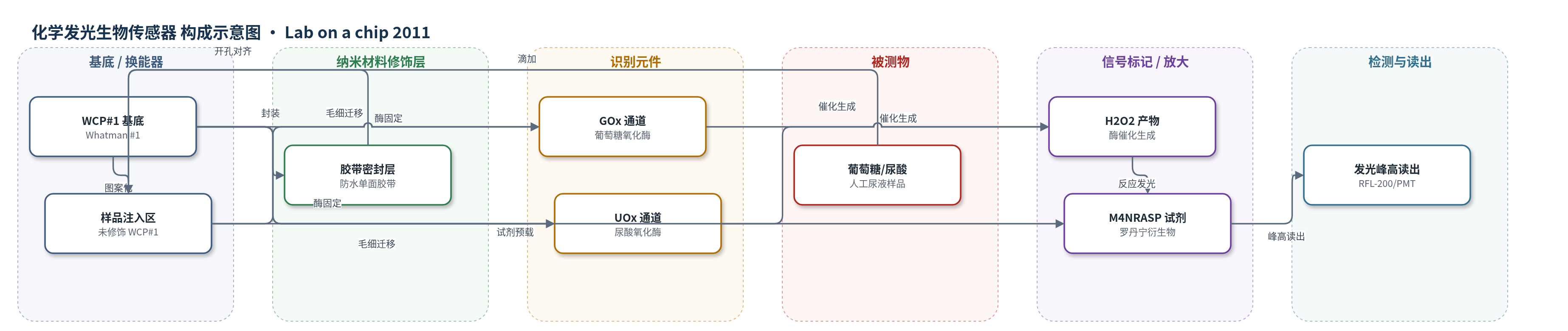
样品滴加到纸基注入区后,依靠 WCP#1 毛细作用沿两条不同长度的生物活性通道迁移。葡萄糖通道上的 GOx 催化葡萄糖氧化并生成 H2O2,尿酸通道上的 UOx 催化尿酸氧化并生成 H2O2。生成的 H2O2 随缓冲液继续迁移至预载 M4NRASP 的化学发光检测区,在 TBS(pH 6.4)介质中与 M4NRASP 发生化学发光反应。发光峰高与进入检测区的 H2O2 量成正比,而 H2O2 量又取决于样品中葡萄糖或尿酸浓度,因此可实现定量。两条通道迁移距离不同,使葡萄糖和尿酸的发光峰在时间上分离,从而在同一装置上同步测定。
检测灵敏度
LOD: 0.14 mmol L−1(葡萄糖)、0.52 mmol L−1(尿酸);线性范围: 0.42–50 mmol L−1(葡萄糖)、1.4–47 mmol L−1(尿酸)
效应效果
在 TBS 中,11 次重复测定的相对标准偏差低于 2.4%(葡萄糖)和 2.6%(尿酸);对人工尿液中 15.0 mmol L−1 葡萄糖/尿酸连续 11 次测定,RSD 为 8.9%。装置在 4 °C 密封干燥保存 10 周后酶和发光试剂仍保持良好性能。人工尿液中乳酸和柠檬酸在正常水平下对葡萄糖/尿酸响应的影响为 3–8%,其他成分无明显干扰。原文未报告加标回收率,也未与 ELISA、HPLC 或 qPCR 等方法直接对比。作者认为该 mPCAD 成本低、样本量小、操作简便、可便携使用,适合即时检测。
传感器的构成
- 基底/微流控载体:Whatman 色谱纸 #1(WCP#1),提供多孔纤维素通道并依靠毛细作用输送样品。
- 图案化/密封层:防水单面胶带(single-sided adhesive tape),上下夹持 WCP#1 形成水密通道,顶部胶带激光切割出样品注入孔。
- 样品注入区:未修饰 WCP#1,用于滴加 30 μL 样品并启动毛细迁移。
- 识别/催化元件(葡萄糖通道):葡萄糖氧化酶(GOx),物理吸附于 WCP#1 生物活性通道,催化葡萄糖生成 H2O2。
- 识别/催化元件(尿酸通道):尿酸氧化酶(UOx),物理吸附于 WCP#1 生物活性通道,催化尿酸生成 H2O2。
- 信号标记/发光试剂:罗丹宁衍生物 M4NRASP(3-p-nitrylphenyl-5-(40-methyl-20-sulfonophenylazo) rhodanine),预载于化学发光检测区,与 H2O2 反应发光。
- 反应介质:Tris-HCl 缓冲液(TBS,pH 6.4),作为样品载体和酶/化学发光反应介质。
- 读出装置:超微弱发光分析仪(RFL-200)及光电倍增管(PMT),采集化学发光峰高。
中文摘要
本研究设计了一种新型微流控纸基化学发光分析装置(mPCAD),可同步、快速、灵敏且定量地检测葡萄糖和尿酸。该纸基实验室生物传感器基于氧化酶反应(葡萄糖氧化酶 GOx 和尿酸氧化酶 UOx)以及罗丹宁衍生物与酸性介质中生成的过氧化氢之间的化学发光反应。文中解释了 mPCAD 可能的化学发光检测原理,并发现通过改变葡萄糖和尿酸样品在纸基上迁移的距离,可实现两者的同时测定。该纸基生物传感器在 4 °C 密封干燥保存至少 10 周后仍可提供可重复结果。随后在人工尿液中成功同步测定葡萄糖和尿酸。研究表明,mPCAD 与化学发光方法的结合是一种易于使用、低成本、便携的即时检测替代方案。
英文摘要
In this study, a novel microfluidic paper-based chemiluminescence analytical device (μPCAD) with a simultaneous, rapid, sensitive and quantitative response for glucose and uric acid was designed. This novel lab-on-paper biosensor is based on oxidase enzyme reactions (glucose oxidase and urate oxidase, respectively) and the chemiluminescence reaction between a rhodanine derivative and generated hydrogen peroxide in an acid medium. The possible chemiluminescence assay principle of this μPCAD is explained. We found that the simultaneous determination of glucose and uric acid could be achieved by differing the distances that the glucose and uric acid samples traveled. This lab-on-paper biosensor could provide reproducible results upon storage at 4 °C for at least 10 weeks. The application test of our μPCAD was then successfully performed with the simultaneous determination of glucose and uric acid in artificial urine. This study shows the successful integration of the μPCAD and the chemiluminescence method will be an easy-to-use, inexpensive, and portable alternative for point-of-care monitoring.