组成图示
点击图片查看大图 · 依据论文自动绘制
传感器类型
比色生物传感器
检测对象
炭疽保护抗原 PA63(protective antigen, PA;Bacillus anthracis PA);样品基质为 HEPES 缓冲液中的重组 PA63 蛋白、牛血清白蛋白(BSA)和牛血清对照。
检测原理
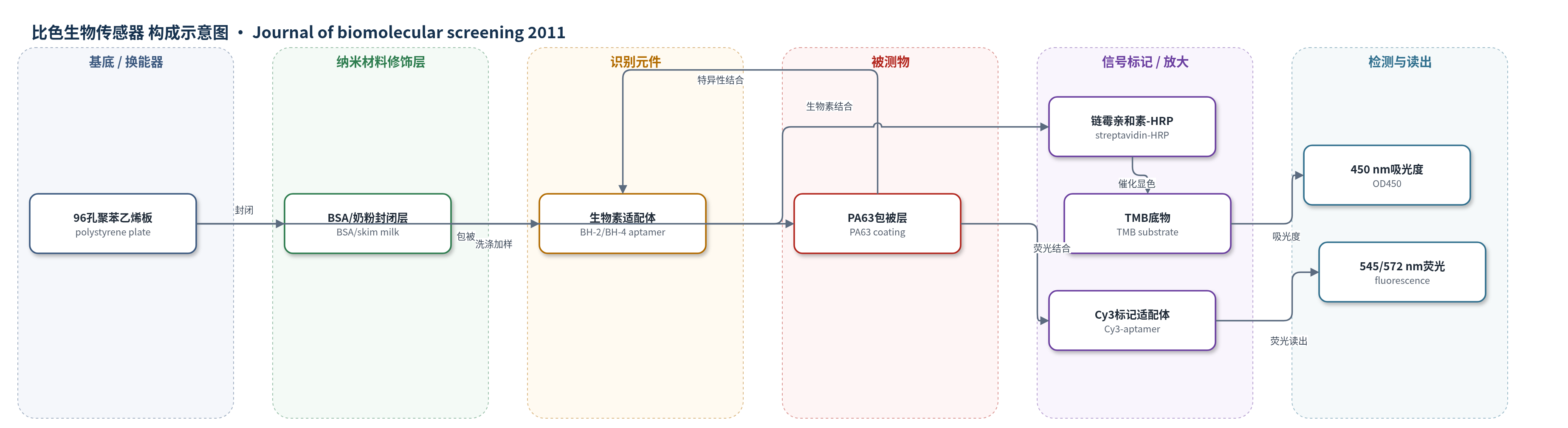
检测以 PA63 蛋白包被于 96 孔聚苯乙烯板或黑色免疫板开始,经 BSA 或脱脂奶粉封闭后,加入生物素标记 ssDNA 适配体。适配体与 PA63 发生特异性识别结合,未结合适配体经洗涤去除。比色 ELISA 中,链霉亲和素-HRP 通过生物素-链霉亲和素作用结合适配体,HRP 催化 TMB 氧化显色,加入 1 M H2SO4 终止反应,450 nm 吸光度随 PA63-适配体结合量增加而升高。荧光法中,Cy3 标记适配体结合 PA63 后,545 nm 激发、572 nm 发射的荧光强度随结合量增加。Kd 由饱和结合曲线非线性拟合获得。该方法未使用 HCR、RCA 等核酸放大策略,主要依赖适配体识别和酶催化显色/荧光标记。
检测灵敏度
Kd (fluorophotometry): BH-1 38.17 ± 31.6 nM;BH-2 8.52 ± 4.3 nM;BH-3 1.30 ± 1.4 nM;BH-4 1.75 ± 0.3 nM;Kd (ELISA): BH-2 126.87 ± 3.6 nM;BH-3 18.06 ± 18.8 nM;BH-4 135.17 ± 4.4 nM;8-mer Kd: 1.99 ± 1.5 nM
效应效果
4 个适配体均呈纳摩尔级亲和力,荧光法 Kd:BH-1 38.17±31.6 nM、BH-2 8.52±4.3 nM、BH-3 1.30±1.4 nM、BH-4 1.75±0.3 nM;ELISA 法 Kd 较高:BH-2 126.87±3.6 nM、BH-3 18.06±18.8 nM、BH-4 135.17±4.4 nM,作者归因于额外 HRP-链霉亲和素步骤。特异性上,BH-1 和 BH-3 对 BSA 与牛血清结合接近 PA63,而 BH-2 和 BH-4 对 BSA 选择性优异,对牛血清也较好。5% 脱脂奶粉和无标记适配体对照无明显信号。8-mer Kd 1.99±1.5 nM,但对 BSA 无选择性,对 PA63 仅比牛血清蛋白高约 2 倍。作者认为适配体 ELISA 可替代抗体,克服抗体不稳定问题,用于炭疽 PA 检测。
传感器的构成
- 固相载体:96孔聚苯乙烯板/黑色免疫板(polystyrene plate/black immunoplate),提供 PA63 包被与洗涤表面。
- 捕获抗原层:PA63(炭疽保护抗原 C 端片段),包被于孔壁,作为目标蛋白/捕获抗原。
- 封闭层:2% BSA 或 5% 脱脂奶粉(skim milk),封闭非特异结合位点。
- 识别元件:生物素标记 ssDNA 适配体(biotinylated ssDNA aptamer,BH-1 至 BH-4,优选 BH-2/BH-4),特异性结合 PA63。
- 信号标记物:链霉亲和素-HRP(streptavidin-HRP),结合生物素适配体并催化 TMB 显色。
- 底物:TMB(3,3′,5,5′-tetramethylbenzidine),HRP 催化生成有色产物。
- 终止剂:1 M H2SO4,终止 TMB 显色反应。
- 读出:Biotrak 多微孔板读数仪(multiwell plate reader),450 nm 吸光度;荧光法用 Gemini EM 微孔板读数仪,545/572 nm。
中文摘要
炭疽杆菌(Bacillus anthracis)分泌的保护抗原(protective antigen, PA)是重要的毒力因子,也被选作细菌感染检测的生物标志物。本研究采用系统进化指数富集(SELEX)技术,从随机单链 DNA 文库中筛选能紧密结合 PA63 的寡核苷酸适配体。经过 8 轮体外筛选,获得 4 个含 30 个碱基序列的 ssDNA 适配体(BH-1 至 BH-4)。以 Cy3 标记适配体并通过荧光光度法测定解离常数(Kd),结果显示 4 个适配体均具有纳摩尔级亲和力,其中 BH-2、BH-3 和 BH-4 为低纳摩尔范围。作者进一步建立基于适配体的酶联免疫吸附试验(ELISA)方法,用生物素标记适配体、链霉亲和素-HRP 和 TMB 显色可视化 PA63 结合,证实该方法在纳摩尔 Kd 范围内可行。特异性测试表明,BH-2 和 BH-4 对牛血清白蛋白和牛血清具有较好的 PA 选择性。研究展示了寡核苷酸生物传感器在特定蛋白标志物疾病诊断中的应用潜力。
英文摘要
The protective antigen (PA) of Bacillus anthracis is a secreted protein that functions as a critical virulence factor. Protective antigen has been selected as a biomarker in detecting bacterial infection. The in vitro selection method, systematic evolution of ligands by exponential enrichment (SELEX), was used to find single-stranded DNAs that were tightly bound to PA. After 8 rounds of the SELEX process with PA, 4 different oligonucleotides (referred to as aptamers) that contain a 30-residue ssDNA sequence were identified. Dissociation constant (K(d)) values with Cy3-attached aptamers were determined via fluorophotometry to be within a nanomolar range. The authors attempted to visualize the detection of PA using an aptamer-based enzyme-linked immunosorbent assay method, which has proven to be successful within a nanomolar K(d) value range. Furthermore, 2 of the 4 aptamers exhibited specificity to PA against bovine serum albumin and bovine serum. The results of this study demonstrate the analytical potential of an oligonucleotide-based biosensor for a wide variety of applications, particularly in diagnosing disease through specific protein biomarkers.