组成图示
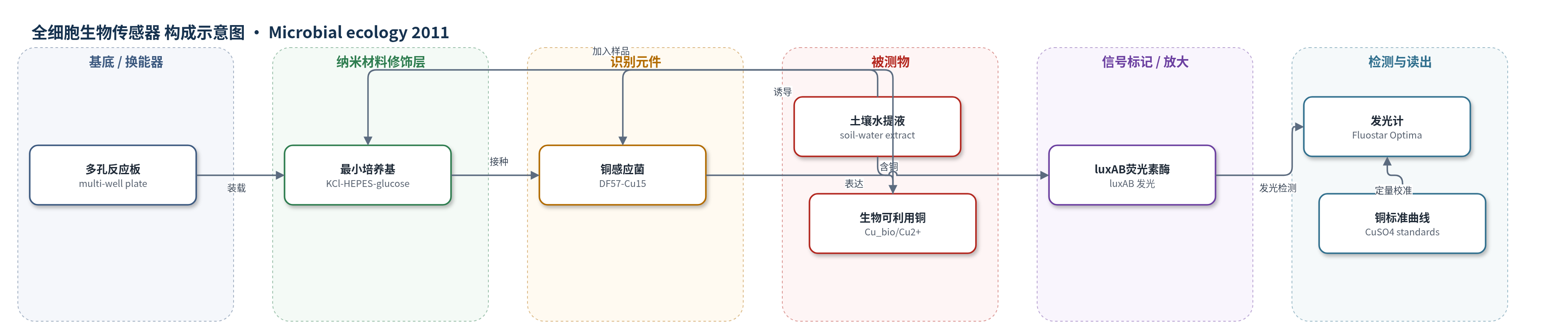
点击图片查看大图 · 依据论文自动绘制
传感器类型
全细胞生物传感器
检测对象
生物可利用铜(bioavailable copper, [Cu]bio);样品基质:土壤-水提取液(soil-water extracts)
检测原理
该传感方法以铜特异性全细胞生物发光菌株 Pseudomonas fluorescens DF57-Cu15 为识别与换能单元。菌株携带铜诱导的 luxAB 报告基因,当细胞接触土壤-水提取液中的生物可利用铜(可诱导 luxAB 表达的 Cu 物种,如游离 Cu2+ 或 Cu-DOM 复合物)时,铜感应调控系统被激活,luxAB 表达产生荧光素酶。荧光素酶催化底物氧化,在 490–500 nm 产生生物发光。90 min 孵育后,发光强度随 [Cu]bio 升高而增强,并与 CuSO4 标准溶液的发光标准曲线比较,换算为 μg Cu g−1 新鲜土壤。该方法通过基因表达实现信号放大,直接反映可诱导毒性铜池,而非总铜。
检测灵敏度
LOD: <0.005 μg g−1(原文标注为低于检出限);线性范围: 0–1.5 μg g−1 [Cu]bio(原文:添加铜与 [Cu]bio 呈对数-对数线性关系);斜率: 1.58 ± 0.083 SE(ln [Cu]bio 对 ln [Cu]add);截距: -3.33 ± 0.138 SE
效应效果
该生物传感器用于 8 周微宇宙土壤-水提取液,发光值取两个分析重复均值,未报告 RSD、回收率或抗干扰数据。测定显示 [Cu]bio 随添加 Cu 增加,150 μg g−1 添加 Cu 时最高 1.57 μg g−1 fw;植物存在显著降低 [Cu]bio。作者称其为稳健的铜特异性生物传感器,可统一不同土壤与微生物毒性终点的暴露水平。据此,G. intraradices 菌丝生长 EC50 为 0.26 μg g−1 fw [Cu]bio(95% CI 0.16–0.34),相当于 55 μg g−1 fw 添加 Cu(41–65);HNOEC 为 10 μg g−1 添加 Cu(0.019 μg g−1 [Cu]bio),LOEC 为 40 μg g−1(0.17 μg g−1)。ARDRA 在 0.019 μg g−1 [Cu]bio 即显示细菌群落结构变化,提示可用于评估低投入农业铜污染风险。
传感器的构成
- 反应容器:多孔板(multi-well plate),承载细胞悬液与样品,供发光计读取。
- 反应介质:最小培养基(100 mM KCl、20 mM HEPES pH 7.2、7.6 mM (NH4)2SO4、4 mM glycerol-2-phosphate disodium salt、0.8% w/v glucose),维持 P. fluorescens DF57-Cu15 活性与发光。
- 识别/感应元件:铜特异性 Pseudomonas fluorescens DF57-Cu15 菌株,含铜诱导 luxAB 报告基因,感知生物可利用 Cu。
- 样品基质:土壤-水提取液(soil-water extracts),提供待测生物可利用 Cu。
- 信号标记/换能元件:luxAB 基因编码荧光素酶,催化生物发光(peak emission 490–500 nm)。
- 定量标准:CuSO4 标准溶液,建立发光值与 [Cu]bio 的标准曲线。
- 读出仪器:Fluostar Optima 多板发光计(BMG Labtech),检测 490–500 nm 生物发光。
中文摘要
常见农业措施导致铜在全球农业土壤中累积。本研究在含铜土壤微宇宙中,考察生物可利用铜([Cu]bio)对丛枝菌根真菌 Glomus intraradices 定殖及其他土壤微生物的影响。为避免经植物产生的间接效应,铜仅加入无根侧室。采用铜特异性 Pseudomonas fluorescens DF57-Cu15 生物发光菌株测定 [Cu]bio。在 0–1.5 μg g−1 [Cu]bio 范围内,添加铜与 [Cu]bio 呈对数-对数线性关系。无根室微生物定殖通过全细胞脂肪酸分析(WCFA)和扩增 rDNA 限制性分析(ARDRA)评价。WCFA 显示铜强烈抑制 AM 真菌定殖,[Cu]bio 为 0.26 μg g−1 时菌根生长减少 50%;其他主要微生物类群生物量未受显著影响。ARDRA 显示铜强烈改变细菌群落组成,可能因耐铜细菌比例增加。结果表明,将轻度铜污染土壤转为依赖 AM 真菌共生的低投入可持续农业时,可能出现产量问题。
英文摘要
Common agricultural practices result in accumulation of copper in agricultural soils worldwide. The effect of bioavailable copper ([Cu](bio)) on colonization of soil by the AM fungus Glomus intraradices and other soil microorganisms was investigated in microcosms containing copper-amended soil. To avoid indirect effects through the plant, copper was only added to root-free microcosm compartments. [Cu](bio) was measured using a Pseudomonas fluorescens biosensor strain. In the range of 0-1.5 μg g(-1) [Cu](bio), a log-log linear relationship between added copper and [Cu](bio) was found. Microbial colonization of the root-free compartment was evaluated by whole-cell fatty acid analysis (WCFA) and amplified rDNA restriction analysis (ARDRA). The WCFA analysis showed that the AM fungus soil colonization was severely inhibited by Cu with a 50% reduction of mycorrhizal growth at 0.26 μg g(-1) [Cu](bio). The growth of other main microbial groups was not significantly affected by copper. However, ARDRA analysis showed a very strong effect of copper on the bacterial community composition probably caused by an increased proportion of Cu-resistant bacteria. Our results suggest that problems with plant yield may arise when converting slightly copper-contaminated soils to land uses such as low-input and sustainable agriculture that are dependent on AM fungal symbiosis.