组成图示
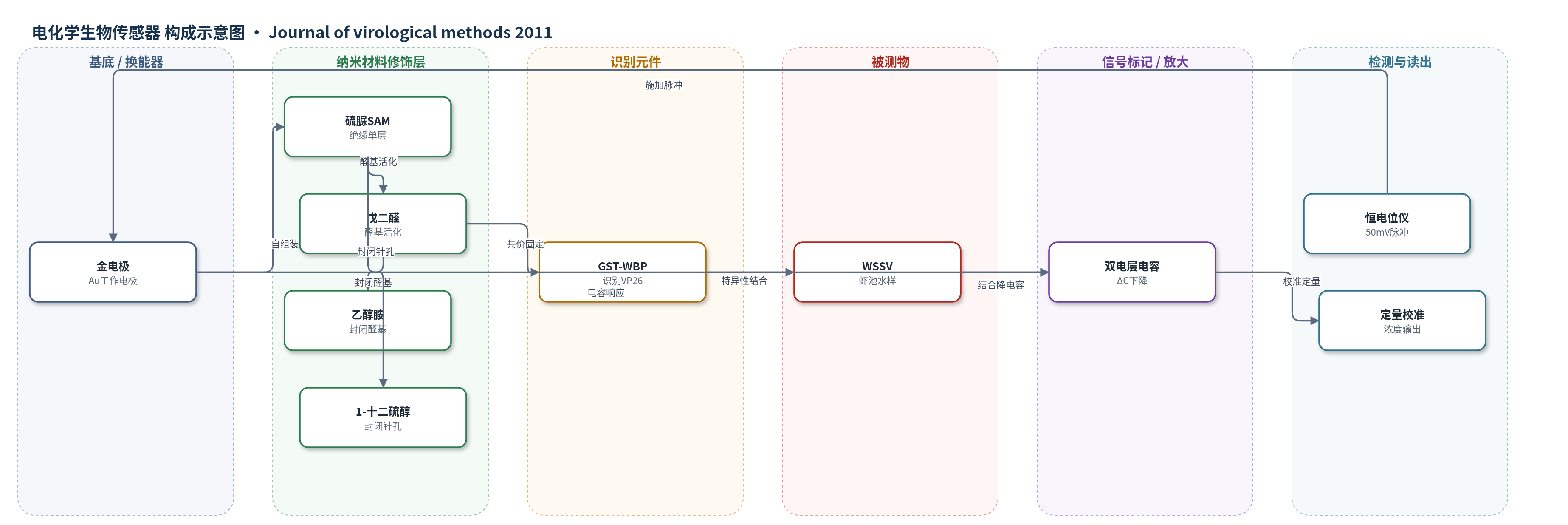
点击图片查看大图 · 依据论文自动绘制
传感器类型
电化学生物传感器
检测对象
白斑综合征病毒(White spot syndrome virus, WSSV);样品基质:虾池水(shrimp pond water)
检测原理
金电极表面先形成硫脲自组装单层,使界面绝缘;戊二醛活化后与GST-WBP的氨基共价结合,形成识别层。GST-WBP特异性结合虾池水样中WSSV表面的VP26蛋白。结合事件使电极-溶液界面介电层增厚,离子和水分子被推离电极表面,双电层电容下降。恒电位仪施加50 mV电位阶跃脉冲,由于无电子转移,瞬态电流按指数衰减,由ln i(t)对t线性拟合得到总电容Ctotal。结合前后电容差ΔC随WSSV浓度对数增加而增大,实现无标记定量检测;25 mM甘氨酸-HCl(pH 2.40)可解离WSSV再生电极。
检测灵敏度
LOD: 1 copy/μl;线性范围: 1–1 × 10^5 copies/μl;r = 0.9957
效应效果
该传感器对WSSV选择性高,黄头病毒(YHV)在1–10^5 copies/μl范围内响应很低,低于WSSV检出限响应。电极经25 mM甘氨酸-HCl(pH 2.40)再生后可重复使用39次,RSD为2.4%,残余活性95.8±2.3%。8个虾池水样结果与实时定量PCR无显著差异(P>0.05);加标回收率平均68–127%,RSD 3–19%,10和75 copies/μl回收率分别为93±5%和97±3%。其LOD 1 copy/μl优于实时PCR(20 copies/μl)、PCR-免疫法(160 copies/μl)和RT-LAMP(100 copies/μl),分析时间20–25 min,可用于虾池水WSSV放苗前检测和养殖过程监测。
传感器的构成
- 基底/换能器电极:金电极(Au,直径3.0 mm,99.99%),经抛光和电化学刻蚀,作为工作电极与电容换能器
- 绝缘自组装单层:硫脲(thiourea,250 mM)自组装单层(SAM),绝缘电极表面并形成电容层
- 交联活化层:戊二醛(glutaraldehyde,5% v/v,10 mM磷酸钠缓冲液pH 7.00),活化醛基用于共价固定识别蛋白
- 识别元件:GST-WBP(glutathione-S-transferase tag white spot binding protein,150 μg/mL),特异性结合WSSV的VP26蛋白
- 封闭剂:乙醇胺(ethanolamine,1.0 M,pH 8.50),封闭未与GST-WBP反应的剩余醛基
- 针孔封闭层:1-十二硫醇(1-dodecanethiol,10 mM乙醇溶液),封闭SAM针孔并提高界面绝缘性
- 流动测量系统:定制10 μL流动池、不锈钢辅助电极、自制Ag/AgCl参比电极和恒电位仪(EA161),用于电位阶跃电容测量
中文摘要
水是白斑综合征病毒(WSSV)进入虾类养殖设施的主要途径之一。本文报道了一种用于虾池水中 WSSV 定量检测的高灵敏电容生物传感器。将谷胱甘肽-S-转移酶标记白斑结合蛋白(GST-WBP)通过硫脲自组装单层固定于金电极表面,WSSV 与固定化 GST-WBP 的结合通过电容测量直接检测。在优化条件下,该传感器对 WSSV 的线性范围为 1–1×10^5 copies/μl,检出限为 1 copy/μl,并对 WSSV 表现出高选择性。单个分析周期仅需 20–25 min 分析时间和 25 min 再生时间。将该传感器用于 8 个虾池水样分析,结果与实时定量 PCR 方法一致(P>0.05)。固定化 GST-WBP 可重复使用最多 39 个分析周期,相对标准偏差为 2.4%,残余活性为 95.8±2.3%。上述性能表明该传感器具有用于 WSSV 准确、高灵敏、定量检测的应用潜力。
英文摘要
Water is one major pathways by which the white spot syndrome virus (WSSV) pathogen enters aquaculture facilities. This paper describes the production and use of a capacitive biosensor for the quantitative detection of as little as 1copy/μl of WSSV in shrimp pond water. A glutathione-S-transferase tag for white spot binding protein (GST-WBP) was immobilized on a gold electrode through a self-assembled monolayer. Binding between WSSV and the immobilized GST-WBP was directly detected by a capacitance measurement. Under optimum conditions, the capacitive biosensor detected WSSV over a wide linear range of between 1 and 1 × 10(5)copies/μl. The system was highly selective for WSSV. One analysis cycle required only 20-25 min of analysis time and 25 min of regeneration time. The capacitive biosensor was applied to analyze WSSV concentration in eight shrimp pond water samples and the results were in good agreement with those obtained by a real time quantitative polymerase chain reaction (real-time PCR) method (P>0.05). The immobilized GST-WBP provided and could be reused for up to 39 analysis cycles for one electrode preparation with a relative standard deviation (RSD) of 2.4% and a good reproducibility of residual activity (95.8 ± 2.3%). The appealing performance of this biosensor indicated that it had great potential for an accurate very sensitive, quantitative, detection method for WSSV.