组成图示
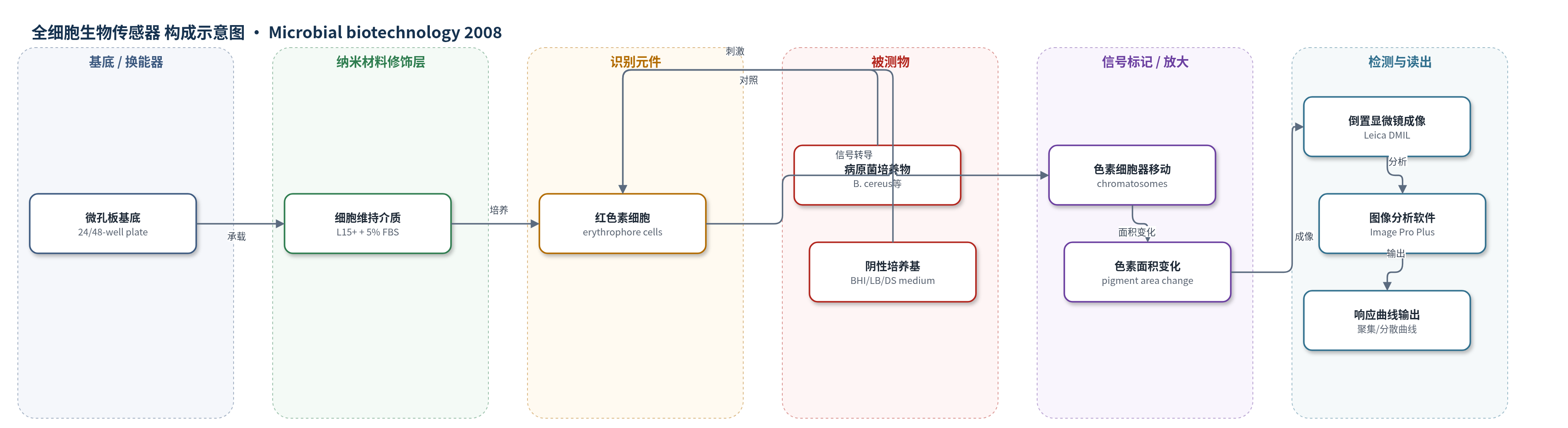
点击图片查看大图 · 依据论文自动绘制
传感器类型
全细胞生物传感器
检测对象
蜡样芽孢杆菌(Bacillus cereus)、肠炎沙门氏菌(Salmonella enteritidis)、产气荚膜梭菌(Clostridium perfringens)、肉毒梭菌(Clostridium botulinum);样品基质为细菌培养物/食品相关病原菌培养液(BHI、LB、Duncan-Strong 培养基)
检测原理
病原菌或其分泌的毒力因子/毒素与红色素细胞表面受体相互作用,激活细胞内信号转导通路,驱动色素细胞器(chromatosomes)沿微管网络发生聚集或分散,从而改变细胞色素面积。倒置显微镜连续成像,图像分析计算色素面积百分比变化:聚集为负值,分散为正值。不同病原菌引起不同动力学和形态,如 B. cereus 在 2–5 min 内快速聚集,C. botulinum 约 2 h 后缓慢聚集并伴树突形成;非致病株与培养基仅轻微分散且无显著差异。该传感器依赖全细胞功能响应,而非 DNA/抗体结构识别,因此可反映病原菌活性与毒性。
检测灵敏度
原文未报告 LOD、线性范围、灵敏度斜率或 R^2。
效应效果
该细胞传感器可区分致病 B. cereus ATCC 49064/14579 与非致病 B. subtilis 1A1 及 ΔplcR 突变体;致病株与阴性对照差异显著(P<0.001),非致病株无显著差异(P=0.635、P=0.0754)。对 S. enteritidis、C. perfringens 和 C. botulinum 均产生与培养基显著不同的响应(P<0.001、P<0.004、P<0.005/0.006)。响应具有病原菌特异性:B. cereus 2–5 min 内聚集,C. perfringens 4 min 聚集后缓慢分散,C. botulinum 约 2 h 开始聚集、5 h 完成并出现树突。实验为三次重复、三种细胞制备。作者认为其可评估活菌致病行为,弥补 DNA/抗体方法不能区分活死菌和毒性的不足。
传感器的构成
- 检测基底:24孔/48孔微孔板(microtitre plate),承载细胞与样品
- 细胞维持介质:Leibovitz L15 Medium+(L15+,含 HEPES 和 Antibiotic-Antimycotic)加 5% 胎牛血清(FBS),维持细胞活性
- 识别/换能元件:Betta splendens 红色素细胞(erythrophore cells),通过表面受体感知病原菌并转导信号
- 细胞分离试剂:胶原酶 I(collagenase type 1)和透明质酸酶(hyaluronidase),用于从鱼尾鳍组织分离细胞
- 被测物/样品:食品相关病原菌培养物(B. cereus、S. enteritidis、C. perfringens、C. botulinum)及阴性培养基(BHI、LB、Duncan-Strong)
- 信号读出系统:倒置显微镜(Leica DMIL)、SPOT Insight 320 彩色相机、SPOT 软件与 Image Pro Plus,记录色素面积变化
- 功能验证剂:黑素细胞刺激激素(MSH)和可乐定(clonidine),分别诱导色素分散/聚集以验证细胞响应
中文摘要
基于细胞的生物传感器被提议作为毒性物质的功能型检测器。本研究报道利用暹罗斗鱼(Betta splendens)色素细胞,特别是红色素细胞(erythrophore cells),检测食品相关病原菌。通过枯草芽孢杆菌属评估,红色素细胞反应可区分致病性蜡样芽孢杆菌(Bacillus cereus)与非致病性 B. cereus ΔplcR 缺失突变体及非致病性枯草芽孢杆菌(Bacillus subtilis)。将红色素细胞暴露于肠炎沙门氏菌(Salmonella enteritidis)、产气荚膜梭菌(Clostridium perfringens)和肉毒梭菌(Clostridium botulinum)后,每种病原菌均引起与相应细菌培养基可区分的细胞反应,且不同病原菌的反应具有独特性。这些结果表明,红色素细胞反应在食品相关病原菌检测和毒性评估方面具有作为生物传感器的应用潜力。
英文摘要
Cell-based biosensors have been proposed for use as function-based detectors of toxic agents. We report the use of Betta splendens chromatophore cells, specifically erythrophore cells, for detection of food-associated pathogenic bacteria. Evaluation of erythrophore cell response, using Bacillus spp., has revealed that this response can distinguish pathogenic Bacillus cereus from a non-pathogenic B. cereus ΔplcR deletion mutant and a non-pathogenic Bacillus subtilis. Erythrophore cells were exposed to Salmonella enteritidis, Clostridium perfringens and Clostridium botulinum. Each bacterial pathogen elicited a response from erythrophore cells that was distinguished from the corresponding bacterial growth medium, and this observed response was unique for each bacterial pathogen. These findings suggest that erythrophore cell response has potential for use as a biosensor in the detection and toxicity assessment for food-associated pathogenic bacteria.