组成图示
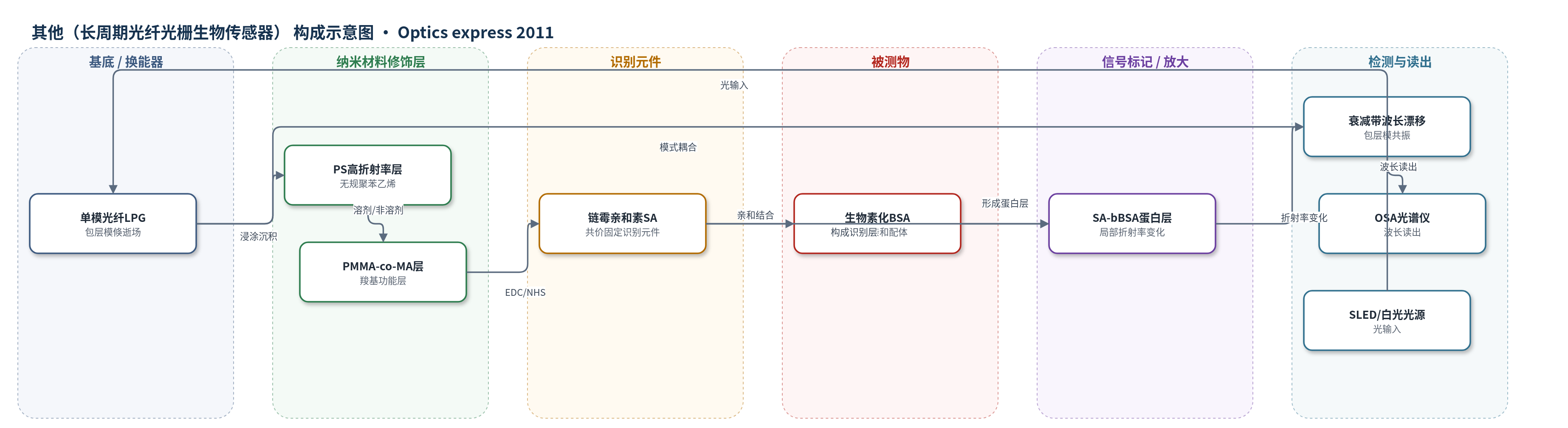
点击图片查看大图 · 依据论文自动绘制
传感器类型
其他(长周期光纤光栅生物传感器)
检测对象
生物素化牛血清白蛋白(biotinylated bovine serum albumin, bBSA);样品基质:HEPES 缓冲液/水溶液
检测原理
LPG通过核心模与同向包层模的相位匹配耦合,在透射谱形成衰减带;其倏逝场对周围介质折射率(SRI)敏感。约320 nm的PS高折射率层使包层模有效折射率进入模态过渡区,使器件在SRI≈1.33附近具有数千nm/RIU的共振波长漂移灵敏度。约30 nm的PMMA-co-MA层提供表面羧基,经EDC/NHS活化后共价固定链霉亲和素(SA)。当生物素化牛血清白蛋白(bBSA)与SA结合时,在包层表面形成蛋白层,引起局部折射率增加,导致衰减带红移。OSA实时记录波长漂移,漂移量随表面结合蛋白量增加而增大;采用高阶包层模可进一步提高灵敏度与线性度。
检测灵敏度
LOD: around 5 pg/mm2(estimated);SRI sensitivity: approx. 2000 nm/RIU;|∂λres/∂SRI|: largely exceeding one thousand nm/RIU;RI resolution: approaching 5 × 10^-6
效应效果
共价固定SA后,洗涤步骤中信号平台基本保持,表明蛋白层稳定且无明显脱落,固定速度较吸附法更快。实时传感图显示SA共价固定引起约3.1 nm漂移,bBSA亲和结合约0.9 nm;优化实验中bBSA漂移约2.1–2.2 nm,SA亲和层漂移约3.2–3.3 nm,洗涤后平台平均差异约0.4 nm。AFM显示固定后表面粗糙度由2.19 nm增至3.45 nm,并出现约5 nm高的球形蛋白特征。器件SRI灵敏度超过1000 nm/RIU,5阶模约2000 nm/RIU,折射率分辨率接近5×10^-6,估计LOD约5 pg/mm2,与光纤SPR水平相当;双层设计仅损失约3.6%峰值灵敏度,高阶模可改善线性度。
传感器的构成
- 基底/换能器:单模光纤长周期光栅(LPG),周期性折射率调制使核心模耦合到包层模,倏逝场探测周围介质折射率变化。
- 初级修饰层:无规聚苯乙烯(PS),约320 nm,高折射率约1.59,浸涂沉积,调谐LPG至过渡区并提高折射率灵敏度。
- 次级功能修饰层:聚甲基丙烯酸甲酯-甲基丙烯酸共聚物(PMMA-co-MA),约30 nm,含羧基,提供共价固定位点并最小化光学扰动。
- 表面偶联剂:EDC/NHS(1-ethyl-3-(3-dimethylaminopropyl)carbodiimide / N-hydrosuccinimide),活化羧基形成氨基共价键,用于固定生物受体。
- 识别元件:链霉亲和素(streptavidin, SA),共价固定于PMMA-co-MA表面,作为亲和识别元件捕获生物素化蛋白。
- 被测物/亲和配体:生物素化牛血清白蛋白(biotinylated bovine serum albumin, bBSA),与SA结合形成表面蛋白层。
- 信号读出:SLED/白光光源与光学频谱分析仪(OSA),监测包层模衰减带波长漂移。
中文摘要
本文报道了一种基于工作在过渡模式的叠层长周期光纤光栅(LPG)的无标记生物传感平台。该工作的主要创新在于采用多层设计,将高效表面功能化与包层模过渡区调谐问题解耦。作者发展了一种用于浸涂的溶剂/非溶剂策略,以在LPG上沉积多层透明聚合物。其中,无规聚苯乙烯(PS)初级涂层作为高折射率层,用于将器件工作点调谐至过渡区,从而获得对环境介质折射率变化具有竞争力的灵敏度。随后,通过选择性溶剂在PS层上沉积极薄的聚甲基丙烯酸甲酯-甲基丙烯酸共聚物(PMMA-co-MA)次级功能层,使器件表面获得羧基,用于生物受体的稳定共价连接,同时尽量减小对光学设计的扰动。采用标准EDC/NHS偶联化学将链霉亲和素(SA)连接在涂层LPG表面,并通过跟踪LPG衰减带波长漂移,对SA与生物素化牛血清白蛋白(bBSA)之间的多重亲和实验进行高灵敏实时监测。
英文摘要
We report our latest research results concerning the development of a platform for label-free biosensing based on overlayered Long Period Gratings (LPGs) working in transition mode. The main novelty of this work lies in a multilayer design that allows to decouple the problem of an efficient surface functionalization from that of the tuning in transition region of the cladding modes. An innovative solvent/nonsolvent strategy for the dip-coating technique was developed in order to deposit on the LPG multiple layers of transparent polymers. In particular, a primary coating of atactic polystyrene was used as high refractive index layer to tune the working point of the device in the so-called transition region. In this way, state-of-the-art-competitive sensitivity to surrounding medium refractive index changes was achieved. An extremely thin secondary functional layer of poly(methyl methacrylate-co-methacrylic acid) was deposited onto the primary coating by means of an original identification of selective solvents. This approach allowed to obtain desired functional groups (carboxyls) on the surface of the device for a stable covalent attachment of bioreceptors and minimal perturbation of the optical design. Standard 1-ethyl-3-(3-dimethylaminopropyl)carbodiimide / N-hydrosuccinimide (EDC / NHS) coupling chemistry was used to link streptavidin on the surface of the coated LPG. Highly sensitive real-time monitoring of multiple affinity assays between streptavidin and biotinylated bovine serum albumin was performed by following the shift of the LPGs attenuation bands.