组成图示
点击图片查看大图 · 依据论文自动绘制
传感器类型
综述或非传感器论文
检测对象
细菌(bacteria,1–20 μm 颗粒)、病毒(viruses,<1 μm 颗粒);样品基质:商用飞机客舱空气/乘客呼气气溶胶
检测原理
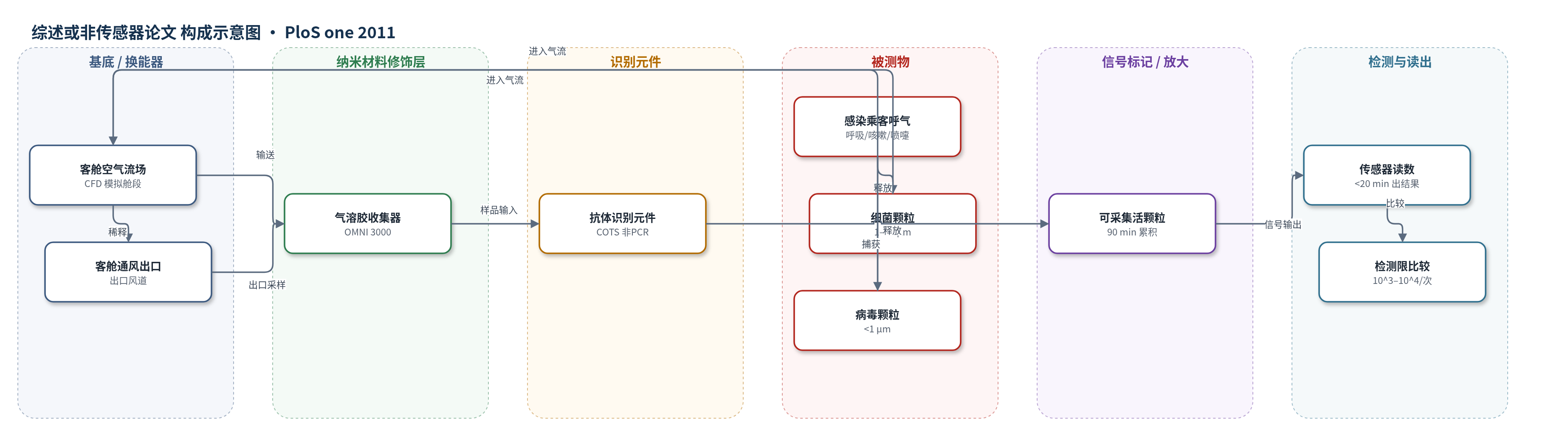
该文未提出新传感换能机制,而是评估现有商用检测链路的可行性。感染乘客在呼吸、咳嗽或喷嚏时释放含细菌/病毒的气溶胶颗粒,颗粒随飞机客舱通风气流输运、稀释并达到稳态浓度。商用气溶胶收集器以 0.3 m3/min 流量连续采集 90 min 客舱空气,按粒径收集效率与存活分数计算可采集活颗粒数。随后将样品输入非 PCR 抗体基生物传感器,由抗体识别目标生物颗粒,传感器在 20 min 内给出定性/定量结果。被测物浓度越高,单位体积颗粒数与 90 min 累积采集量越大;当可采集活颗粒数超过传感器检测限时判为阳性。文中未涉及 HCR、RCA、CRISPR-Cas 或酶催化沉积等信号放大策略。
检测灵敏度
LOD: 低于 10 copies(PCR 生物传感器,未纳入);LOD: 10^3–10^4 个/次(COTS 抗体基生物传感器)
效应效果
该文为计算可行性分析,未报告选择性、抗干扰、稳定性、重现性、RSD、实际样品加标回收率或与 ELISA/HPLC/qPCR 的实验对比。在乐观假设下,7 名感染乘客在呼吸+咳嗽场景 90 min 可采集活细菌 2771.79 个,在呼吸+喷嚏场景为 4635 个,均超过 COTS 抗体基传感器 10^3–10^4 个/次检测限;1 名感染乘客在呼吸+喷嚏场景为 1039 个,可能达到检测下限;仅呼吸场景为 46.62 个,不足。病毒颗粒最高为 138.69 个,均低于 10^3 个/次,因此不可行。作者主张需要更灵敏传感器或针对单个乘客采样。
传感器的构成
- 系统总体:商用现成(COTS)气溶胶收集器与生物传感器组合,用于客舱空气采样与病原体检测
- 采样模块:OMNI 3000 气溶胶收集器,按 0.3 m3/min 流量采集 90 min 客舱空气
- 识别模块:抗体基(antibody-based)识别元件,用于捕获细菌/病毒颗粒
- 读出模块:非 PCR 生物传感器,20 min 内给出检测结果
- 性能基准:COTS 抗体基生物传感器检测限约 10^3–10^4 个/次
中文摘要
通过商业航空旅行传播传染病是重大现实威胁。为阐明检测空气传播病原体的可行性,作者开展了传感器集成研究,并对飞机客舱内污染物输运进行了计算研究。研究考虑了传感器灵敏度、出结果时间、尺寸、重量和功耗,以及最佳商用现成(COTS)设备。采用计算流体力学模拟三种场景:(1) 正常呼吸(最多20次/分钟)和咳嗽(20次/小时);(2) 正常呼吸和打喷嚏(4次/小时);(3) 仅正常呼吸。每个场景设置1名或7名感染乘客按指定频率呼气、打喷嚏或咳嗽。场景2另设1名感染乘客每小时打喷嚏20次和50次两种情况。所有计算基于90分钟采样,并使用商用气溶胶收集器和生物传感器规格。仅纳入无需人工前处理且20分钟内出结果的生物传感器。主要发现:在7名感染乘客呼气且场景1和2下,以及1名感染乘客在场景2下,飞机内稳态细菌浓度足以被检测;仅呼吸不足以产生可检测细菌颗粒,且所有场景均不足以产生可检测病毒颗粒。结果表明,检测飞机内细菌和病毒需要比现有COTS设备更灵敏的传感器和/或对单个乘客采样。
英文摘要
The spread of infectious disease via commercial airliner travel is a significant and realistic threat. To shed some light on the feasibility of detecting airborne pathogens, a sensor integration study has been conducted and computational investigations of contaminant transport in an aircraft cabin have been performed. Our study took into consideration sensor sensitivity as well as the time-to-answer, size, weight and the power of best available commercial off-the-shelf (COTS) devices. We conducted computational fluid dynamics simulations to investigate three types of scenarios: (1) nominal breathing (up to 20 breaths per minute) and coughing (20 times per hour); (2) nominal breathing and sneezing (4 times per hour); and (3) nominal breathing only. Each scenario was implemented with one or seven infectious passengers expelling air and sneezes or coughs at the stated frequencies. Scenario 2 was implemented with two additional cases in which one infectious passenger expelled 20 and 50 sneezes per hour, respectively. All computations were based on 90 minutes of sampling using specifications from a COTS aerosol collector and biosensor. Only biosensors that could provide an answer in under 20 minutes without any manual preparation steps were included. The principal finding was that the steady-state bacteria concentrations in aircraft would be high enough to be detected in the case where seven infectious passengers are exhaling under scenarios 1 and 2 and where one infectious passenger is actively exhaling in scenario 2. Breathing alone failed to generate sufficient bacterial particles for detection, and none of the scenarios generated sufficient viral particles for detection to be feasible. These results suggest that more sensitive sensors than the COTS devices currently available and/or sampling of individual passengers would be needed for the detection of bacteria and viruses in aircraft.