组成图示
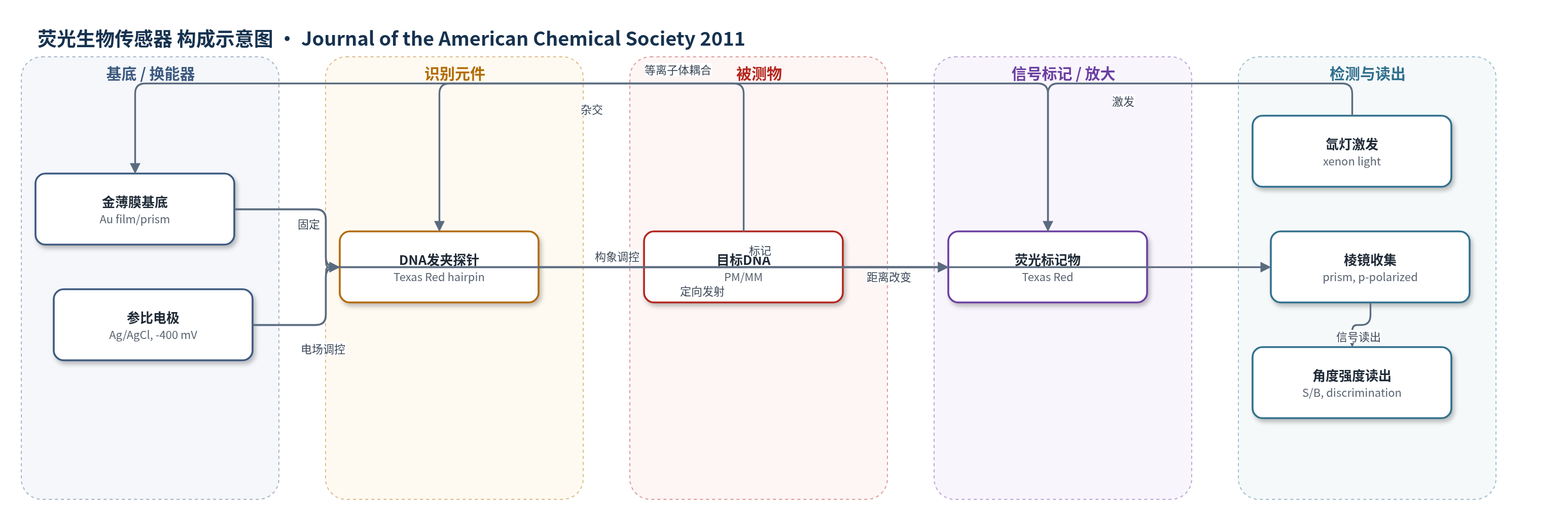
点击图片查看大图 · 依据论文自动绘制
传感器类型
荧光生物传感器
检测对象
DNA(完美匹配 DNA, PM;单碱基错配 DNA, MM),缓冲液(buffer)基质
检测原理
Texas Red标记的DNA发夹探针固定于金薄膜表面,未杂交时荧光染料靠近金表面而被猝灭。目标DNA与探针杂交后,发夹茎环打开,双链伸展,使染料远离金表面并进入表面等离子体耦合增强区。在反向Kretschmann构型中,氙灯激发染料,其发射与金膜表面等离子体耦合,经棱镜形成窄角度、p偏振的定向荧光。施加-400 mV负电位后,带负电的匹配双链被排斥而直立,染料更充分进入增强区,信号增强;错配双链稳定性低,杂交受静电排斥抑制,染料仍靠近金表面,耦合弱而被猝灭。因此匹配信号随目标浓度升高而增强,错配信号被抑制,实现高灵敏度与单碱基突变区分。
检测灵敏度
LOD: 100 pM(原文表述:detectable to a target concentration as low as 100 pM)
效应效果
在被动SPCDE中,杂交后荧光强度较杂交前增强超过70倍;在电场辅助E-SPCDE中增强超过120倍。与自由空间各向同性荧光相比,E-SPCDE在定向角度处获得超过12倍的荧光增强。对0.10–3.0 μM的完美匹配(PM)和单碱基错配(MM)DNA测试中,E-SPCDE的区分比(PM/MM)较SPCDE提高约10倍,达到超过20倍,同时抑制错配信号并避免假阳性与假阴性。作者认为该主动策略可提升芯片微阵列等微型化DNA传感平台的灵敏度和特异性。
传感器的构成
- 基底/换能器:金薄膜(Au film)与棱镜(prism)组成反向Kretschmann构型,支持表面等离子体并实现定向荧光收集
- 识别元件:Texas Red标记DNA发夹探针(Texas Red-labeled DNA hairpin probe)固定于Au表面,通过茎环打开识别目标DNA
- 信号标记物:Texas Red荧光染料(Texas Red fluorophore)标记探针,随与Au表面距离变化发生猝灭或SPCDE增强
- 电场控制电极:Ag/AgCl参比电极(Ag/AgCl reference electrode)施加-400 mV负电位,主动调控DNA双链取向与错配杂交
- 光学读出:氙灯(xenon light)激发、偏振器(polarizers)和角度分辨检测,读取p偏振定向发射强度
中文摘要
本文证明了电场辅助表面等离子体耦合定向发射(E-SPCDE)的原理。将表面等离子体耦合定向发射(SPCDE)与外部电场控制相结合,可产生显著协同效应,以主动策略智能放大正确信号并抑制错误信号。作者设计了一种基于SPCDE中荧光猝灭与增强的新型发夹结构DNA生物传感器。通过调节荧光与表面等离子体的耦合效率,在增强完全匹配信号的同时抑制单碱基错配信号,实现了超过20倍的高区分比。E-SPCDE在DNA传感中成功应用,可消除检测中的假阳性和假阴性。该策略有望用于构建新一代微型化高性能传感平台,尤其适用于芯片微阵列,并使纳米尺度界面过程更易操控和检测。
英文摘要
We have demonstrated the proof-of-principle of electric field assisted surface plasmon-coupled directional emission (E-SPCDE). The combination of SPCDE and electric field control produced a significant synergistic effect to amplify the right signal and suppress the wrong signal intelligently in an active strategy. A novel hairpin structured DNA biosensor based on the quenching and enhancing of fluorescence in SPCDE has been designed. With modulation of the fluorescence coupling efficiency, a high discrimination ratio up to more than 20-fold has been achieved by enhancing the signal of match and suppressing that of mismatch. E-SPCDE has shown a successful application in DNA sensing, eliminating false positives and false negatives in the detection. E-SPCDE should provide an opportunity to create a new generation of miniaturized high-performance sensing platforms especially in chip-based microarrays and to make the manipulation of the nanometer-scale processes more accessible and detectable.