组成图示
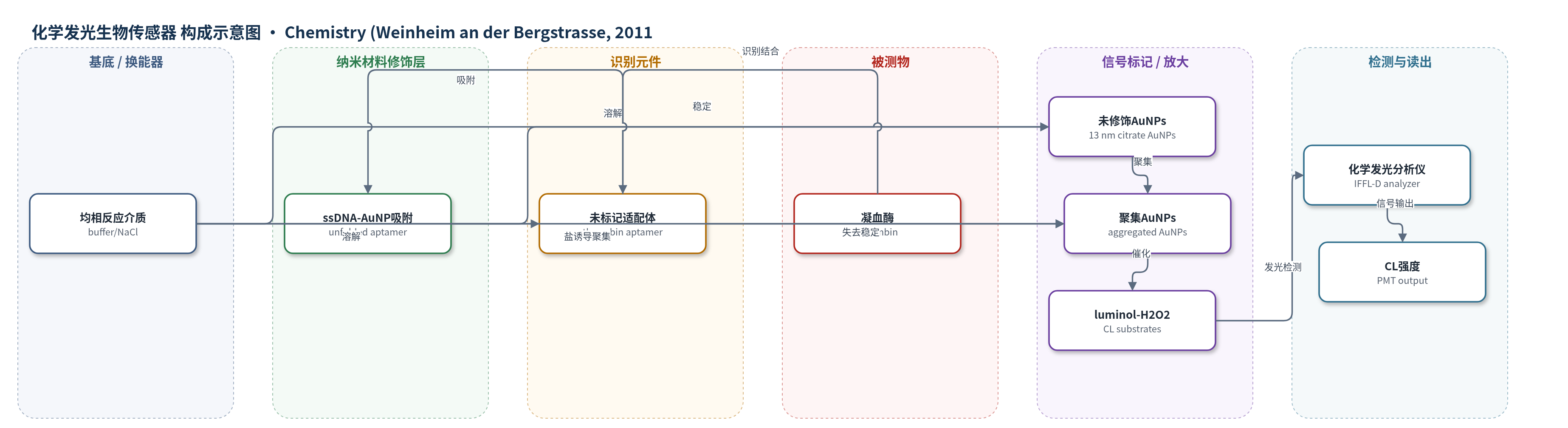
点击图片查看大图 · 依据论文自动绘制
传感器类型
化学发光生物传感器
检测对象
凝血酶(thrombin)、钾离子(K+);样品基质为缓冲液/水溶液(未涉及血清等实际生物样品)
检测原理
无靶标时,单链适配体呈随机卷曲态,碱基与未修饰AuNPs表面配位吸附,使其在0.5 mol/L NaCl中保持分散;分散AuNPs表面负电荷密度高,与碱性介质中HO2−/鲁米诺阴离子静电排斥,对luminol–H2O2化学发光催化弱。加入凝血酶后,适配体折叠为三维构象,无法吸附AuNPs,失去稳定作用;NaCl屏蔽AuNPs间静电排斥,诱导AuNPs聚集。聚集后AuNPs表面负电荷密度降低,更易与HO2−/鲁米诺阴离子相互作用,显著增强luminol–H2O2 CL反应。因此CL强度随靶标浓度升高而增强,实现无标记、均相检测。
检测灵敏度
凝血酶:LOD: 2.6×10^-14 M(原文:2.6×10⁻¹⁴ m;摘要:26 fm);线性范围: 6.3×10^-14–6.3×10^-11 M(原文:6.3×10⁻¹⁴–6.3×10⁻¹¹ m)。K+:LOD: 1.6×10^-8 M(原文:1.6×10⁻⁸ m);线性范围: 7.4×10^-8–3.2×10^-5 M(原文:7.4×10⁻⁸–3.2×10⁻⁵ m)。
效应效果
在优化条件下,凝血酶检测的相对标准偏差(RSD)为4%(4.3×10^-12 M,6次重复)。选择性方面,无凝血酶、BSA替代或随机序列替代时,CL信号均不超过适配体/凝血酶体系的5%。与已知AuNP比色法相比,灵敏度提高4个数量级以上;其检测限比已报道的适配体CL凝血酶传感器低1000倍。K+检测RSD为3.6%(5.6×10^-7 M),对Li+、Na+、Rb+、NH4+、Mg2+、Ca2+及随机序列无明显响应。体系为均相液相,无需分离洗涤,30 min内完成,适合微孔板自动化。AuNPs新鲜一周内信号稳定,存放一个月后灵敏度下降。未报告实际样品加标回收率。
传感器的构成
- 识别元件:未标记凝血酶适配体(thrombin aptamer, 15-mer 5'-GGT TGG TGT GGT TGG-3'),识别凝血酶并发生构象变化
- 信号催化元件:未修饰柠檬酸稳定金纳米颗粒(AuNPs, ~13 nm),催化luminol-H2O2化学发光反应
- 聚集调控剂:0.5 mol/L NaCl,屏蔽AuNPs表面电荷并诱导聚集
- 化学发光底物:鲁米诺(luminol, 5×10^-4 M)与过氧化氢(H2O2, 1.0×10^-3 M),产生CL信号
- 反应介质:pH 7.4结合缓冲液与pH 12.0碱性CL介质,维持适配体结合和CL反应
- 读出装置:IFFL-D化学发光分析仪(含光电倍增管PMT),记录CL强度
中文摘要
本文报道了一种无标记、基于适配体的化学发光生物传感器。该传感器利用未修饰金纳米颗粒(AuNPs)对鲁米诺–过氧化氢(luminol–H2O2)化学发光(CL)反应的催化活性,以及未修饰AuNPs与适配体之间的相互作用。未修饰AuNPs能够有效区分无结构的单链适配体与折叠后的适配体。在0.5 mol/L NaCl存在下,适配体与靶标分子结合可诱导AuNPs发生聚集;聚集后的AuNPs对luminol–H2O2 CL反应的催化活性显著增强。整个检测过程无需对AuNPs或适配体进行共价功能化。对凝血酶的检测限低至26 fM,灵敏度比已报道的AuNP比色法检测凝血酶的方法高4个数量级以上。该适配体生物传感器具有操作简单、成本低廉、检测快速和灵敏度高等优点。
英文摘要
We report a label-free, aptamer-based chemiluminescent biosensor. The biosensor relies upon the catalytic activity of unmodified gold nanoparticles (AuNPs) on the luminol-H(2)O(2) chemiluminescence (CL) reaction, and the interaction of unmodified AuNPs with the aptamer. The unmodified AuNPs can effectively differentiate unstructured and folded aptamer. The binding of the aptamer with the target can induce the AuNP aggregation in the presence of 0.5 M NaCl, and after aggregation the catalytic activity of the AuNPs on the luminol-H(2)O(2) CL reaction is greatly enhanced. During the assay, no covalent functionalization of the AuNPs or aptamer is required. The detection limit of thrombin was estimated to be as low as 26 fM, and the sensitivity was more than 4 orders of magnitude better than that of known AuNP-based colorimetric methods for the detection of thrombin. This aptamer-based biosensor offers the advantages of being simple, cheap, rapid, and sensitive.