组成图示
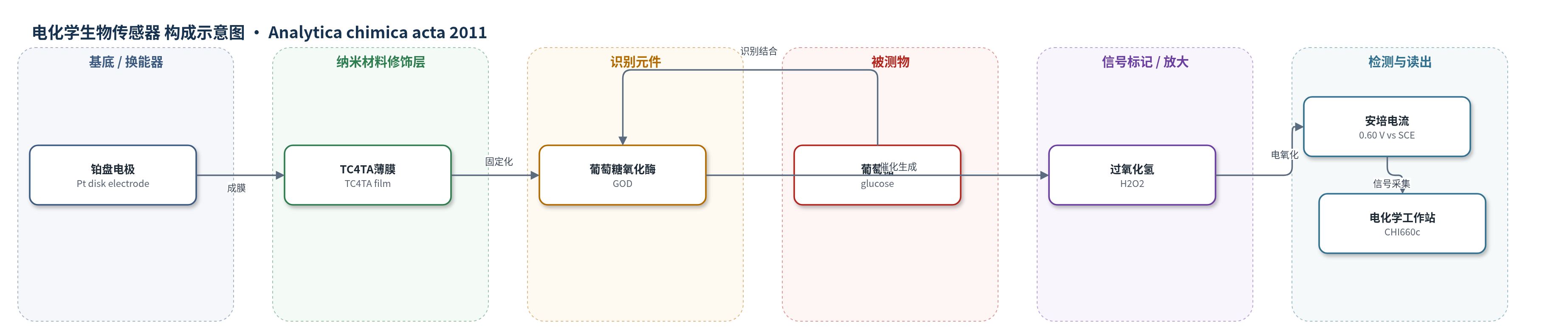
点击图片查看大图 · 依据论文自动绘制
传感器类型
电化学生物传感器
检测对象
葡萄糖(glucose);样品基质:PBS 缓冲液、血清/血浆样品
检测原理
该传感器以铂盘电极为换能器,TC4TA 薄膜作为固定化基质。TC4TA 的氨基在 EDC/NHS 作用下与 GOD 的羧基形成共价键,同时其疏水空腔与酶之间发生非共价相互作用,使 GOD 稳定负载于电极表面。检测时,葡萄糖进入 GOD 活性中心并被催化氧化,生成过氧化氢;在 0.60 V(vs SCE)下,H2O2 在铂电极表面发生电氧化,产生与葡萄糖浓度成正比的安培电流。TC4TA 复合膜提高了酶负载量、生物相容性和界面电子传递效率,从而增强电催化响应。
检测灵敏度
LOD: 20 μM (S/N = 3);线性范围: 0.08–10 mM;灵敏度: ca. 10.2 mA M−1 cm−2
效应效果
传感器在 5 s 内达到稳态电流的 95%。对尿酸、抗坏血酸、多巴胺、对乙酰氨基酚、L-半胱氨酸和还原型谷胱甘肽等常见干扰物进行考察,除尿酸外其余干扰影响较弱。5 个电极各 50 次连续测量的相对标准偏差为 5.32%;4 ℃ PBS 中储存 30 d 后仍保留 80% 响应。血清样品测定结果与医院 Olympus AU2700 生化分析仪一致,相对误差为 −3.1% 至 +6.7%,加标回收率为 94%–110%(正文称 94%–106%)。表观 Michaelis–Menten 常数为 7.4 mM,表明该传感器具有实际检测潜力。
传感器的构成
- 基底/换能器电极:铂盘电极(Pt disk electrode),提供电子转导与安培检测界面
- 修饰层:对叔丁基硫代杯[4]芳四胺(TC4TA)薄膜,作为酶固定化基质,提供氨基与疏水空腔
- 偶联剂:EDC/NHS,活化 GOD 羧基并与 TC4TA 氨基形成共价键
- 识别元件:葡萄糖氧化酶(GOD),催化葡萄糖氧化生成 H2O2
- 信号产物:过氧化氢(H2O2),酶反应产物,在电极表面氧化产生电流
- 读出系统:CHI660c 电化学工作站、饱和甘汞电极(SCE)与铂丝对电极,0.60 V 安培检测
中文摘要
杯芳烃及其衍生物因具有特殊构型、分子识别功能和聚集特性,有望用于酶固定化。本文首次将对叔丁基硫代杯[4]芳四胺(TC4TA)用作酶固定化材料,通过温和条件固定葡萄糖氧化酶(GOD),构建葡萄糖安培生物传感器。GOD 在 TC4TA 修饰电极上强烈吸附,形成 TC4TA/GOD 复合膜;其固定化机制主要源于 TC4TA 氨基与 GOD 羧基之间的共价键以及 TC4TA 的分子识别作用。在 0.60 V(对饱和甘汞电极)下,电极氧化酶反应生成的过氧化氢,从而实现对葡萄糖的安培检测。该传感器响应时间约 5 s,检出限为 20 μM(S/N=3),灵敏度约 10.2 mA M−1 cm−2,葡萄糖线性范围为 0.08–10 mM,并具有良好的操作稳定性和储存稳定性。文章还优化了传感器制备条件,并考察了施加电位及常见干扰化合物对安培响应的影响。
英文摘要
Calixarenes and their derivatives may be a promising material for enzyme immobilization owing to their particular configuration, unique molecule recognition function and aggregation properties. In this paper, p-tert-butylthiacalix[4]arene tetra-amine (TC4TA) was first used as enzyme immobilization material. This attractive material was exploited for the mild immobilization of glucose oxidase (GOD) to develop glucose amperometric biosensor. GOD was strongly adsorbed on the TC4TA modified electrode to form TC4TA/GOD composite membrane. The adsorption mechanism was driven from the covalent bond between amino-group of TC4TA and carboxyl group of GOD and molecule recognition function of TC4TA. Amperometric detection of glucose was evaluated by holding the modified electrode at 0.60 V (versus SCE) to oxidize the hydrogen peroxide generated by the enzymatic reaction. The sensor (TC4TA/GOD) showed a relative fast response (response time was about 5 s), low detection limit (20 μM, S/N=3), and high sensitivity (ca. 10.2 mA M⁻¹ cm⁻²) with a linear range of 0.08-10 mM of glucose, as well as a good operational and storage stability. In addition, optimization of the biosensor construction, the effects of the applied potential as well as common interfering compounds on the amperometric response of the sensor were investigated and discussed herein.