组成图示
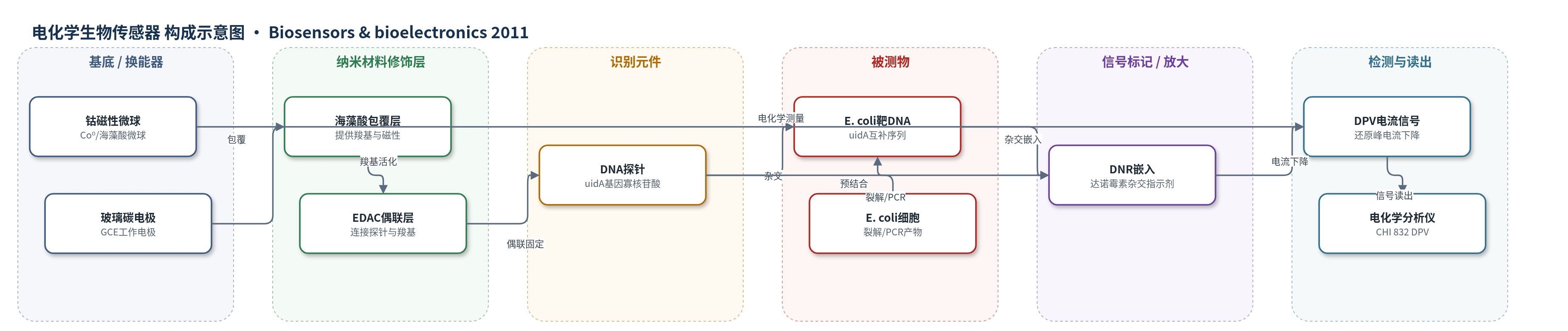
点击图片查看大图 · 依据论文自动绘制
传感器类型
电化学生物传感器
检测对象
大肠杆菌(Escherichia coli, E. coli)及其uidA基因靶DNA(互补寡核苷酸/PCR产物);样品基质:真实水样、E. coli细胞裂解液、PCR扩增产物
检测原理
海藻酸包覆钴磁性微球表面羧基经EDAC/咪唑活化,与5′-氨基寡核苷酸探针偶联,形成可磁性分离的固相DNA探针。探针针对E. coli uidA基因。样品中E. coli经裂解或PCR获得uidA互补靶DNA,在40 ℃、0.2 mol/L PBS和0.9 mol/L NaCl中与探针杂交形成双链DNA。达诺霉素(DNR)作为嵌入型杂交指示剂,嵌入双链DNA后其电化学可还原性发生变化,DPV扫描(-0.30至-0.70 V)测得DNR还原峰电流下降。杂交靶标越多,DNR嵌入程度越高,峰电流下降越大,下降量与E. coli浓度成正比。外部磁场用于分离复合物并洗涤非特异吸附,提高信噪比。
检测灵敏度
LOD: 3.0 × 10⁻¹⁰ mol/L(互补靶序列);LOD: 0.5 ng/μL(变性PCR产物);LOD: 50 cells/mL(E. coli细胞);线性范围: 1.0 × 10²–2.0 × 10³ cells/mL;R^2 = 0.9868;实际水样最低检测: 10 cells/mL
效应效果
该传感器对互补序列响应显著,非互补序列几乎无杂交,三碱基错配序列响应明显低于互补序列,显示高序列特异性。对潜在干扰菌枯草芽孢杆菌和microzyme菌裂解液,DNR电流下降小于10%,而E. coli裂解液下降50%–70%,抗干扰良好。50 cells/mL E. coli重复5次,RSD为4.7%。完整检测约2 h,无需外部试剂即可检测细胞样品。经预浓缩/富集后,真实水样中可检测10 cells/mL E. coli,与平板计数法结果13 cells/mL一致。作者认为该方法可用于环境监测和生物医学检测。
传感器的构成
- 换能器电极:玻璃碳工作电极(GCE)、Ag/AgCl参比电极和铂对电极,用于差分脉冲伏安法(DPV)读出DNR还原电流
- 磁性微球基底:海藻酸包覆钴磁性微球(Co⁰/alginic acid magnetic beads),由Co²⁺/海藻酸微胶囊还原制备,提供磁性分离与固相吸附
- 表面功能化层:海藻酸羧基(-COOH)经EDAC/咪唑活化,与5′-氨基寡核苷酸偶联固定
- 识别元件:5′-氨基寡核苷酸DNA探针(针对uidA基因,序列5′-GGTAGCGTCGCATTACGAGATGTGGTGCGGCTTATGGACC-3′),与E. coli靶DNA杂交
- 信号标记物:达诺霉素(DNR),嵌入杂交形成的双链DNA,作为电化学杂交指示剂
- 杂交缓冲液:0.2 mol/L PBS(pH 7.4)加0.9 mol/L NaCl,用于维持杂交条件
- 磁性分离模块:外部磁场与PBS洗涤步骤,用于分离探针-靶标复合物并去除非特异吸附
中文摘要
本文报道了一种基于磁性微球的大肠杆菌(E. coli)DNA序列特异性电化学生物传感器。海藻酸包覆的钴磁性微球经5′-氨基寡核苷酸修饰,既可作为磁性分离载体,也可作为固相吸附剂,用于与E. coli靶DNA序列杂交。该检测基于E. coli uidA基因,该基因编码β-D-葡萄糖醛酸酶。以达诺霉素(DNR)作为DNA杂交指示剂时,靶序列与探针杂交导致DNR还原峰电流下降,且下降量与E. coli浓度成正比。作者优化了杂交条件并验证了探针特异性。该传感器可检测3.0×10⁻¹⁰ mol/L互补靶序列和0.5 ng/μL变性PCR产物;对E. coli细胞的线性范围为1.0×10²–2.0×10³ cells/mL,检出限为50 cells/mL。经简短富集后,可在真实水样中检测10 cells/mL的E. coli。
英文摘要
A new type of DNA sequence-specific electrochemical biosensor based on magnetic beads for the detection of Escherichia coli is reported in the present work. Alginic acid-coated cobalt magnetic beads, capped with 5'-(NH(2)) oligonucleotide and employed not only for magnetic separation but also as the solid adsorbent, were used as DNA probes to hybridize with the target E. coli DNA sequence. This assay was specific for E. coli detection depending on the uid A gene, which encodes for the enzyme β-d-glucuronidase produced by E. coli strains. When daunomycin (DNR) was used as DNA hybridization indicator, the target sequences of E. coli hybridized with the probes resulted in the decrease of DNR reduction peak current, which was proportional to the E. coli concentration. The optimization of the hybridization detection was carried out and the specificity of the probes was also demonstrated. This DNA biosensor can be employed to detect a complementary target sequence for 3.0×10(-10) mol/L and denatured PCR products for 0.5 ng/μL. The linear range of the developed biosensor for the detection of E. coli cells was from 1.0×10(2) to 2.0×10(3) cells/mL with a detection limit of 50 cells/mL. After a brief enrichment process, a concentration of 10 cells/mL E. coli in real water samples was detected by the electrochemical biosensor.