组成图示
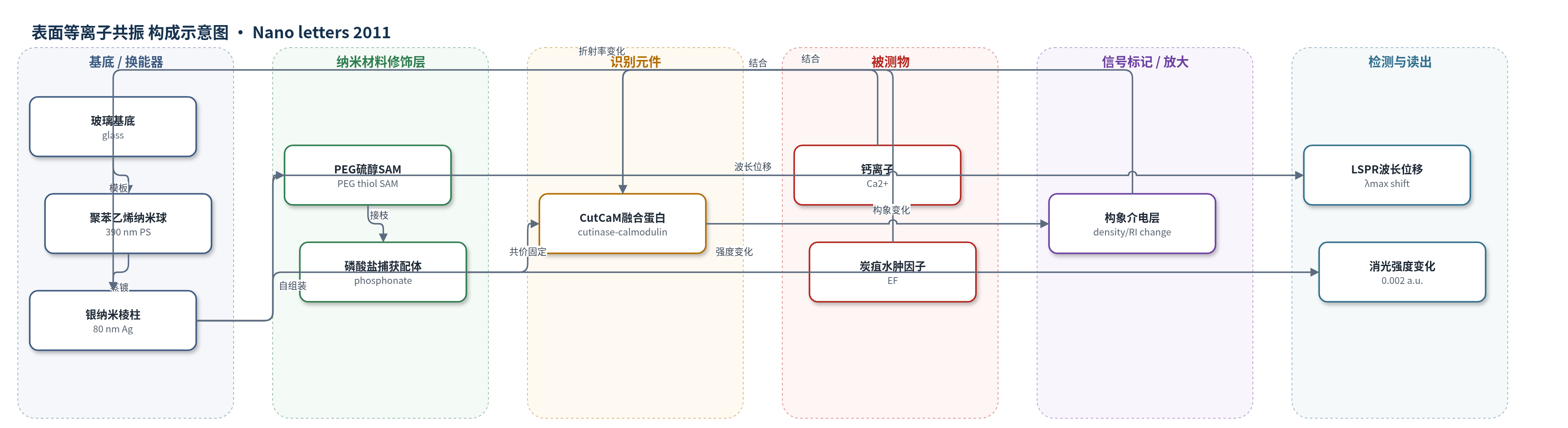
点击图片查看大图 · 依据论文自动绘制
传感器类型
表面等离子共振(SPR)生物传感器
检测对象
钙离子(calcium ion, Ca2+)、炭疽水肿因子(anthrax edema factor, EF);样品基质:20 mM Tris缓冲液(pH 8,无盐)及含100 μM CaCl2的Tris缓冲液
检测原理
传感器将CutCaM或CutCaMCut通过C端cutinase共价固定于Ag纳米棱柱表面。钙调蛋白的EF-hand结构协同结合Ca2+后,暴露疏水口袋并改变蛋白构象与表面介电层密度;EGTA螯合Ca2+则使构象恢复。由于LSPR电磁场衰减长度约5 nm,对表面数纳米内折射率变化高度敏感,构象变化引起有效折射率改变,使Ag纳米棱柱LSPR消光峰λmax发生可逆位移,钙结合产生约0.96 nm红移。同时消光强度随表面折射率线性变化,形成波长与强度双模态信号。Ca2+浓度响应按Langmuir方程拟合,Kd为52 μM,LOD为23 μM;EF结合则产生6.6 nm红移。
检测灵敏度
LOD: 23 μM;灵敏度斜率: 241 nm/RIU
效应效果
传感器在多次CaCl2/EGTA循环中可逆响应,平均λmax位移0.96 ± 0.06 nm,λmax标准差降至2×10^-3 nm,构象变化信噪比约500;开/关速率常数分别为0.059 ± 0.01 s^-1和0.13 ± 0.06 s^-1。钙检测Kd为52 μM,LOD 23 μM,低浓度非特异基线0.1 ± 0.012 nm。1 μM炭疽水肿因子EF结合产生6.6 nm红移,而BSA无特异结合,显示选择性。消光强度变化0.002 a.u.,S/N 130,实现双模态读出。作者认为可用于蛋白构象研究、水相钙检测及可携式等离子体传感器件。
传感器的构成
- 基底:玻璃片(glass)与390 nm聚苯乙烯纳米球(polystyrene nanospheres),作为纳米球光刻模板
- 换能器:80 nm银纳米棱柱(Ag nanoprisms),提供LSPR消光峰并感应局部折射率变化
- 自组装单分子层:三乙二醇硫醇SAM(triethylene glycol thiol SAM),96%羟基端与4%马来酰亚胺端,用于表面功能化
- 捕获配体:磷酸盐捕获配体(phosphonate capture ligand),与cutinase共价结合以定向固定蛋白
- 识别元件:CutCaM融合蛋白(cutinase-calmodulin, CutCaM)或CutCaMCut,calmodulin作为钙/配体识别元件
- 信号标记物:无外源标记;蛋白构象变化改变介电层密度与折射率,CutCaMCut中N端cutinase可作介电标签增强信号
- 读出:UV-vis消光光谱仪(photodiode array spectrometer)监测λmax与消光强度
中文摘要
本文展示了一种响应蛋白质构象变化的局域表面等离子体共振(LSPR)传感器的多功能光学与生物学特性。该传感器可检测表面固定的钙敏感情蛋白钙调蛋白(calmodulin)构象变化。钙离子浓度升高使 LSPR 消光峰最大波长(λmax)发生 0.96 nm 红移;加入钙螯合剂后蛋白恢复原始构象,表现为 λmax 位移反转。与以往工作不同,本文证明即使没有蛋白标记,这些构象变化也能产生可检测的 λmax 位移,信噪比接近 500。此外,蛋白构象变化可逆地切换共振峰波长和强度,构成可同时传递两种不同光学信息的双模态等离子体元件。该多功能等离子体器件可作为生物传感器,以具有生物学意义的检出限 23 μM 检测钙离子,并检测钙调蛋白特异性蛋白配体。
英文摘要
The versatile optical and biological properties of a localized surface plasmon resonance (LSPR) sensor that responds to protein conformational changes are illustrated. The sensor detects conformational changes in a surface-bound construct of the calcium-sensitive protein calmodulin. Increases in calcium concentration induce a 0.96 nm red shift in the spectral position of the LSPR extinction maximum (λ(max)). Addition of a calcium chelating agent forces the protein to return to its original conformation and is detected as a reversal of the λ(max) shift. As opposed to previous work, this work demonstrates that these conformational changes produce a detectable shift in λ(max) even in the absence of a protein label, with a signal:noise ratio near 500. In addition, the protein conformational changes reversibly switch both the wavelength and intensity of the resonance peak, representing an example of a bimodal plasmonic component that simultaneously relays two distinct forms of optical information. This highly versatile plasmonic device acts as a biological sensor, enabling the detection of calcium ions with a biologically relevant limit of detection of 23 μM, as well as the detection of calmodulin-specific protein ligands.