组成图示
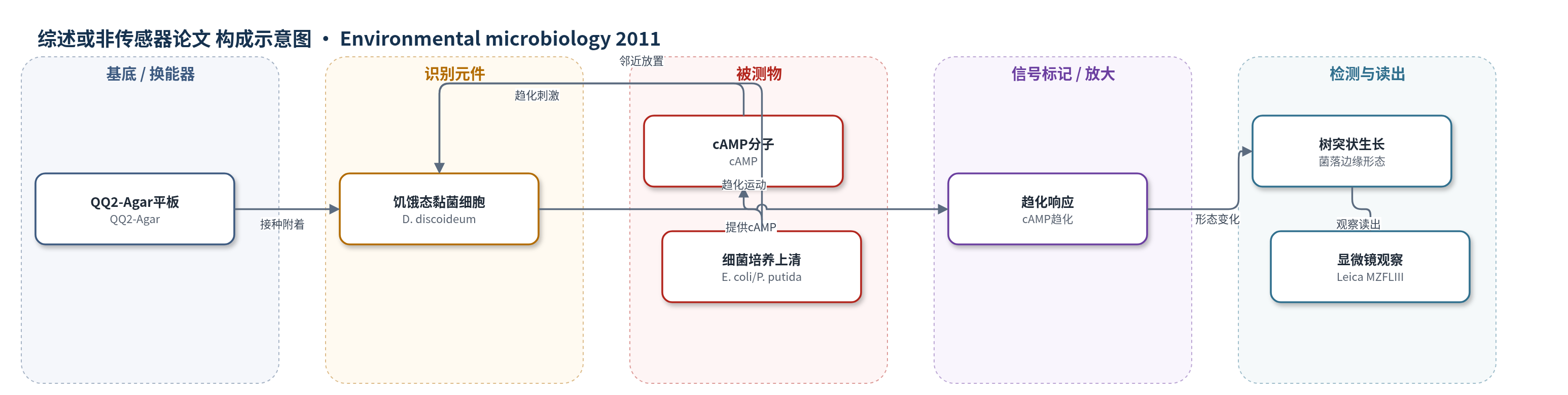
点击图片查看大图 · 依据论文自动绘制
传感器类型
综述或非传感器论文
检测对象
环腺苷酸(cAMP);样品基质:E. coli 或 P. putida 培养上清(M9 培养基,0.2% 果糖,过夜消耗后 0.45 μm 过滤并 5 倍浓缩)
检测原理
文中用于 cAMP 检测的体内生物传感器基于 Dictyostelium discoideum 饥饿细胞对 cAMP 的趋化性。饥饿态黏菌细胞将 cAMP 作为分化与趋化信号,cAMP 浓度在 nM–mM 范围可诱导细胞定向运动。实验将 E. coli 或 P. putida 培养上清置于黏菌菌落旁,若上清中存在 cAMP,则 cAMP 在 QQ2-Agar 中扩散并被黏菌细胞感知,激活其趋化信号通路,导致菌落边缘出现树突状延伸;营养态细胞无此响应。形态学变化作为读出信号,cAMP 浓度越高,趋化树突通常越明显。该检测为定性或半定量方法,未使用 HCR、RCA、CRISPR-Cas、酶催化沉积或纳米酶等信号放大策略。
检测灵敏度
—
效应效果
该 cAMP 趋化检测在文中仅作定性工具:饥饿态 D. discoideum 对 cAMP 产生树突状趋化,营养态细胞无此形态;文中指出饥饿黏菌对 cAMP 的趋化信号浓度范围为 nM–mM。E. coli 上清可诱导趋化,P. putida 上清不能,表明 P. putida 培养条件下 cAMP 低于该传感器检测限。未报告 LOD、线性范围、RSD、回收率或与 ELISA、HPLC、qPCR 的定量对比。作者据此推断 P. putida cyaA 虽转录但 cAMP 生成极低或 CyaA 活性弱,Crp 功能依赖 cAMP;crp 与 cyaA 突变体表型高度重叠,提示协同调控,但整体代谢表型影响有限,支持 Crp-cAMP 系统发生调控 exaptation。
传感器的构成
- 基底/介质:QQ2-Agar 平板,提供 D. discoideum 细胞附着与 cAMP 扩散的固体基质。
- 识别/换能元件:饥饿态 Dictyostelium discoideum 细胞,作为全细胞生物传感器,感知 cAMP 并产生趋化运动。
- 信号分子:cAMP,作为被检测小分子,激活黏菌趋化信号通路。
- 读出装置:Leica MZFLIII 立体显微镜,用于观察菌落边缘树突状生长形态。
中文摘要
土壤细菌 Pseudomonas putida KT2440 基因组编码大肠杆菌 crp(编码分解代谢抑制蛋白 Crp)和 cyaA(腺苷酸环化酶)基因的单拷贝直系同源物。利用 Dictyostelium 生物传感器在体内检测时,P. putida 细胞产生的 cAMP 水平低于检测限。cyaAP.putida 基因在体内可转录,但未能互补大肠杆菌 cyaA 突变体麦芽糖利用缺陷,提示其在异源宿主中翻译效率低或功能丧失;然而,在 cAMP 高敏感大肠杆菌菌株中表达 cyaAP.putida 可验证 CyaAP.putida 能生成 cAMP。另一方面,crpP.putida 可恢复大肠杆菌 crp 突变体的代谢能力,但不能在 crp/cyaA 双突变体中恢复,说明其调控功能依赖 cAMP。为明确 P. putida Crp/cAMP 系统的作用范围,作者构建 crp 和 cyaA 突变体并进行表型微阵列等代谢与胁迫耐受测试。结果显示,两个基因缺失在多数情况下导致相同表型,提示协同功能;但突变不影响 P. putida 可利用的碳源谱,仅削弱多种二肽作为氮源的利用能力,且对总体生长指纹影响很小。与大肠杆菌相比,P. putida Crp-cAMP 系统生理表型较弱,体现了调控 exaptation,即原本为某一功能演化的性质被征用于新功能。
英文摘要
The genome of the soil bacterium Pseudomonas putida KT2440 encodes singular orthologues of genes crp (encoding the catabolite repression protein, Crp) and cyaA (adenylate cyclase) of Escherichia coli. The levels of cAMP formed by P. putida cells were below detection with a Dictyostelium biosensor in vivo. The cyaA(P. putida) gene was transcribed in vivo but failed to complement the lack of maltose consumption of a cyaA mutant of E. coli, thereby indicating that cyaA(P. putida) was poorly translated or rendered non-functional in the heterologous host. Yet, generation of cAMP by CyaA(P. putida) could be verified by expressing the cyaA(P. putida) gene in a hypersensitive E. coli strain. On the other hand, the crp(P. putida) gene restored the metabolic capacities of an equivalent crp mutant of E. coli, but not in a double crp/cyaA strain, suggesting that the ability to regulate such functions required cAMP. In order to clarify the breadth of the Crp/cAMP system in P. putida, crp and cyaA mutants were generated and passed through a battery of phenotypic tests for recognition of gross metabolic properties and stress-endurance abilities. These assays revealed that the loss of each gene led in most (but not all) cases to the same phenotypic behaviour, indicating a concerted functionality. Unexpectedly, none of the mutations affected the panel of carbon compounds that can be used by P. putida as growth substrates, the mutants being impaired only in the use of various dipeptides as N sources. Furthermore, the lack of crp or cyaA had little influence on the gross growth fingerprinting of the cells. The poor physiological profile of the Crp-cAMP system of P. putida when compared with E. coli exposes a case of regulatory exaptation, i.e. the process through which a property evolved for a particular function is co-opted for a new use.