组成图示
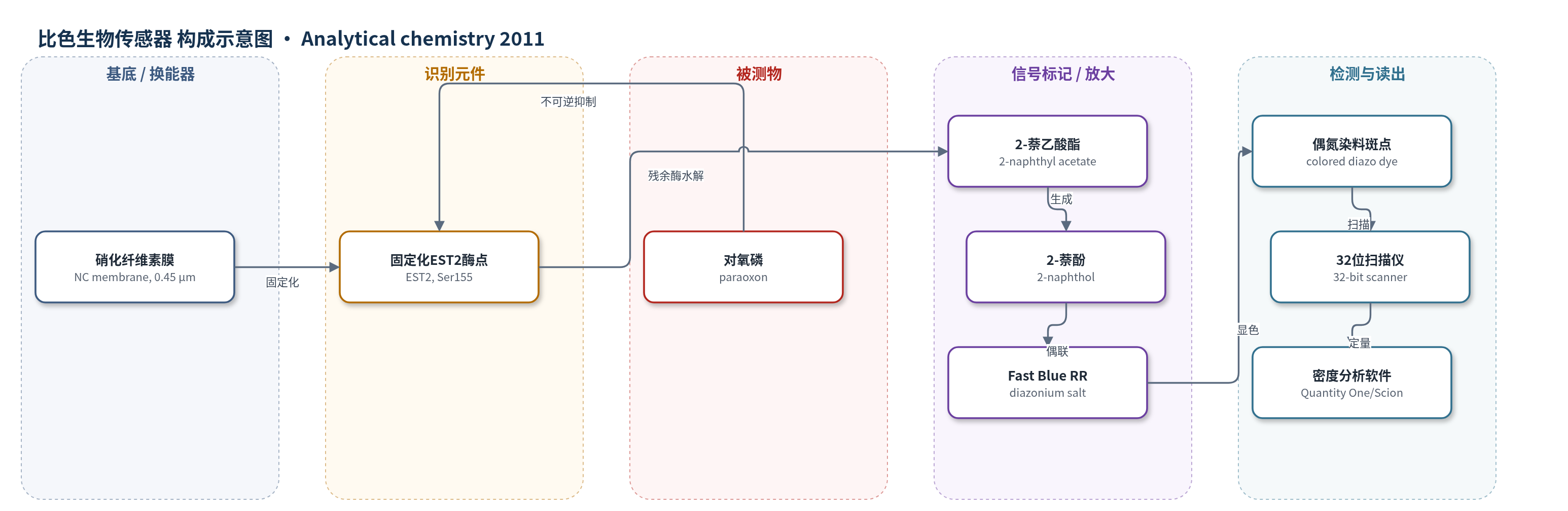
点击图片查看大图 · 依据论文自动绘制
传感器类型
比色生物传感器
检测对象
对氧磷(paraoxon)、甲基对氧磷(methyl-paraoxon)等有机磷农药(organophosphate pesticides, OPs);样品基质:水、商业果汁(桃汁、梨汁等)
检测原理
该传感器以嗜热酯酶2(EST2)为生物识别/催化元件。对氧磷(paraoxon)进入固定化酶点后,其磷酸基团与 EST2 催化位点 Ser155 共价结合,形成高亲和不可逆磷酸化抑制,使残余酶活随对氧磷浓度增加而下降。随后加入底物 2-萘乙酸酯,残余 EST2 通过 Ser155 亲核攻击酯键,经四面体中间体水解生成 2-萘酚;2-萘酚与 Fast Blue RR 重氮盐发生亲电取代偶联,生成不溶性有色偶氮染料并保留在膜上。对氧磷浓度越高,残余酶活越低,显色斑点面积和颜色强度越弱。通过 32-bit 扫描仪和密度分析软件读取斑点信号,即可实现对氧磷的比色定量。溶液法中也可利用对氧磷与 EST2 反应释放 pNP 或在抑制后残余酶活水解 pNP-C6 释放 pNP,在 405 nm 处比色。
检测灵敏度
LOD: 2.75 × 10^-3 ppm;线性范围: 10–80 nM (10–80 pmol/mL);R^2 = 0.992677 (10–60 pmoles);R^2 = 0.98979 (10–80 nM, 二次拟合);果汁 0.1% R^2 = 0.97130;膜法线性范围: 0–0.9 μM;分辨率: 5 pmoles
效应效果
EST2 对对氧磷和甲基对氧磷呈快速不可逆抑制,而对对硫磷、甲基对硫磷、毒死蜱、二嗪农、coumaphos、fensulfothion 等无抑制,酶活保持 100%,选择性优于乙酰胆碱酯酶的广谱抑制。果汁基质 0.1–4% 不显著干扰,低浓度区偏离标准曲线小于 10%,高浓度区约 10–20%,不同果汁间重现性良好。固定化 EST2 膜室温或 4°C 保存 60 天后酶活完全恢复。方法可检出 2.75×10^-3 ppm 对氧磷,与乙酰胆碱酯酶型生物传感器效率相当,适合构建廉价、快速、现场和液态食品检测的比色传感器。
传感器的构成
- 基底/载体:硝化纤维素膜(nitrocellulose membrane, HATF13250 50/PK, 0.45 μm, Millipore),承载固定化酶点并保留显色产物
- 识别/生物催化元件:Alicyclobacillus acidocaldarius 酯酶2(EST2, ~34 kDa),点样干燥固定于膜上,催化底物水解并被对氧磷不可逆抑制
- 被测物:对氧磷(paraoxon, diethyl-p-nitrophenyl phosphate),加入酶点与 EST2 活性位点 Ser155 反应,降低残余酶活
- 底物/信号前体:2-萘乙酸酯(2-naphthyl acetate),被残余 EST2 水解生成 2-萘酚(2-naphthol)
- 显色偶联剂:Fast Blue RR 重氮盐(Fast Blue RR salt),与 2-萘酚发生亲电取代偶联生成不溶性有色偶氮染料
- 反应缓冲体系:Tris/HCl 缓冲液(pH 8.5)、0.5 mM EDTA、0.25 mM MgCl2,维持固定化酶显色反应
- 信号读出:32-bit 扫描仪与密度分析软件(Quantity One、Scion Image),读取斑点面积/颜色强度并定量
中文摘要
农药是现代社会的顽疾,尽管农业必需,却损害包括人类在内的整个生态系统。由于农药检测成本高且需专业人员,亟需开发廉价、快速、易用的生物传感器。本研究评估了来自 Alicyclobacillus acidocaldarius 的酯酶2(EST2)作为检测特定有机磷农药生物传感器的可行性。基于 EST2 对对氧磷(paraoxon)具有极高亲和力的前期发现,作者进一步在水样和人为污染的果汁中开展检测分析。研究考察了多种其他农药对 EST2 的抑制作用,结果表明其选择性优于有机磷农药主要靶标乙酰胆碱酯酶的非特异性反应。所建立方法可检出 2.75×10^-3 ppm 的神经毒性物质,效率与其他乙酰胆碱酯酶型生物传感器相当。最后,作者构建了基于 EST2 固定于硝化纤维素膜的简易生物传感器,用于对氧磷检测,表现出长期稳定性、重现性和灵敏度。
英文摘要
Pesticides are the plague of modern times, although much needed in agriculture, causing damage to the entire ecosystem, including humans. The high operative costs and the requirement of specialized personnel for pesticide detection, incentive to develop alternative solutions such as the set up of cheap, rapid, and simple to use biosensors. In this work, we evaluate the possibility to use the esterase 2 from Alicyclobacillus acidocaldarius as a biosensor for the detection of specific organophosphate pesticides. With the recent demonstration of the very high affinity of esterase 2 toward paraoxon, a more complete analysis on the detection methods in water as well as in purposely contaminated fruit juices was carried out. The inhibitory effects of a wide range of other pesticides on esterase 2 were investigated, showing a better selectivity with respect to nonspecific reaction of acethylcholinesterases, the main target of organophosphate pesticides. The applied methodology allowed one to detect 2.75 × 10(-3) ppm of neurotoxic agent, comparable to the efficiency of other acethylcholinesterase-based biosensors. Finally, a raw biosensor, based on EST2 immobilization on a nitrocellulose membrane, was devised and tested for paraoxon detection, showing longtime stability, reproducibility, and sensibility.