组成图示
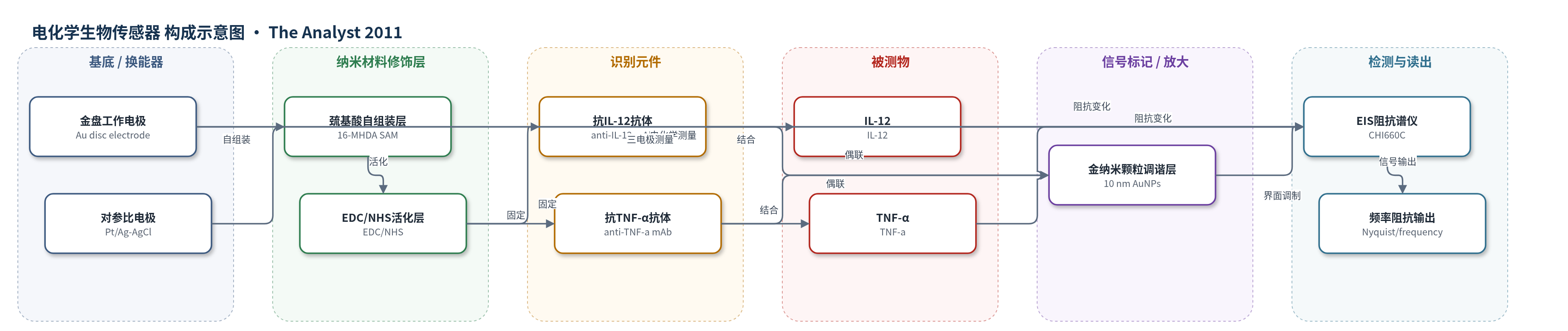
点击图片查看大图 · 依据论文自动绘制
传感器类型
电化学生物传感器
检测对象
白介素-12(IL-12)、肿瘤坏死因子-α(TNF-α);样品基质为PBS缓冲液中的标准品浓度梯度
检测原理
金电极表面自组装16-MHDA,EDC/NHS活化后共价固定抗IL-12或抗TNF-α单克隆抗体;抗体预先与AuNP偶联,形成AuNP-抗体识别层。当PBS中IL-12或TNF-α与对应抗体结合时,界面双电层电容、电子转移电阻及纳米颗粒介导的界面阻抗发生变化。EIS在0.1 Hz–100 kHz施加5 mV交流扰动,测量阻抗幅值/相位,绘制Nyquist图并提取特征频率。未调谐抗IL-12/IL-12体系特征频率约5 Hz;AuNP偶联后特征频率被调谐至约1 Hz,使不同标记物频率分离,便于单传感器多路检测。结合量随浓度增加,特征频率/阻抗响应变化,实现无标记定量。
检测灵敏度
LLD/LOD: <4 pg mL−1(IL-12)和 ~60 pg mL−1(TNF-α);ELISA LLD: 3.9 pg mL−1、60 pg mL−1、3.4 pg mL−1、109 pg mL−1;responsivity: 7.3×10⁻⁴、3.6×10⁻⁵、4.3×10⁻⁴、4.3×10⁻⁵;R^2 = 0.999。
效应效果
ELISA验证显示AuNP偶联抗体仍保持高特异性,对另一标记物几乎无交叉反应;但偶联使检测下限和响应斜率下降,如anti-IL-12由3.9 pg/mL降至60 pg/mL,anti-TNF-α由3.4 pg/mL降至109 pg/mL。EIS证明10 nm AuNP可将anti-IL-12/IL-12特征频率从5 Hz调谐至1 Hz,偏移4 Hz,并在4个数量级浓度范围内可测量。作者认为该方法无需标记目标物,可简化多标记物检测,有望用于糖尿病等慢性病中葡萄糖、HbA1c、CRP、IL-2RA等指标的单传感器监测。
传感器的构成
- 换能器电极:金盘工作电极(Au working electrode,2 mm)、铂对电极(Pt counter electrode)和Ag/AgCl参比电极,用于电化学阻抗谱(EIS)测量。
- 自组装修饰层:16-巯基十六酸(16-MHDA)通过硫醇键在金表面形成自组装单层,提供羧基用于后续偶联。
- 活化偶联层:EDC(1-ethyl-3-(3-dimethylaminopropyl) carbodiimide)和NHS(N-hydroxysuccinimide sulfo-derivative)将羧基活化为琥珀酰亚胺酯,实现抗体共价固定。
- 识别元件:抗白介素-12单克隆抗体(anti-IL-12 mAb)或抗TNF-α单克隆抗体(anti-TNF-α mAb),特异性结合目标炎症因子。
- 信号调谐/标记层:金纳米颗粒(AuNPs,5/10/20 nm,实验采用10 nm)偶联至抗体,改变界面阻抗特征频率并实现多标记物频率分离。
- 封闭层:1%乙醇胺(ethanolamine)封闭非特异性结合位点。
- 电化学介质:5 mM铁氰化钾/亚铁氰化钾([Fe(CN)6]3−/4−)PBS溶液,作为电子转移探针提供EIS阻抗信号。
中文摘要
疾病管理与检测中同时测量多种分析物的需求日益增加。对于侵入性设备,最好只需采集少量样品即可快速检测分析物,如自我血糖监测,无需额外步骤、阵列或试剂。电化学阻抗谱(EIS)以无标记、快速方式测量极低浓度分析物与分子识别元件的相互作用。作者将金纳米颗粒(AuNPs)连接到抗白介素-12(IL-12)和肿瘤坏死因子-α(TNF-α)抗体上,构建阻抗谱生物传感器;这两种炎症标记物的响应接近重叠。ELISA验证了调谐抗体的交叉反应和特异性。通过浓度梯度定量阻抗频率,IL-12的天然特征频率5.00 Hz被调谐至更低频率,使两者相差4 Hz,便于信号处理。该过程未显著改变检测下限(IL-12 <4 pg/mL,TNF-α约60 pg/mL),且无交叉反应。通过建模纳米尺度效应并进一步开发,可实现更大调谐,构建更好的多路传感器。该传感器有望用于糖尿病等疾病的简化管理,例如同时获得葡萄糖和糖化血红蛋白A1c值。
英文摘要
There is an increasing desire to measure multiple analytes simultaneously for disease management and detection. However, in the case of invasive devices, it would be better to obtain one small sample and immediately be able to detect the analytes rapidly, as in the case of self-monitoring blood glucose, without the need for additional steps, arrays, or reagents. Electrochemical impedance spectroscopy is used to measure the interaction between ultralow levels of analyte and molecular recognition element in a label-free and rapid manner. Gold nanoparticles were attached to antibodies against interleukin-12 and tumor necrosis factor-α, typical inflammatory markers found with near overlapping responses, on an impedance spectroscopy based biosensor. Cross-reactivity and specificity of tuned antibodies were verified using ELISA. Impedance frequency was quantified by concentration gradients of marker against the device. The natural impedance frequency for interleukin-12 (5.00 Hz) was tuned to a lower frequency four Hertz away from one another for better signal processing. This was accomplished without significantly altering the lower limits of detection (<4 pg ml(-1) and ∼60 pg ml(-1) for interleukin-12 and tumor necrosis factor-α, respectively), no cross-reactivity and specificity as determined by ELISAs. With modeling the nanoscale effects and further development, a larger tuning will be possible for making a better multiplexed sensor. Although interleukin-12 and TNF-α equivalent circuit calculations were modeled here, a sensor with the potential to measure multiple markers at once might offer a solution on the sensor front for simplified management of conditions such as diabetes, where both glucose and hemoglobin A1c values could be obtained.