组成图示
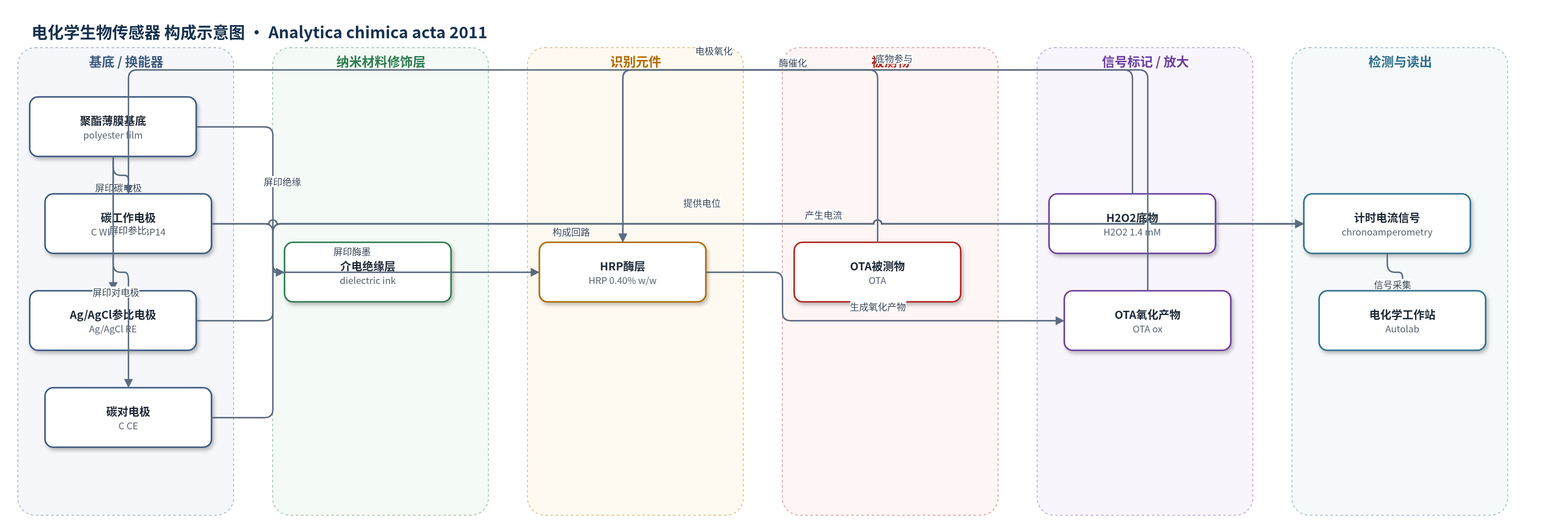
点击图片查看大图 · 依据论文自动绘制
传感器类型
电化学生物传感器
检测对象
赭曲霉毒素A(Ochratoxin A, OTA);样品基质:缓冲溶液、啤酒样品
检测原理
该传感器以屏印碳工作电极为换能器,HRP 直接负载于电极表面。检测时,在 pH 5 的 50 mM 磷酸盐/100 mM KCl 缓冲液中,向体系加入 1.4 mM H2O2。HRP 催化 H2O2 氧化 OTA,生成 OTA 氧化产物(OTA ox);随后 OTA ox 在 -0.3 V(vs Ag/AgCl)工作电极上发生二次氧化,释放电子并形成计时电流。OTA 浓度越高,生成的 OTA ox 越多,稳态氧化电流越大,因此电流响应与 OTA 浓度呈线性关系。HRP 的 Fe(III/II) 直接电子转移峰用于确认酶负载,但定量信号主要来自 OTA ox 的电极氧化。
检测灵敏度
线性范围: 23.85 to 203.28 nM;灵敏度: 0.81–1.04 ×10⁻⁹ nA M−1;R^2: 0.990–0.996;检测能力: 26.77 ± 3.61 nM (α = 0.05 and β = 0.05, n = 3)
效应效果
在 23.85–203.28 nM 范围内,不同 HRP-SPCE 的校准斜率相对标准偏差为 10%(n=4),重现性可接受;同一传感器连续三次校准后保留 30% 初始灵敏度,作者认为对一次性传感器影响不大。平均检测能力为 26.77±3.61 nM(α=0.05,β=0.05,n=3)。啤酒样品加标 1.24 μM OTA 后,测得 1.22±0.21 μM(n=3,α=0.05),平均回收率 98.70%,RSD<7%。传感器在 4 °C 保存 8 周仍保持 HRP 活性。方法优势在于 HRP 墨水直接屏印,减少固定步骤、污染和人工操作,适合低成本一次性 OTA 检测。
传感器的构成
- 基底:0.5 mm 聚酯薄膜(polyester film),承载三电极结构
- 工作电极/对电极:碳导电墨水(C10903P14,Gwent)屏印形成碳工作电极与碳对电极,60 °C 固化 30 min
- 参比电极:Ag/AgCl 墨水屏印形成 Ag/AgCl 参比电极,60 °C 固化 30 min
- 绝缘层:介电墨水(dielectric ink)屏印覆盖导电路径,80 °C 固化 30 min
- 识别/催化元件:HRP 含碳墨水(HRP 0.40% w/w,超声 20 min)直接屏印于工作电极,40 °C 固化 1 h,催化 OTA 氧化
- 信号底物:H2O2(1.4 mM),与 HRP 共同催化 OTA 氧化
- 电解液:50 mM 磷酸盐缓冲液 + 100 mM KCl,pH 5,提供离子导电环境
中文摘要
本文报道了一种基于辣根过氧化物酶(HRP)的屏印生物传感器,用于测定真菌毒素赭曲霉毒素A(OTA)。传感器采用单一丝网印刷技术制备:将含 HRP 的碳墨水直接印刷到碳电极上,避免了酶固定后的额外步骤,使制造过程更快速、简单,并有利于一次性传感器批量生产。通过 HRP 中 Fe(III/II) 基团的直接电子转移循环伏安响应,证实酶已成功负载于电极。在优化条件下,计时电流法测得的氧化电流与溶液及啤酒等样品中的 OTA 浓度呈线性关系。在 23.85–203.28 nM 范围内评估精密度,不同传感器间斜率相对标准偏差为 10%(n=4);同一传感器第三次校准后仍保留 30% 初始灵敏度。平均检测能力为 26.77±3.61 nM(α=0.05,β=0.05,n=3)。
英文摘要
This work summarizes the manufacturing procedure of Horseradish peroxidase (HRP) based biosensors for the determination of the mycotoxin Ochratoxin A (OTA). The biosensors have been fabricated using the single technology of screen-printing. That is to say, an HRP containing ink has been directly screen-printed onto carbon electrodes, which offers a higher rapidity and simplicity in the manufacturing process of biosensors for OTA determination. The formal redox potential of the Fe(III/II) moiety of HRP has been used to demonstrate the effective loading of enzyme into the ink. The chronoamperometric oxidation current registered has been successfully related to the concentration of OTA in solution from different samples, including beer ones. Under the optimum conditions of the experimental variables, precision in terms of reproducibility and repeatability has been calculated in the concentration range from 23.85 to 203.28 nM. A relative standard deviation for the slopes of 10% (n = 4) was obtained for reproducibility. In the case of repeatability, the biosensor retained a 30% of the initial sensitivity after the third calibration. The average capability of detection for 0.05% probabilities of false positive and negative was 26.77 ± 3.61 nM (α = 0.05 and β=0.05, n = 3).