组成图示
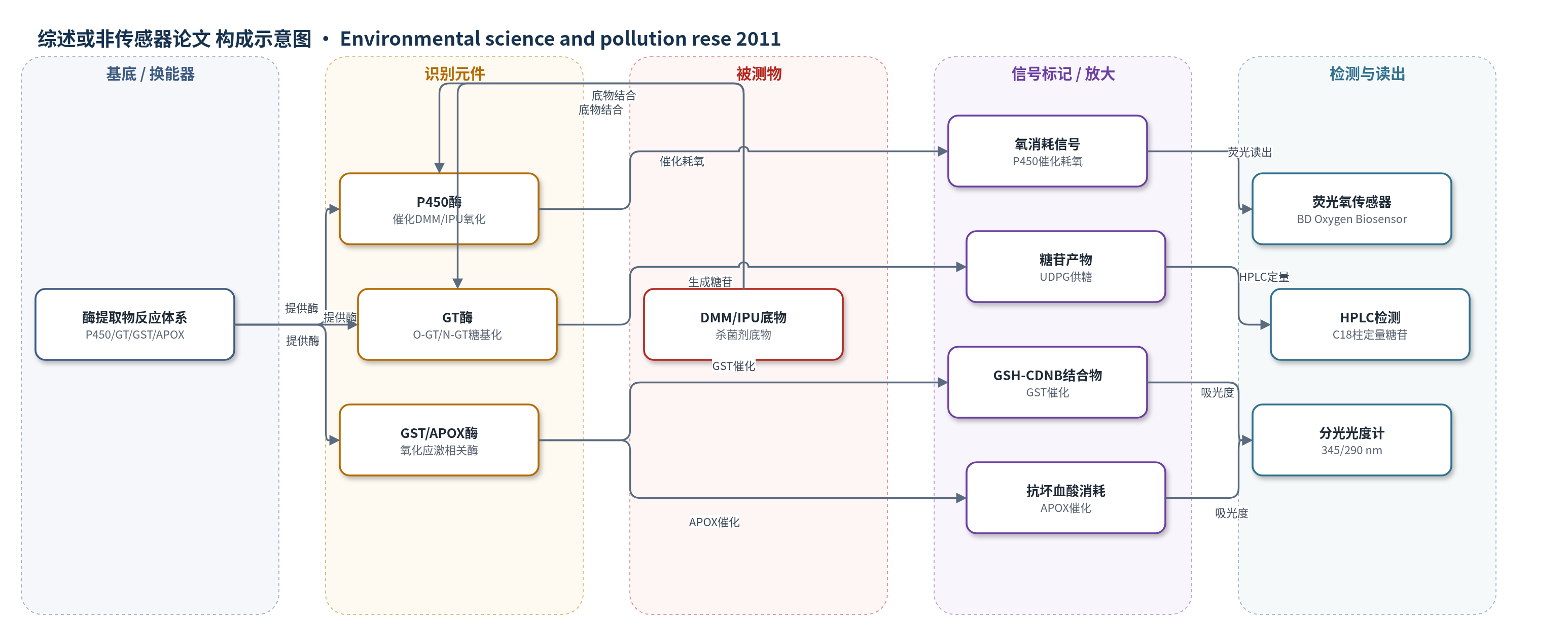
点击图片查看大图 · 依据论文自动绘制
传感器类型
综述或非传感器论文
检测对象
二甲菌灵(dimethomorph, DMM)、异丙隆(isoproturon, IPU);样品基质:加拿大水蕴草(Elodea canadensis)酶提取物/植物组织培养液
检测原理
本文并非单一传感检测,而是酶活检测体系。P450以DMM或IPU为底物催化氧化反应并消耗O2,氧浓度下降被BD Oxygen Biosensor以荧光变化读出,底物浓度越高或酶被诱导越强,耗氧速率越大。GT以UDPG为糖供体,将葡萄糖基转移到DMM、2,4,5-TCP、槲皮素或DCA上生成糖苷,HPLC按保留时间和UV峰定量,糖苷量反映GT活性。GST催化GSH与CDNB结合,345 nm吸光度上升;APOX催化抗坏血酸还原H2O2,290 nm吸光度下降。DMM暴露通过诱导P450和GT活性改变上述信号,从而反映植物解毒能力。
检测灵敏度
原文未报告LOD、线性范围、灵敏度斜率或相关系数。
效应效果
DMM在100 μM时显著增加P450活性;24 h、30 μM DMM预孵育后,DMM底物(50–100 μM)的P450活性显著高于未预孵育组,而IPU底物活性无显著变化,提示DMM诱导特定P450亚型。1 μM IPU预孵育则主要提高IPU底物活性。DMM预孵育显著提高O-GT和N-GT活性:2,4,5-TCP糖苷产物由72.5 μM substrate eq mg−1 protein升至161.0,DCA由26.3升至35.4,槲皮素由0.6升至6.9。GST活性未受DMM刺激,APOX与GST响应相似,提示GST更可能参与氧化应激而非DMM结合解毒。研究支持利用酶活指标优化水生植物修复杀菌剂污染。
传感器的构成
- 样品基质:加拿大水蕴草(Elodea canadensis)酶提取物,提供P450、GT、GST、APOX等酶
- 识别/催化元件:细胞色素P450(P450)、O-糖基转移酶(O-GT)、N-糖基转移酶(N-GT)、谷胱甘肽S-转移酶(GST)、抗坏血酸过氧化物酶(APOX)
- 被测底物:二甲菌灵(dimethomorph, DMM)、异丙隆(isoproturon, IPU)、2,4,5-三氯苯酚(2,4,5-TCP)、槲皮素(quercetin)、3,4-二氯苯胺(DCA)
- 辅因子/电子供体:尿苷二磷酸葡萄糖(UDPG)、谷胱甘肽(GSH)、抗坏血酸(ascorbate)、过氧化氢(H2O2)
- 信号标记/产物:P450催化氧消耗、GT生成糖苷产物、GST生成GSH-CDNB结合物、APOX消耗抗坏血酸
- 检测系统:BD Oxygen Biosensor荧光氧传感器、HPLC(Varian Prostar 210,C18 Hypersil-ODS柱)、分光光度计
- 读出信号:荧光变化、HPLC峰面积/浓度、345 nm和290 nm吸光度变化
中文摘要
植物能够吸收并代谢多种天然和人工合成有毒化合物,其解毒机制包括氧化、糖结合、谷胱甘肽结合及更复杂反应。本研究以水生植物加拿大水蕴草(Elodea canadensis)为对象,探讨杀菌剂二甲菌灵(dimethomorph, DMM)的解毒机制。采用氧生物传感器系统测定细胞色素P450(P450)活性,高效液相色谱(HPLC)测定糖基转移酶(GT)活性,分光光度法测定谷胱甘肽S-转移酶(GST)和抗坏血酸过氧化物酶(APOX)活性。结果显示,DMM处理诱导P450活性升高;GST活性未被DMM刺激,提示GST不直接参与DMM解毒。暴露于DMM的植物中,GST与APOX活性呈现相似响应,表明GST更可能参与氧化应激响应。DMM预孵育显著提高O-和N-GT活性,提示两种酶可能参与DMM解毒的第二阶段结合反应。结论认为,DMM可能经P450介导的羟基化,再经糖基化形成可溶性或细胞壁结合残留物。该研究首次在水生植物中证明杀菌剂可诱导P450活性,并首次提供DMM和异丙隆激活水生植物P450多酶家族的证据。
英文摘要
PURPOSE: Plants can absorb a diversity of natural and man-made toxic compounds for which they have developed diverse detoxification mechanisms. Plants are able to metabolize and detoxify a wide array of xenobiotics by oxidation, sugar conjugation, glutathione conjugation, and more complex reactions. In this study, detoxification mechanisms of dimethomorph, a fungicide currently found in aquatic media were investigated in Elodea canadensis.
METHODS: Cytochrome P450 (P450) activity was measured by an oxygen biosensor system, glucosyltransferases (GTs) by HPLC, glutathione S-transferases (GSTs), and ascorbate peroxidase (APOX) were assayed spectrophotometrically.
RESULTS: Incubation of Elodea with dimethomorph induced an increase of the P450 activity. GST activity was not stimulated by dimethomorph suggesting that GST does not participate in dimethomorph detoxification. In plants exposed to dimethomorph, comparable responses were observed for GST and APOX activities showing that the GST was more likely to play a role in response to oxidative stress. Preincubation with dimethomorph induced a high activity of O- and N-GT, it is therefore likely that both enzymes participate in the phase II (conjugation) of dimethomorph detoxification process.
CONCLUSIONS: For the first time in aquatic plants, P450 activity was shown to be induced by a fungicide suggesting a role in the metabolization of dimethomorph. Moreover, our finding is the first evidence of dimethomorph and isoproturon activation of cytochrome P450 multienzyme family in an aquatic plant, i.e., Elodea (isoproturon was taken here as a reference molecule). The detoxification of dimetomorph seems to proceed via hydroxylation, and subsequent glucosylation, and might yield soluble as well as cell wall bound residues.