组成图示
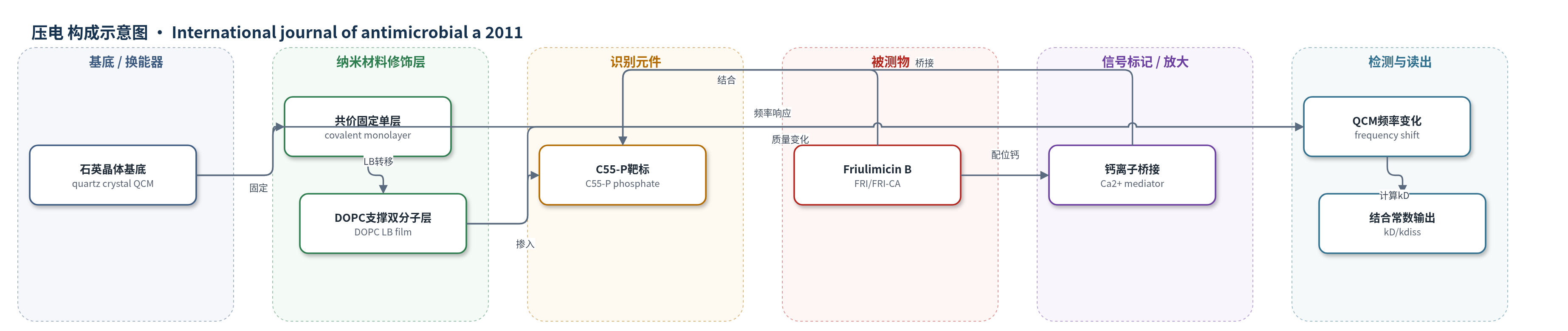
点击图片查看大图 · 依据论文自动绘制
传感器类型
压电(QCM)生物传感器
检测对象
friulimicin B(FRI)、friulimicin 钙盐(FRI-CA)、预孵育 friulimicin(FRI-PI);样品基质为 DOPC 模型膜(含 0.1 mol% C55-P 或 DCP)及 25 ℃ 水相流动体系。
检测原理
该 QCM 生物传感器以石英晶体为压电换能器,表面经共价固定单层和 Langmuir–Blodgett 转移的 DOPC 支撑双分子层模拟细菌膜,并在其中掺入 0.1 mol% C55-P 作为识别靶标。当含钙 friulimicin(FRI-CA)流过膜表面时,Ca2+ 一方面与带负电的 friulimicin 结合,另一方面桥接 C55-P 的磷酸基团,使肽以适合构象结合到膜上。结合事件使晶体表面质量增加,按 Sauerbrey 关系引起共振频率下降;频率随时间变化可解析结合与解离速率,从而得到结合亲和力 kD。C55-P 存在时解离更慢、稳态频率偏移更大,因此信号随靶标结合强度增强而增大。该体系未使用酶或核酸放大,主要依赖钙桥接和构象稳定提高结合。
检测灵敏度
kD: 0.21 μM vs. 1.22 μM;kD = 0.21 ± 0.08 μM 和 0.28 ± 0.07 μM;kdiss 0.75E−3 s−1 vs. 3.57E−3 s−1;kass = 1138 ± 635 M−1s−1;kdiss = 1.18E−3 ± 0.90E−3 s−1
效应效果
FRI-CA 对含 0.1 mol% C55-P 的 DOPC 膜亲和力较纯 DOPC 高约 6 倍(kD 0.21 μM 对 1.22 μM),主要因解离更慢(0.75E−3 s−1 对 3.57E−3 s−1)。DCP 替代 C55-P 时 kD 为 0.28 ± 0.07 μM,与 C55-P 的 0.21 ± 0.08 μM 接近,说明磷酸基团主导结合。无钙 FRI 不结合,FRI-CA 结合;1.25 mM CaCl2 过量未增强结合,预孵育 FRI-PI 的 kD 为 1.9 ± 1.25 μM,kass 接近 FRI-CA。AFM 显示钙对约 50 nm 聚集体影响很小,FRI-CA 在 C55-P 膜上形成粗糙度低于 1 nm 的薄密层。CD 显示钙使 194 nm 和 213 nm 峰蓝移 2–3 nm 并增强 75 μM 振幅,提示构象稳定。作者认为该结果阐明 friulimicin 靶向 C55-P 并依赖钙的抗菌机制。
传感器的构成
- 换能器基底:石英晶体(quartz crystal)QCM 传感器,提供压电频率换能。
- 底层固定层:共价固定第一单分子层(covalently fixed first monolayer),用于支撑后续 Langmuir–Blodgett 膜。
- 模型膜基质:DOPC(1,2-dioleoyl-sn-glycero-3-phosphocholine)单分子层,经 LB 转移形成支撑双分子层,模拟细菌膜。
- 靶标识别组分:C55-P(undecaprenyl phosphate,0.1 mol%)掺入 DOPC 膜,作为 friulimicin 结合靶标。
- 对照磷酸组分:DCP(dicetylphosphate)替代 C55-P,用于验证磷酸基团作用。
- 信号读出:QCM 频率变化(LiquiLab21),由结合质量变化产生频率偏移并计算结合常数。
中文摘要
Friulimicin 是一种处于临床开发阶段的环脂肽抗生素,对包括多重耐药株在内的革兰阳性菌具有良好活性。近期研究提示其通过钙依赖性结合细菌细胞壁生物合成载体 C55-P,干扰细胞壁合成。本研究采用模型膜方法,利用生物传感器检测 friulimicin 与 C55-P 的结合亲和力,并以原子力显微镜(AFM)和圆二色(CD)光谱进行补充。比较无钙 friulimicin(FRI)与钙盐(FRI-CA)发现,钙对 friulimicin 与 DOPC 模型膜的相互作用至关重要;当膜中含 0.1 mol% C55-P 时,结合亲和力更高(kD 0.21 μM 对 1.22 μM),证实 C55-P 的靶向作用。补充钙盐实验提示 C55-P 的磷酸基团是关键结构,钙在带负电的 friulimicin 与 C55-P 之间起桥接作用,并诱导肽形成适合结合的构象。AFM 显示钙对 friulimicin 聚集体形成无或仅有轻微影响。这些数据为 friulimicin 的抗菌机制提供了新见解。
英文摘要
Friulimicin is a cyclic lipopeptide antibiotic, currently in clinical development, that possesses excellent activity against Gram-positive bacteria, including multiresistant strains. A recent study on the mode of action of friulimicin reported on the interference with bacterial cell wall biosynthesis via a calcium-dependent complexing of the bactoprenol phosphate carrier C₅₅-P. The calcium dependency of this non-common targeted activity remains to be elucidated. In the present model membrane approach, the role of calcium for friulimicin targeting to C₅₅-P was investigated by biosensor-based detection of binding affinities. The findings were supplemented by atomic force microscopy (AFM) and circular dichroism (CD) spectroscopy. Comparing the calcium salt of friulimicin with the calcium-free peptide, calcium appeared to be essential for friulimicin interaction with DOPC model membranes. The binding affinity was even higher in the presence of 0.1 mol% C₅₅-P (0.21 μM vs. 1.22 μM), confirming the targeted mode of action. Binding experiments with supplemented calcium salts suggest (i) the phosphate group as the essential moiety of C₅₅-P, referring to a bridging function of calcium between the negatively charged friulimicin and C₅₅-P, and (ii) a structural effect of calcium shifting the peptide into a suitable binding conformation (CD spectra). AFM images confirmed that calcium has no, or only a minor, effect on the aggregate formation of friulimicin. These data shed new light on the mechanisms of antibacterial activity of friulimicin.