组成图示
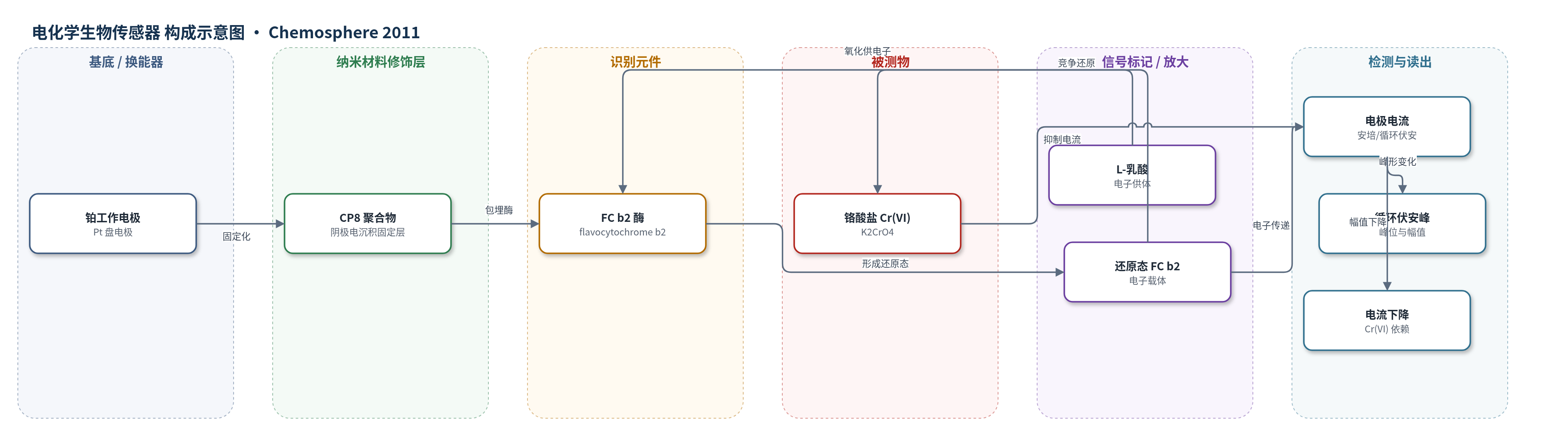
点击图片查看大图 · 依据论文自动绘制
传感器类型
电化学生物传感器
检测对象
六价铬/铬酸盐(Cr(VI), chromate, K2CrO4);样品基质:磷酸盐/醋酸缓冲液模拟环境水样
检测原理
该传感方法基于 FC b2 对 L-乳酸的专一氧化和 Cr(VI) 的高氧化还原电位。L-乳酸在 FC b2 的 FMN 域被氧化,电子经血红素域传递至还原态 FC b2。在无 Cr(VI) 时,还原态 FC b2 可将电子直接传递给铂电极,产生 L-乳酸氧化电流。加入铬酸盐后,Cr(VI) 作为竞争性最终电子受体捕获还原态 FC b2 的电子,并被还原为 Cr(III),从而与电极竞争电子。Cr(VI) 浓度越高,被酶还原的 Cr(VI) 越多,流向电极的电子越少,循环伏安峰发生位移且幅值下降;去除 Cr(VI) 后电流恢复。该竞争型电流变化可用于铬酸盐的定性/半定量监测。
检测灵敏度
未报告 LOD、线性范围、灵敏度斜率或相关系数。
效应效果
重组菌株 tr1 的 FC b2 活性较亲本提高约 6 倍,无细胞提取物约 3.2 U mg^-1 蛋白,干燥细胞约 0.38 μmol min^-1 mg^-1。电化学中,Cr(VI) 0–70 μM 引起电流下降,10 μM 使电流降低约 50%,去除后恢复,显示可逆竞争响应。光度法中 DCPIP 为最佳介质,还原态 DCPIP 被 Cr(VI) 氧化速率 2.54 μmol min^-1,细胞对 L-乳酸 KM 为 2.09 mM。活细胞修复中,初始 50 μM 铬酸盐时重组细胞还原 42% Cr(VI),亲本仅 30%;浓度升高时还原率下降。作者主张可用于环境铬酸盐监测与废水生物修复。
传感器的构成
- 工作电极:铂盘电极(Pt, 2 mm diameter),作为电子传递与电流读出的换能器。
- 固定化基质:阴极电沉积聚合物(CP8),通过电沉积将 FC b2 包埋/固定于 Pt 表面并维持酶活性。
- 催化/识别元件:L-乳酸:细胞色素 c 氧化还原酶(flavocytochrome b2, FC b2),催化 L-乳酸氧化并传递电子。
- 电子供体:L-乳酸(L-lactate),作为 FC b2 的专一底物,生成还原态 FC b2。
- 被测物/竞争电子受体:铬酸盐(Cr(VI), K2CrO4),捕获还原态 FC b2 电子并被还原为 Cr(III)。
- 参比电极:Ag/AgCl 3 M KCl 电极,用于三电极体系电位控制。
- 对电极:铂丝(Pt wire),用于完成电化学回路。
- 缓冲介质:50 mM 磷酸盐缓冲液(pH 7.8),维持酶反应与电化学测量环境。
中文摘要
尽管六价铬 Cr(VI) 的毒性及其生物修复机制备受关注,但铬酸盐生物还原的分子机制仍不清楚。酵母 L-乳酸:细胞色素 c 氧化还原酶(黄素细胞色素 b2,FC b2)对 L-乳酸具有绝对特异性,但对电子受体无选择性,因此可作为活细胞在 L-乳酸存在下还原铬酸盐的候选酶。本研究采用热耐受甲基营养酵母 Hansenula polymorpha 重组菌株,其 FC b2 酶活性较亲本提高 6 倍(无细胞提取物中最高约 3 μmol min^-1 mg^-1 蛋白)。在 L-乳酸作为电子供体、不同低分子量氧化还原介质(DCPIP、亚甲基蓝、Meldola 蓝、尼罗蓝)存在下,检测干燥及活细胞的铬酸盐还原活性,发现 DCPIP 效果最佳。将纯化 FC b2 固定于铂电极表面后,Cr(VI) 浓度升高使 L-乳酸氧化产生的酶介导电流下降,循环伏安峰位移和幅值降低表明铬酸盐与电极竞争还原态 FC b2 的电子。该结果支持利用过量表达 FC b2 的重组酵母细胞进行铬酸盐生物修复,并构建基于细胞的铬酸盐环境监测生物传感器。
英文摘要
In spite of the great interest to studies of the biological roles of chromium, as well as the toxic influence of Cr(VI)-species on living organisms, the molecular mechanisms of chromate bioremediation remain vague. A reductive pathway resulting in formation of less toxic Cr(III)-species is suggested to be the most important among possible mechanisms for chromate biodetoxification. The yeast l-lactate:cytochrome c-oxidoreductase (flavocytochrome b(2), FC b(2)) has absolute specificity for l-lactate, yet is non-selective with respect to its electron acceptor. These properties allow us to consider the enzyme as a potential candidate for chromate reduction by living cells in the presence of l-lactate. A recombinant strain of thermotolerant, methylotrophic yeast Hansenula polymorpha with sixfold increased FC b(2) enzyme activity (up to 3μmolmin(-1)mg(-1) protein in cell-free extract) compared to the parental strain was used for approval our suggestion. The recombinant cells, stored in dried state, as well as living yeast cells were tested for chromate-reducing activity in vitro in the presence of l-lactate (as an electron donor for chromate reduction) and different low molecular weight, redox-active mediators facilitating electron transfer from the reduced form of the enzyme to chromate (as a final electron acceptor): dichlorophenolindophenol (DCPIP), Methylene blue, Meldola blue, and Nile blue. It was shown that the highest chromate-reducing activity of the cells was achieved in the presence of DCPIP. The ability of chromate to catch electrons from the reduced flavocytochrome b(2) was confirmed using purified enzyme immobilized on the surface of a platinum electrode. The increasing concentration of Cr(VI) resulted in a decrease of enzyme-mediated current generated on the electrode during l-lactate oxidation. The shift and drop in amplitude of the peak in the cyclic voltammogram are indicative of Cr(VI)-dependent competition between reaction of chromate with reduced FC b(2) and direct electron transfer from the enzyme to the electrode surface. The application of the chromate-reducing ability of FC b(2)-over-producing recombinant cells of H. polymorpha toward chromate bioremediation and the construction of cells-based biosensor for chromate monitoring in the environment are discussed.